Skin Care Essentials
Caring for our animals in Summer & Winter brings many challenges, not least trying to maintain a healthy skin, avoiding sores and cuts and effectively dealing with skin abrasions that can occur.
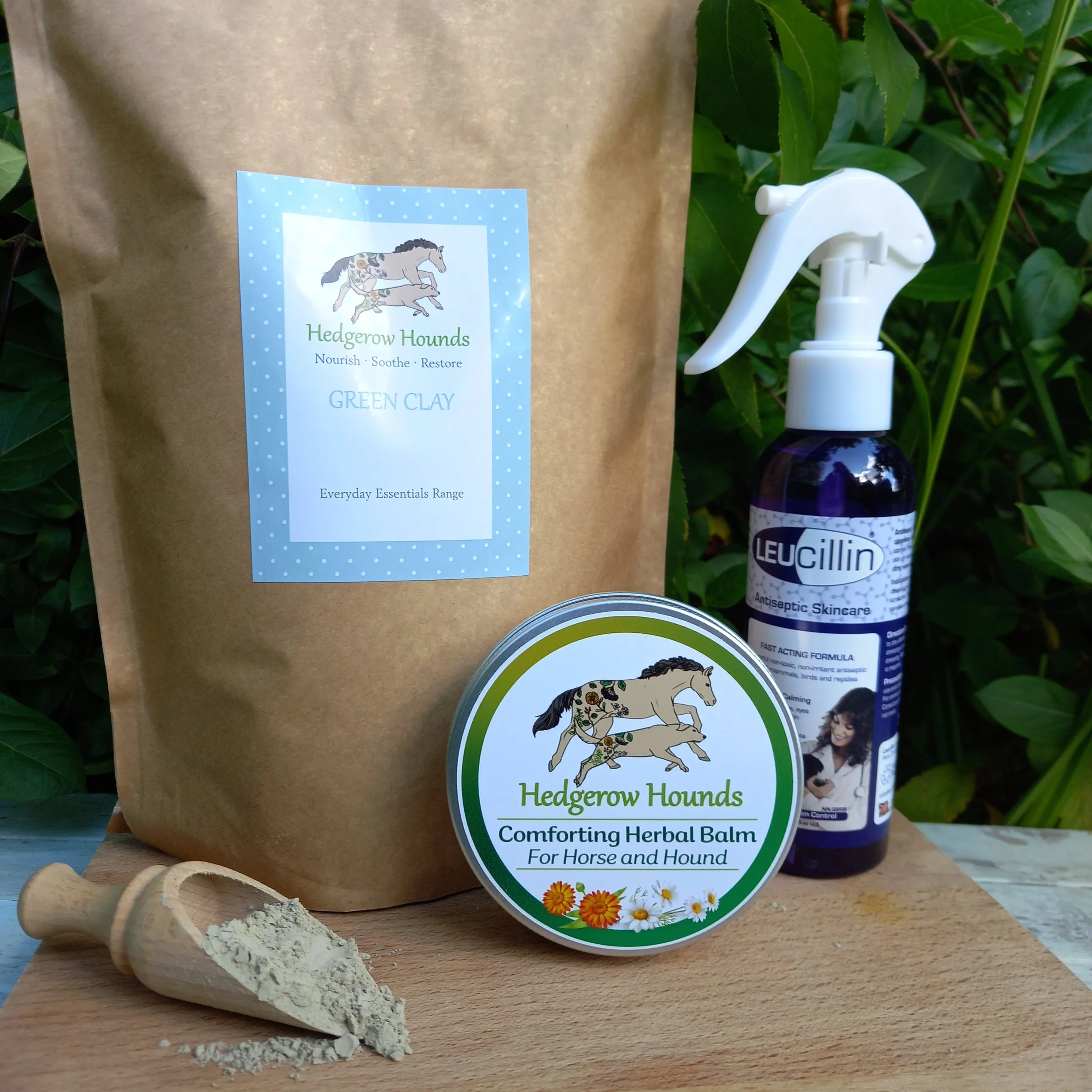
There are four products that I wouldn`t be without at any time of the year but they really are an essential in the colder and wetter months in order to quickly deal with any issues and prevent infection taking hold.
GREEN CLAY has excellent drawing properties so can be used for drying up wet eczema and hot spots and helping control infection in wounds and abscesses. Green Clay is so versatile and can be used for dogs, cats, horses, sheep and other livestock. It forms a protective layer over injuries and also naturally repels insects. I have found when treating horses and livestock which are troubled by flies, a drop of tea tree or lavender essential oil into the wet clay can further aid in repelling flies away from the treated area.
Used dry, it has a calming and soothing effect on a dog’s itchy or traumatised skin, breaking the itch, scratch cycle and is completely safe should your dog accidentally lick or consume it. The clays perfect partner in dealing with wounds, sores and fragile skin is Leucillin, they compliment each other beautifully.
Green clay can be made into a thick paste with a little water and spread onto the effected area. This acts as a protective barrier for sore or fragile wounds and as the clay dries, moisture is drawn away from any wet areas of skin. It is now available in two sizes (250g & 650g bags) on the shop https://www.hedgerowhounds.co.uk/products/green-clay
Leucillin Is an extraordinary product that I have to hand at all times. It works wonders on so many skin issues, wounds, cuts and scrapes as well as an effective and kind skin cleanser, with the added bonus that it doesn`t sting on application. It also makes a brilliant hand sanitiser!
It is available in four sizes from the small dropper bottle which is ideal for use to cleanse eyes, for tiny animals or those that are very scared by the sound of sprays, to the large 500ml spray which is great value for larger animals such as horses or livestock or a multi dog household.
Leucillin contains the active ingredient Hypochlorous, this is a naturally occurring chemical in the body produced by white blood cells. Hypochlorous is one of the most effective and efficient biocides known to man. Whilst being totally safe, it is 300 times more effective than bleach and is almost instant in its effect. Hypochlorous is a natural chemical already existing in the body, so animals that have shown a sensitivity with other products in the past, will not suffer any adverse reactions to Leucillin. It`s 100% safe to use on sensitive areas such as, cuts and open minor wounds and is completely harmless should it be licked off the treated area. https://www.hedgerowhounds.co.uk/products/leucillin-antiseptic-spray
Healing Balm A versatile healing balm that can be used on minor cuts, scrapes, sores or dry skin. Perfect as a paw balm for dry and cracked pads or for crusty noses, mud fever and general winter skin woes.
Ideal to use as a protective barrier and the perfect partnership with Green Clay & Leucillin
A beautiful blend of Sweet Almond, Coconut oil, Beeswax and a selection of herbs including Calendula for its anti-inflammatory & moisturising properties, Plantain to promote healing, Comfrey for its well known soothing & healing abilities, Yarrow as a wound healer and Rosemary for its anti-bacterial property. https://www.hedgerowhounds.co.uk/products/comfort-balm-horse-hound
The Photizo Vetcare is a valuable tool for health professionals and owners alike. Photizo has a powerful combination of pre-programed 31 second doses of pulsating red and infra red LED Phototherapy.
It is widely known for helping with arthritic and muscular conditions but it is also excellent for accelerating the healing of wounds, injuries and skin complaints. This is really important in the Winter months as even the smallest cut or wound can become infected due to wet, muddy and gritty conditions underfoot.
I have had excellent results treating a horse with severe mud fever that meant he was unable to be turned out in a paddock. The area was cleaned with Leucillin and a twice daily treatment with the Photizo meant that the healing time was greatly reduced. When the skin was healed enough to allow turn out, a thick paste of clay was applied to the area for added protection.


Caroline Hearn MICHT, Dip ICAT. MIIAT - Human, Canine & Equine Sports Therapist
www.hedgerowhounds.co.uk
Fascia- What is it and why is it so important?
All body parts are interconnected by this continuous, vast silken web like structure, and we could travel from any chosen place in the body to another without ever leaving the fascia.

Fascinating Fascia
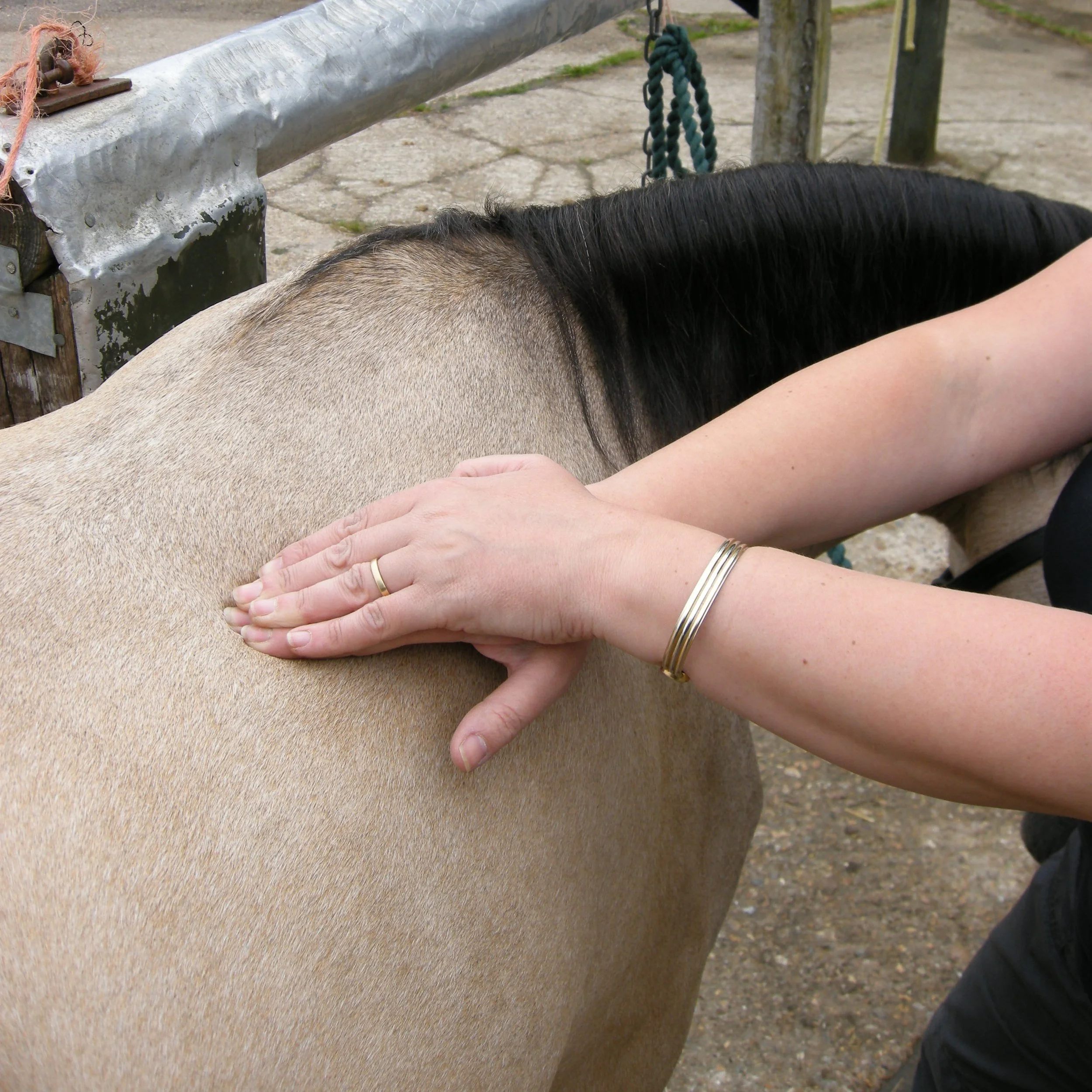
Within the therapeutic massage and bodywork industry fascia is becoming the hottest of topics and with so many discoveries as to its influence on the whole body, it is a therapy that can bring about huge benefits to those experiencing pain and loss of mobility.
Brief History:
The early discoveries of myofascial techniques started in the 1920s with connective tissue massage (CTM) developed by Elizabeth Dicke.
In the 1960s a technique called Rolfing was developed by Ida Rolfe. Rolfing seeks to re-establish vertical alignment in the body by manipulating the tissues to encourage the fascia to elongate and slide rather than to adhere.
The 1980s brought the term Myofascial Release (MFR), which was used by the therapist John Barnes. His method aimed to free any restrictions in the fascial system in order to relieve pain, restore function and mobility and to release emotional trauma.
In 2001 Thomas Myers released a book called Anatomy Trains, showing how the muscles are functionally linked in “myofascial meridians” throughout the body. This is still regarded by many therapists as the bible of myofascial work.
Dr. Pischinger book (2004) The Extracellular Matrix, is based on his 30-year study of fascia, where he states that fascia is the largest single organ in the body.
When I started my training as a massage therapist in 2000 there was little mention of the fascial system and it was regarded as of minor importance. Thankfully it is now a recognised treatment and fast becoming very popular in treating canine and equine patients who benefit from it in just the same way as we do.
So, what is Fascia?
The fascia is the tough, fibrous, sticky connective tissue that literally holds us together.
If we were able to magically dissolve all our muscles and bones, leaving the fascia intact, we would still have a complete three-dimensional representation of our bodily form, a little like wearing a 3D mesh body suit that would show off our bad postural habits in all their glory!
All body parts are interconnected by this continuous, vast silken web like structure, and we could travel from any chosen place in the body to another without ever leaving the fascia.
Fascia envelopes each and every structure of the body, from the tiniest nerve with its own fascial sheath, all our organs, muscles and bone and even the brain. So, you can see the potential for an injury or restriction in one part of the body to greatly impact on others.
Fascia is composed of two types of fibres called elastin and collagen. Elastin has the ability to stretch and has a “memory” ie: the tissues go back to its original state after stretching. Collagen fibres give strength but have no “memory” ie: they are unable to spring back after stretching.
A key role of fascia is to enable the gliding of adjacent tissues over each other, any restriction and loss of the gliding capability will resort in pain and loss of the range of movement. The musculoskeletal system is basically a system of pulleys and levers with the muscles and fascia pulling on the bones to produce movement.
Because fascia is a continuous fibrous sheet, restrictions and pain can be referred to other parts of the body. If you can imagine fascia as wearing a loose knit jumper and pulling one corner of it down, you will see that the snag in the jumper will distort the overall shape and travel to other areas, in this case as far as the neck area of the jumper, and this is how fascia responds and reacts. If one area is tight or injured, it will have a direct influence on the tissues around it.
The fascia is the richest sensory organ in the body with 10 times more sensory nerve receptors than muscle, the brain communicates far more with fascia than it does muscles. It also holds patterns of past emotional stresses and trauma and is considered as the second nervous system.
Many people report an emotional release and initially feeling very tearful after a session of myofascial release, so it must be something to be mindful of when treating animals also, especially those that have a history of emotional stress and trauma and be aware that they may require extra support after early treatments.
Superficial fascia lies directly under the skin, and you may have noticed this slightly opaque slippery substance when preparing raw meat such as chicken or in between separate muscles on a large joint of meat, such as a leg of lamb.
The deep fascia stabilizes, supports and maintains the dog’s posture during movement and is particularly important when travelling at speed and over uneven terrain. It is essential that working or competing dogs are kept adequately hydrated as dehydration can cause the fascia to become tight and inflexible, therefore making injury more likely. When injured, fascia can form adhesions, become inflamed and painful and with a poorer blood supply than many other tissues, this can lead to slow healing.
With the advancement of ultrasound imaging, Langevin et al (2011) showed that patients with long term low back pain have marked thickening and less sliding capabilities of the fascia in the lumbar area, so this would also apply to our dogs.
What symptoms of fascial pain might we see in our dogs?
Skin twitching, juddering or flinching, even with the lightest touch.
Subtle or marked changes in the coat direction such as the appearance of new swirls, waves and flicks.
Noticeable hot and cold areas on the body
Developing strange postures when lying down in order to get comfortable. This can be suddenly choosing to lay upside down or twisting in unnatural positions.
What appears as arthritic pain but does not respond to normal pain relief for arthritis such as anti- inflammatory medication, may instead be myofascial pain.
Triggers points, which are painful areas within a muscle that can often cause pain in seemingly unrelated parts of the body. This is known as referred pain.
Myofascial Release treatment (MFR)
Fascia displays a special characteristic called thixotrophy. This means that it has the ability to change from a solid to a more liquid gel like consistency, therefore becoming more pliable with movement and temperature. This is something a trained therapist can use to their advantage when carrying out a treatment through massage techniques, application of heat and therapeutic exercises.
Myofascial work can be deeper than the traditional therapeutic massage techniques so it is important to find a therapist that is qualified in this particular area and can adapt the treatment accordingly. This is essential if your dog has a painful medical condition, as overzealous manipulation of tissues can aggravate an existing problem.
Caroline Hearn MICHT. Dip ICAT. MIAAT.