Your Reactive Dog
Dog-dog reactivity is a very common behaviour difficulty dog professionals are contacted for help about. We often see it as a problem if our dog doesn’t get on with every dog they see – but did you know this is ENTIRELY NORMAL?
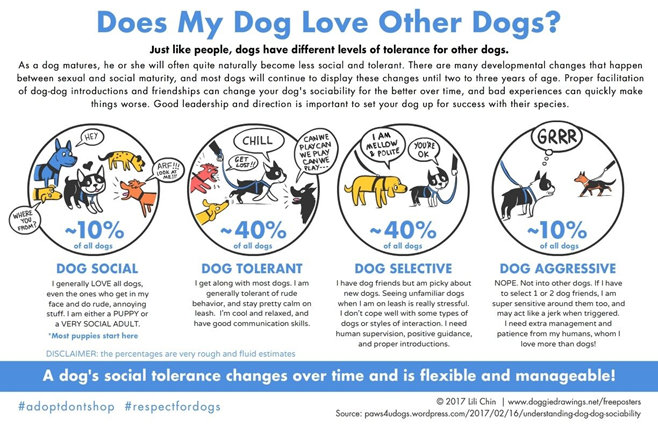
Dog-dog reactivity is a very common behaviour difficulty dog professionals are contacted for help about. We often see it as a problem if our dog doesn’t get on with every dog they see – but did you know this is ENTIRELY NORMAL?
The problem dogs have is that we guardians expect our dogs to do what we do not: accept and embrace everybody we come across in a friendly and unconditional manner. If we are honest with ourselves, we cannot hold ourselves to that standard of perfection – yet we so adamantly hold our dogs to it!
Yes, dogs are social beings but typically this means they like to have friendships with other dogs well matched for their play style and activity choices. This does not automatically mean they like to be thrown into a dog park with 30 other dogs all clumsily communicating to each other in a heightened state of excitement. If you have a dog that can enjoy situations involving a lot of stranger dogs then YOU are in the minority! Most people find their dogs, especially once matured past puppyhood, are more picky and reserved.
Furthermore, “reactive” is a very vague unhelpful label in that a “reactive” dog may be struggling with a variety of things. Their behaviours may look the same: growling, barking, lunging, snapping and so on but the underlying cause of these behaviours can differ.
Perhaps they are easily aroused and get over stimulated at the sight of other dogs because they just want to go say hello and play. Dogs can really struggle with their on-lead behaviour as a result of this overstimulation.
Perhaps they are very immature in social skills due to a “not good enough” socialisation period
Perhaps they have had a traumatic experience with a number of dogs, or just one, and are now highly anxious about interacting with others
Perhaps they struggle to read certain dog breeds and that makes them feel defensive; for example, brachycephalic dogs or those covered with an abundance of curly fluff.
Perhaps they are mature now and tolerating rude/bolshy young dogs is no longer possible for them.
Perhaps they are struggling with pain in their hips/back/neck and are very sensitive to other beings in their personal space for fear an interaction may make the pain worse.
And more…!
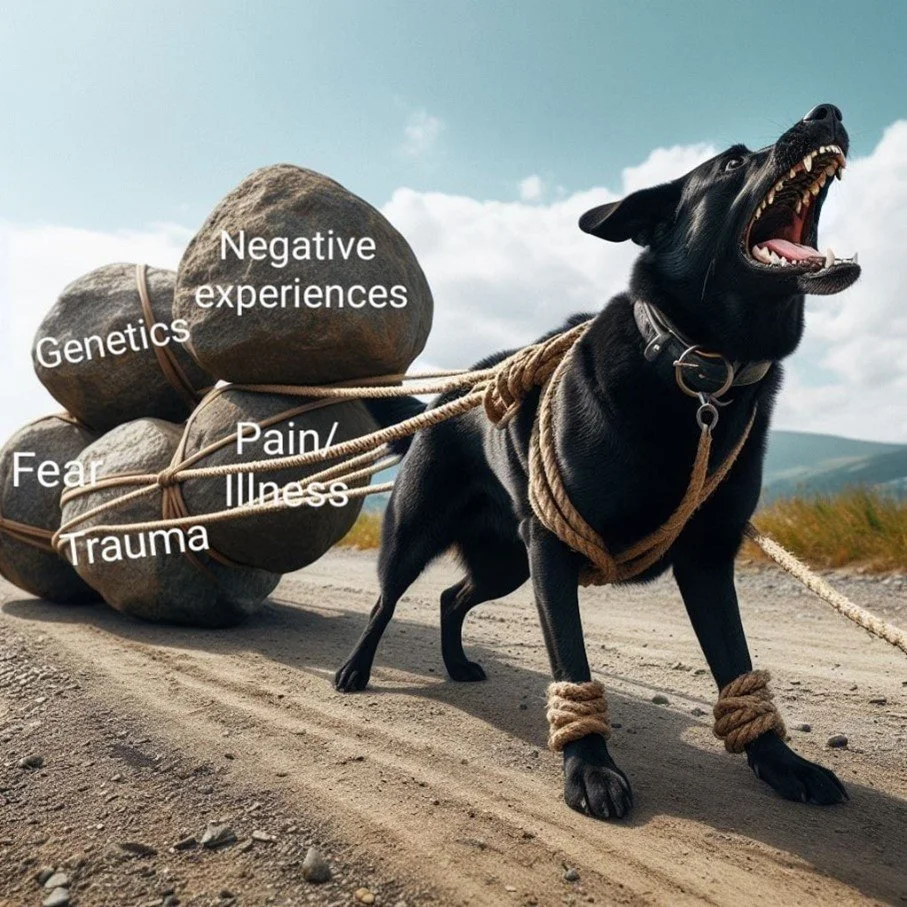
There can be a hundred and one different reasons why your unique dog before you is showing reactive behaviours at the sight of/whilst in interaction with another dog. This is why there is no blanket answer for dog reactivity and no quick fix. How it can be remedied depends on what is the underlying motivation for the reactivity – in short – is it to get the trigger to go away? Or is it to get closer to the stimuli? What if I also add that it is rare for the dog to be feeling ONE emotion! I often see dogs who come across as struggling with frustration because they just want to go over to that dog as soon as possible to play, but are actually highly anxious in their interactions with other dogs as well, further compounding their initial reactivity. Dogs are complex beings just as we are, and we need to appreciate this when dealing with their reactivity.
Typically, every dog I see for “reactivity” training and behaviour modification I recommend goes on a calming supplement such as Hedgerow Hounds Tranquil Blend. Alongside looking at the dog’s diet, their daily activities, the quality of their walks outside of the home and more, the calming supplement helps to put the dog in the best position to learn that the world doesn’t have to be as scary or frustrating (or both!) as they currently believe it to be.
It is highly important to get the right behaviour help though for your dog as some interventions can be truly harmful. If your chosen professional is recommending you “correct” the dog through various methods such as a flick of the wrist with a slip lead, shaking a can of pennies at them, or other aversive tools such as vibration collars, choke chains, prong collars and even shock collars, please be aware there is significant fallout of relying on these corrective methods to alleviate your dogs’ problem behaviour. In the same way children in schools are not punished for getting things wrong, dogs are emotional beings who also can be negatively affected by punishment-based interventions.

Studies have shown that positive based training is more effective and does not cause any unwanted fallouts like corrective training does (1)(2)(3)(4). If you are reading this then you are concerned about your dogs’ emotional welfare and that is the concern of all good behaviour professionals as well. The important part of a reactive dog’s journey isn’t their behaviour, it’s their emotional world! Emotions cannot be corrected; only recognised, understood, and soothed.
Most importantly, oftentimes living with a reactive dog involves compromise. It involves respecting their genuine likes/dislikes with regards to other dogs (some dogs genuinely don’t want to play, or are too little to want to be around large breeds and so on), so they can learn to be less over-reactive on exposure to dogs in general. We often place high expectations on our dogs and when these can’t be fulfilled we blame the dog, when really we need to ask ourselves “is this expectation fair?”
(1) Vieira de Castro AC, Fuchs D, Morello GM, Pastur S, de Sousa L, Olsson IAS. Does training method matter? Evidence for the negative impact of aversive-based methods on companion dog welfare. PLoS One. 2020 Dec 16;15(12):e0225023. doi: 10.1371/journal.pone.0225023. PMID: 33326450; PMCID: PMC7743949.
(2) Blackwell, E.J., Bolster, C., Richards, G. et al. The use of electronic collars for training domestic dogs: estimated prevalence, reasons and risk factors for use, and owner perceived success as compared to other training methods. BMC Vet Res 8, 93 (2012). https://doi.org/10.1186/1746-6148-8-93
(3) Ziv, Gal. (2017). The Effects of Using Aversive Training Methods in Dogs – A Review. Journal of Veterinary Behavior: Clinical Applications and Research. 19. 10.1016/j.jveb.2017.02.004.#
(4) Cooper JJ, Cracknell N, Hardiman J, Wright H, Mills D (2014) The Welfare Consequences and Efficacy of Training Pet Dogs with Remote Electronic Training Collars in Comparison to Reward Based Training. PLoS ONE 9(9): e102722. https://doi.org/10.1371/journal.pone.0102722

Jen Leslie is a canine behaviour specialist based in Buckinghamshire. Originally completing a psychology degree to work with people, she moved across to dealing with the emotional worlds of dogs instead following a period of volunteering at a dog rescue with the dogs hard to rehome due to behaviour difficulties.
Jen has four dogs of her own, ranging from her 3kg chorkies to her 30kg Doberman/shepherd cross. She advocates primarily for little dogs and their misunderstood experience in this big world.
You can read more from Jen at her website www.calvertcanines.com and on her facebook page www.facebook.com/CalvertCanines
Resource Guarding

Mine, all mine !!
Resource guarding is what happens when a dog tries to control access to something it values highly. It is usually food, bones, toys, people or places, but it can be anything the dog finds it wants more than another dog or a human.
Not all dogs will resource guard though; some will guard one thing or just in one particular situation, while others guard everything, everywhere! Many dogs don’t resource guard at all.
You might think that dogs in animal abuse cases, who have been starved, are more likely to guard food, but it isn’t always the case. Sometimes it is the dog who has food available all day long or who is overweight that guards their food. You won’t be surprised to learn that the dogs who do guard, do it with varying degrees of intensity.
Why do they do it?
It is something that has been a very successful strategy for dogs during their evolution. He who controls the resources, eats today or has shelter tonight! So, resource guarding is instinctual and has provided an evolutionary advantage to some dogs over many years.
It also used to be a behaviour that was better understood and tolerated in the past. It used to be the case that most people would say “don’t go near that dog, he is eating/has a bone/sleeping (take your pick)”. I wonder why have we apparently lost that level of understanding of this behaviour? Perhaps it is the increased number of multiple dog homes we have nowadays? Perhaps more frequent fights are occurring where two or more dogs in one household resource guards?
How do you recognise it?
Dogs resource guard by using defensive body language. Hunching over the item and showing the whites of their eyes is a good first indicator. They may put a paw on it indicating ‘this is mine!’ to whoever is approaching. They might run over, barge past you and grab an item – a bone or a toy – if another dog or person dares to approach it.
It is generally explicitly clear that they want it for themselves, and they are not going to give it up easily. If no one is likely to get injured (human or dog), perhaps this behaviour can be viewed as, fair enough! Dogs have very little choice in their lives nowadays so why not let them keep something they value so much?
If it is safe and not going to do anyone any harm, I personally, would probably leave a dog to it. Dogs in my household seem to respect it and are perfectly happy to allow the resource guarder amongst them to get just on with it. The item is clearly not that valuable to the other dogs. It is almost like they have personal preferences and are accommodating to each other. However, if a dog is unfairly resource guarding all the toys, all the bones etc, then yes, I would step in, to even things up. I won’t tolerate one dog bullying the others.
What happens when the item being guarded is dangerous to them or valuable to me?
Sometimes though, it isn’t well tolerated by the other dogs in a household, or a dog resource guards from a human. What happens if the item is not safe for the dog to keep? It might be something inappropriate, like a tv remote, a child’s toy or worse, something that is downright dangerous for the dog – your dropped medication! Then you would want a way to safely take it away from the dog without getting injured or causing a huge rift in your relationship by having a ‘stand-off’ or confrontation with your dog.
What not to do!
So, what could you do when you are facing a lip lifting or growling dog who now sees you as the person who is going to take away the most valuable thing they have ever had in their entire life? Well, the one thing you shouldn’t do is chase them or attempt to get the item away from them. If you do, you or someone else could get injured. Badly!
All that chasing and tugging teaches a dog is that it must be an ultra-valuable resource, really worth guarding, at all costs! Sadly, all you have done is reinforce that it is definitely worth guarding. They may even think it is a fun game that you are happy to partake in and do it all the more just to get some additional attention from you.
Prevention is better than cure
My first important advice is to understand when your dog is likely to resource guard so you can take steps to prevent it. Write a list of all the occasions your dog guards’ items. Most people know about food, bones, chews and toys but it can also be dog beds (or your bed), clothing, chairs, your lap, an area under a table and even things with particular scents.
Writing down what they guard and where they guard it, taking into consideration what time of day it is, are they hungry or full, previously relaxed or excited, at home or away from home, guards from other dogs or people, feeling ill or are in good health, in pain or not, will be extremely valuable information for you and any behaviourist you subsequently engage to help you.
If you know when it is likely to occur, then you can put in place measures to ensure it is either prevented altogether or at least minimised. Your plan may include clearing up the children’s toys before allowing your dog into the room, making sure the remote control is not left in a place accessible to your dog (this may be valuable as it will smell of you). All the socks and shoes are tidied away promptly, and medications are handled well away from your dog over a kitchen or bathroom worktop. Bones and chews can be picked up when your dog is safely away from them (perhaps while they are having their dinner or out on a walk). Prevention is absolutely vital!
What do you do if they get hold of something they shouldn’t have?
You will need a strategy to handle the times when you have not been able to prevent it and I would suggest the first thing you do is take a deep breath and keep calm. Then, walk away and say, ‘Let’s Go’. This means you walk into another room, for me it is the kitchen, where there is a treat jar full of my dogs’ favourite goodies.
Then ask for a well-practiced behaviour or ‘trick’ - a sit, a wave or a down, something you can cue them to do and then can reward them for doing it. As their reward, toss them a treat (in the direction furthest away from the thing they were resource guarding) and while they are distracted retrieving the treat, calmly walk the other way, close the door between you and your dog and pick up the item they discarded in their excitement to follow you. Return and carry on with some more sits, downs, waves and shaking of paws. It’s a fun time for them, they are getting rewarded, and the guarded item is almost certainly forgotten.
Being prepared for when prevention fails
Okay, this doesn’t happen without training. The ‘Let’s Go’ cue needs to be well practiced and practiced without the resource guarding actually happening. Don’t leave it until you have a situation you need to handle. It needs to be an instinctive reaction to your invitation to leave the room and your dog needs to know for sure that they will be getting an opportunity to perform an easy ‘trick’ for a huge reward.
By adding in a cued trick or behaviour, you are breaking the link to the guarding eliciting a reward (for those that were wondering about us just rewarding a dog for guarding). It is a distraction technique that can get you out of all sorts of bother indoors or out. Teach this one now and think of it as an emergency technique included in your toolkit.
Teaching an alternative ‘mutually exclusive’ behaviour
The other thing that worked wonderfully well for me was teaching my dog an alternative behaviour that he just couldn’t do while holding on to his resource guarded item (a mutually exclusive behaviour). Firstly, I taught him how to catch a toy and eventually the game of ‘fetch’. I did spend quite a long time sitting with an open hand waiting for the exact moment he dropped it, just to be able to capture the moment with a ‘yes’, before throwing it back to him, showing him there was more fun in releasing the item than holding on to it. I eventually added a cue, ‘drop’.
Once he got the idea of catching, fetching and dropping, and realised how much fun it could be, he never resource guarded a toy ever again. Well, almost never! A brand-new toy might be guarded for the first 5 minutes but after that it was just like all the other toys in the house; meant for sharing and being caught in mid-air and not for holding on to it for hours at a time (and he did at first)!
Using an old ‘low value’ toy that your dog doesn’t guard when working on teaching catch, fetch and drop will help speed things up. Other things you could teach is ‘leave it’’, ‘go to your bed’, ‘wave’, shake paw’, or ‘back-up’.
Seeking professional help
Of course, if you are worried about your dog biting (in this or any other situation), then you really should seek help and I recommend you always look for a positive, force-free, rewards-based behaviourist.
Please avoid anyone who tells you that you need to punish your dog for resource guarding (or anything else!). It won’t help and it can make things worse. Remember it has been a successful strategy for dogs for many thousands of years and it is a perfectly natural instinct that some dogs utilise more than others.
Don’t allow dogs to sort it out amongst themselves (well, not all the time)
Dogs have a way of setting rules for themselves, for example, if one dog has a toy between his paws and is looking at it, then he should be able to keep it and the other dog should respect that. However, if the toy is between their paws and they are looking around, that usually indicates that the other dog is free to take it. This is great communication and the last thing you want to do is intervene as you could just spoil their perfectly normal relationship.
Finally, if you have more than one dog that resource guards, please don’t allow your dogs to ‘sort it out amongst themselves’, this could be terribly dangerous. They are unlikely to come up with a ‘pecking order’ no matter what your friend who ‘has had dogs all their life’ says! It is much more likely, they will fight! If you then try to intervene you will almost certainly get injured too.
Living with that level of tension and possible intimidation in a household is stressful and can cause other behavioural issues and even stress related illnesses. Much better to get professional help, well before you end up with expensive vets’ bills!
June Pennell, ISCP.Dip.Canine.Prac., MCMA ISCP Principal
Qualified behavioural help can be found at this link Practitioner | The ISCP