The Importance of Water to your Dogs Health
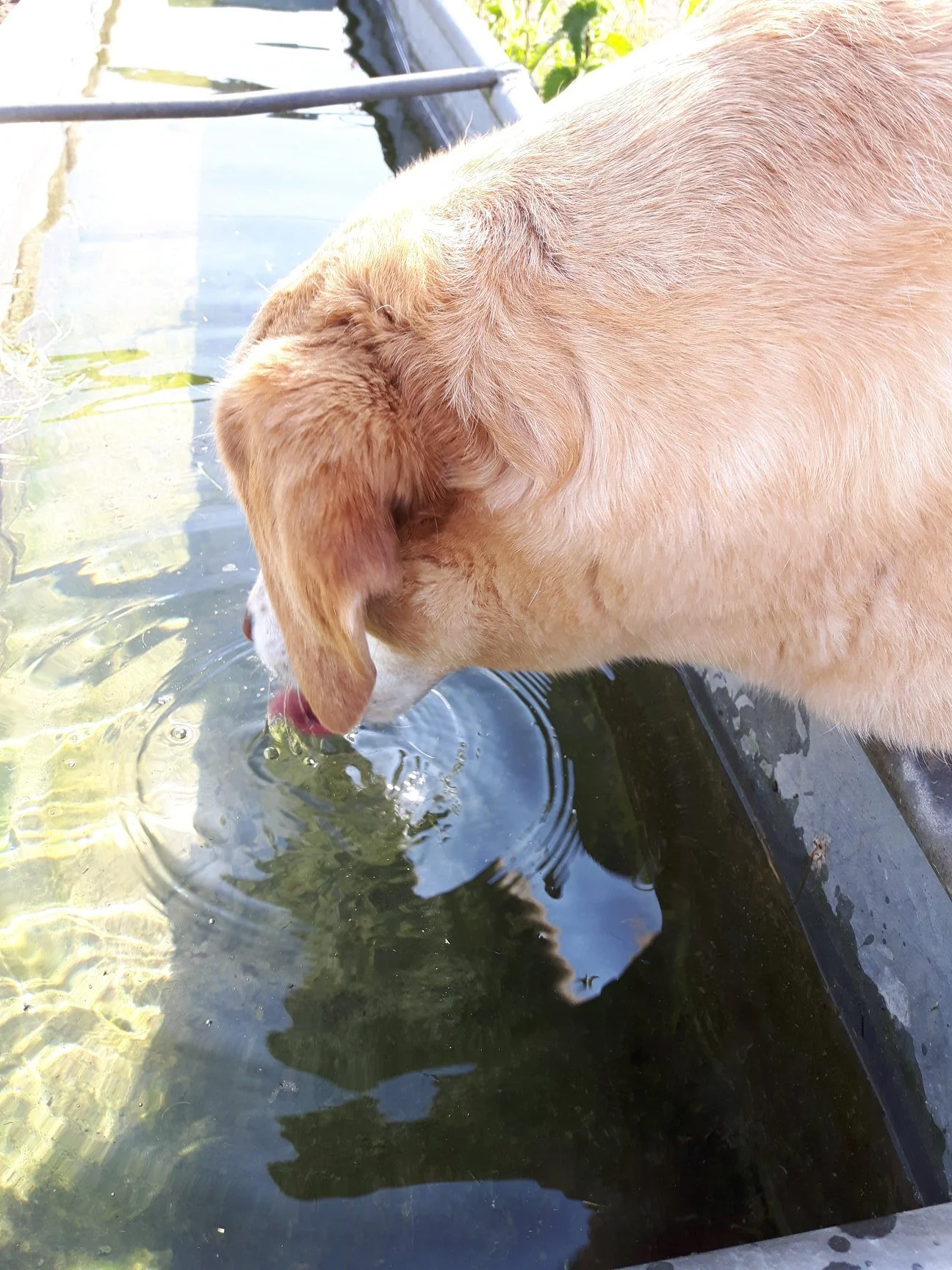
Dogs are made up of around 70% water and it supports every bodily function.
In this current hot spell it is even more important to provide a generous amount of clean, fresh water which helps maintain a normal body temperature and to keep the essential electrolyte balance.

Dogs are made up of around 70% water and it supports every bodily function, without an adequate supply dogs become dehydrated and seriously ill.
In this current hot spell it is even more important to provide a generous amount of clean, fresh water which helps maintain a normal body temperature and to keep the essential electrolyte balance.
Water bowls need to be scrubbed clean to remove any saliva which quickly builds up and is an environment for bacteria to grow. Newly poured water in a clean bowl is much more inviting to a dog and will encourage them to drink freely.
As a guide a dog needs 1oz of water per 1lb of body weight. There are certain circumstances in which a dog will need more water such as very hot weather (3-4 times as much), a bitch that is nursing puppies, kibble fed dogs will need more water than dogs fed a moist food, a dog that has a bout of vomiting and diarrhoea and in this heat it is wise to contact your vet as its essential that they maintain their body fluids.
If you have to take your dog out in warm weather then take plenty of water and a water bowl that your dog is familiar with. At shows and competitions there are often bowls left out for dogs to drink from, not only is there a potential risk of infection between the dogs but also many dogs refuse to drink, even when thirsty from a communal bowl which is full of others saliva and who can blame them.
If you leave your dog at home while you go out make sure they have a non spill bowl, a raised bowl on a stand or a second water bowl elsewhere, then should the water get tipped over there is still another source. Fresh water in the garden is also a good idea but remember to bring the bowl in at night or discard the water and scrub clean before allowing the dog to drink from it due to risk of contamination from wildlife and importantly slugs and snails which will visit it over night and possibly be carrying lungworm.
The signs of dehydration are shown as the dog being very listless, dull sunken eyes, dry, tacky gums and nose, absence of or passing very dark urine, unsteady gait or even collapse.
Along with the above symptoms there are a couple of ways of testing for dehydration in your dog. One is to press lightly on the gums and as you remove your finger the pink colour should return with a couple of seconds.
Another way is to lift a fold of skin up between the dogs shoulder blades and then release, the skin should return immediately. If the dog is dehydrated then the skin will slowly return to normal or may even stay upright. Any of these symptoms would require immediate care from a vet for a successful outcome and full recovery of the dog.
For dogs that are not big drinkers you may need to encourage them to take more fluids in hot weather. This can be done by blending ingredients naturally high in moisture and either offering it to them or stirring into their food. This smoothie shown below, using watermelon, lettuce, chard, spinach & berries blended with water, can also be made into a dog friendly ice lolly or frozen into Kongs etc. Bone broth (home made or shop bought) diluted with water can tempt even the fussiest drinker to consume more fluids.

SEASONAL FEEDING - Making the Most of Fresh Ingredients
The majority of people have lost their connection with the land, nature and the changing seasons.
Natures larder provides us with a huge variety of produce at the perfect time when it will be of most benefit to us nutritionally. With a few small changes we can all benefit from eating seasonally which is better for us, our dogs and the environment.

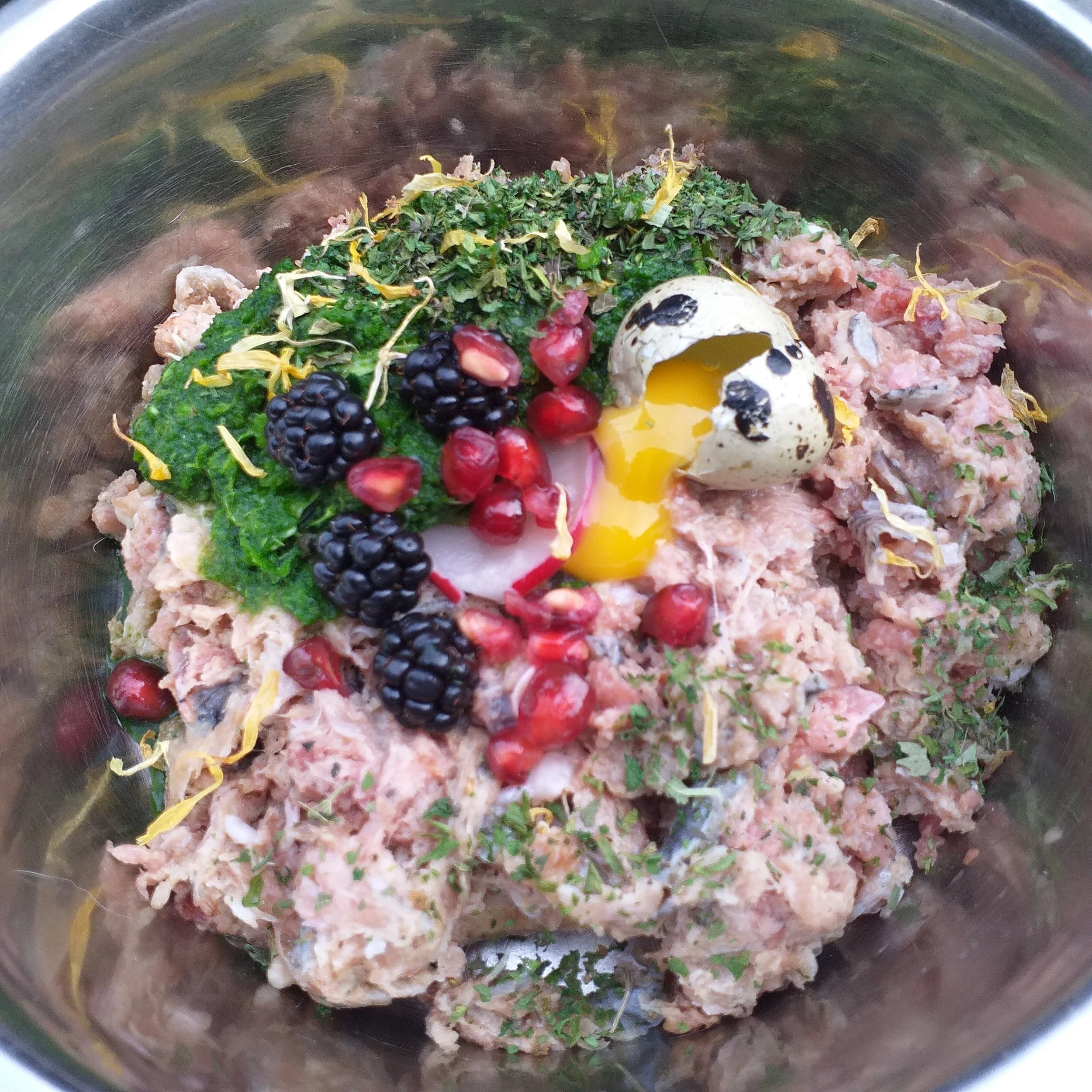
Spring, Summer, Autumn and Winter, seasonal feeding at its freshest and finest. Featuring Hedgerow Hounds seasonal herbal blends.
The majority of people have lost their connection with the land, nature and the changing seasons.
Natures larder provides us with a huge variety of produce at the perfect time when it will be of most benefit to us nutritionally. With a few small changes we can all benefit from eating seasonally which is better for us, our dogs and the environment.
We can utilise herbs and vegetables in the Spring, which are a perfect cleansing tonic to gently ease us out of the long winter months, where we have no doubt been overindulging and less active.
To the cooling and hydrating bounty of Summer, followed by the real bumper harvest of Autumn, which gives us all the foods we need to help boost our immunity and general health in preparation for the cold Winter months ahead.
Here at Hedgerow Hounds, we are passionate about seasonal ingredients, and if you really want to embrace seasonality, then we have a seasonal range of handmade herbal blends.
What`s so special about seasonal food?
Eating more seasonally ourselves and by including some of these foods in our dogs’ diet, we can benefit in so many ways.
. We can reconnect with the cycles of nature and really appreciate the food that is available for a short period of time.
. It is better value for money as well as kinder to the environment, to buy ingredients when they are in abundance locally and haven’t travelled halfway round the world before they even get to our kitchen.
. We can support the local communities, such as small producers, farmers’ markets, organic growers, and game dealers.
. The produce is fresher and therefore more nutritious as it is harvested when ripe or at its best, and has minimal travelling time before we can purchase it.
Could we survive without sugar snap peas from Egypt, asparagus from Peru, and eating Strawberries in January? These have travelled thousands of miles, are harvested unripe, and sprayed with chemicals, gas, or wax to stop them from deteriorating in transit.
Or could we wait until they are ready to eat locally and benefit from much more flavour and far higher nutritional value, while enjoying so many other foods in the meantime?
How does incorporating seasonal food benefit our dogs?
If you feed raw or home-cooked food to your dog, then it is important to offer a good variety of foods over the coming months. If you feed dried or tinned food, it is also possible to start incorporating a small amount of fresh ingredients into the bowl at feed times.
By offering variety, you can ensure your dog gets a broad range of nutrients and avoid the intolerances that can occur if the same protein and carbohydrate are fed continuously.
A wide spectrum of fresh ingredients, either animal proteins or of plant origin, nurtures a healthy gut microbiome, which is vital for a healthy immune system and overall optimal health. The more diverse the diet, the less you will have to rely on supplementation.
By feeding what is in season, you are providing food at its very best. This often means that you don’t need a large amount to benefit from the superior nutritional value.
A few local, handpicked ripe blackberries added to the food will be far superior to a larger number of blueberries that have covered many air miles. Including some free-range, wild, or organic meat whenever you can will also provide your dog with superior-quality ingredients.
Depending on your location, there is generally a good range of proteins available from Spring to Summer, but when Autumn comes, there is suddenly a whole new larder available to the raw feeder or home cook.
The game season varies by the species, but generally partridge and pheasant are available from September until February. Venison is dependent on breed, but around November to March, and Duck from September until January.
If you have been relying on beef, lamb, chicken, and fish from March until August, then this addition of free-range, often organic and minimally farmed protein is a huge bonus. You can either use in addition or temporarily replace the proteins you regularly use until the availability ends.
Putting a small amount of vegetables aside for your dog when preparing your own is a good practice. It will soon become second nature to save a broccoli stalk, steam a little extra courgette, cut off a small slice of pear or apple, or lift out the couple of squashed raspberries that are in the bottom of the punnet for your dog’s supper. You will also start to look out for seasonal bargains at the butchers’ or farmers’ market.
If you can forage for ingredients such as blackberries, dandelion leaves, cleavers, and either keep a few hens or find a local organic supplier of eggs, then that is a big win.
Adding a little fresh, local, and seasonal produce even two or three times a week will help to gradually improve your dog’s overall diet. If your dog is new to fresh ingredients, start off with very small amounts and include one new addition at a time, until they adjust to a different way of eating.
As a rule, although each dog is an individual, the majority of the meal is made up of animal protein, with anything from 5% to 15% being provided by vegetables and berries that are suitable for your dog.
Spring
Spring ingredients offer a gentle tonic to cleanse and wake up the system after less active months and a diet of heavier, warming meals. Many of these ingredients that come into their own now offer support for the kidneys, liver, and lymphatic system that can often get sluggish over the Winter months. You may observe that your dog seeks out the fresh grass shoots as they appear, which are full of energy, sweetness, and moisture.
The Nature’s Skin Tonic is perfect for a gentle Spring cleanse after the long winter months and also great for dogs that are itchy and suffer from seasonal allergies at this time of year.
Incorporate some of the following into your dog’s meals:
Spring nettle tops, Cleavers, Dandelion leaf and root, Asparagus, Watercress, Milk Thistle, Spring Greens, New season Lamb, Rabbit & Free range eggs.
Summer
Summer ingredients are cooling, hydrating, and uplifting, and we are spoilt for choice at the range of produce available. If you can grow a few vegetables yourself, such as courgette, cucumber, spinach, salad greens, chard, and parsley, then these will be bursting with flavour and goodness, and you can add a little of these freshly picked ingredients to your dog’s food. If you grow blackberries and raspberries, you will find that the dogs often help themselves to the fruit from the lower branches.
Nature’s Bounty appears on the shop in February and covers the Summer months until early November. It is a nutritious blend that contains an organic seaweed, and Bounty’s main task is to naturally repel fleas and ticks, which it has successfully done for many years.
Incorporate small amounts of the following:
Fennel, Melon, Spinach, Celery, Blueberries, Bilberries, Raspberries, Dandelion, Seaweed, Sorrel, Courgettes, Mint, Parsley, Calendula, Cucumber, Green beans, Carrot tops, Lettuce, Rabbit, Free range eggs.
Autumn
Autumn provides nourishing produce to prepare for the colder months and are typically rich in antioxidants and high in vitamin C. Many of these vegetables, fruits, and berries also lend themselves to preserving by the process of dry storage, freezing, and fermentation, which would traditionally be used to ensure a supply of nutritious foods through the lean months of Winter that lie ahead:
Incorporate small amounts of the following:
Squash, Blackberries, Rosehips, Beetroot, Pumpkin, Apples, Pear, Burdock root, Chicory, Nettle seeds, Fennel and Dill seeds, Almonds, Pumpkin seeds.
Game meat to include: Partridge, Pheasant, Grouse, Pigeon, Guinea fowl, Quail, Venison, and Duck.
Fish, including Pollack, Mackerel, Coley, and Haddock.
Winter
Winter provides us with comforting food for warmth and sustenance.
Incorporate small amounts of the following:
Ginger root, Turmeric, Kale, Celeriac, Thyme, Ruby Chard, Brussels sprouts, Winter Squash, Jerusalem artichoke, Pear, Russet apple, Turkey, Duck, Venison, Mussels.
Caroline Hearn MICHT, Dip ICAT. MIAAT
Equine and Canine Sports Massage Therapist and Canine Holistic Health Specialist
Find out more at www.hedgerowhounds.co.uk
Instagram hedgerow_hounds Facebook @HedgerowHounds
A Dogs Digestive System- Immunity, Emotions and Microbiome
The more the gut is studied the more we realise the vital role it plays in achieving optimum health, disease prevention and stabilising our dogs emotional state.
At first glance the digestive system appears to have a very simple task of taking in food, digesting it, absorbing nutrients and then excreting the waste, and while everything is in good working order, we never even give it a second thought.
It is in fact an incredibly complex structure with a vast number of tasks to undertake. The more the gut is studied the more we realise the vital role it plays in achieving optimum health, disease prevention and stabilising our dogs emotional state.
Digestive process
Although the teeth are needed to some extent to bite, crush and tear off food the actual process of digestion doesn`t really start until it reaches the stomach. With no digestive enzymes in the saliva to kick start it off, food needs to quickly get where the real work begins, which is in the stomach.
Oesophagus:
Is a long muscular tube that runs down the neck, passes through the diaphragm and uses strong contractions to push food directly into the stomach.
Stomach:
The stomach lies at the front of the abdominal cavity, tucked just behind the liver and acts like a big mixing bowl.
Any incoming food is first subjected to an acid bath of around ph1, this immediately gets to work breaking down protein and also killing any harmful bacteria.
The walls of the stomach are lined with a thick mucous which provides protection from the strong acid as well as stopping the stomach from literally digesting itself.
As the stomach expands with food, a peptide hormone called gastrin is released, which in turn triggers more hydrochloric acid and digestive enzyme production.
To aid digestion even further the surface of the stomach is a mass of wrinkles and folds which expand and contract to grab food particles and perform a churning or chewing like action.
At this point the thick soup like constancy of partly digested food and secretions is known as chyme.
The food has now been in the dogs stomach for anywhere between five and ten hours and its next destination is the duodenum, the first section of the small intestine.
Pancreas
The pancreas is a small gland, which sits next to the stomach and is attached to the small intestine, here it transports digestive enzymes through two excretory ducts into the duodenum.
The enzymes it produces are amylase to help digest starch , lipase to digest fats and trypsin and chymotrypsin to deal with the protein.
Enzymes are needed to break down food into tiny molecules and allow the absorption of nutrients into the cells of the intestines which then go on to be released into the bloodstream.
It also produces and secretes the hormones insulin and glucagon that regulate blood sugar levels. The higher the concentration of sugar in the diet the more insulin is secreted into the bloodstream and the harder the pancreas has to work.
Liver
The liver is the largest gland in the body and the only organ that has the potential to regenerate after disease or injury.
Its many crucial jobs include producing bile to assist the small intestine in breaking down and absorbing fats and to process the nutrients that are absorbed by the small intestine.
Its other roles include storing vitamins and minerals, acting as a filter for toxins in the bloodstream and as a glycogen store for when extra energy is needed.
Small intestine
The small intestine is made up of three sections, Duodenum, Jejunum (longest) and the ileum (shortest)
On receiving the nutrient rich chyme from the stomach, it is joined by secretions from the liver, gallbladder and pancreas to further assist in the digestion process.
The small intestine is lined with millions of tiny finger like projections called the Villi, these act to increase the surface area in order to trap and absorb as many nutrients as possible.
Most of the absorption of nutrients takes place in the small intestine, which are then released into the bloodstream to travel throughout the body to be utilised by the cells.
The final and shortest part of the small intestine is called the Ileum, here the food gets broken down even further in preparation to enter the cecum, the first section of the large intestine.
Large intestine :
The large intestine is made up of the cecum, colon and rectum.
Its purpose is to remove water from the faeces, keep electrolytes in balance and to prepare and temporarily store any indigestible matter for excretion.
But there is much more activity going on in the colon than just that and although not a glamorous area of interest, it does deserve our full care and attention.
The large intestine has a high concentration of bacteria referred to as the Microbiome.
Microbiome.
The microbiome is a collection of microbes made up of bacteria, viruses and fungi that we all have in our gut for efficient digestion, absorption of vital nutrients and to build a strong immune system.
Our dogs would have acquired their unique bugs from their mother at birth and developed others depending on the environment they lived in and the food they ate.
The delicate balance of the microbiome can easily be disrupted by medication such as antibiotics, periods of stress and anxiety and a poor, unsuitable diet.
When everything is in balance these good bugs work hard to extract as much nutrition as possible out of the food that is consumed and to ensure the smooth running of the whole gastrointestinal tract.
The bacteria are also responsible for assisting in hormone production such as serotonin, which occurs in the highest concentration thorough out the lining of the gut.
A thriving, balanced microbiome is absolutely essential for the dogs ability to resist or fight disease, control inflammation in the body and for a positive influence on their mental wellbeing.
Rectum and anal glands.
The faeces are then ready to be expelled along with the indigestible matter and dead red blood cells that it contains.
Ideally the dogs stool will be quite firm, which will press on the anal glands as it is passed, causing the glands to naturally empty.
Emotions and the Gut
The gut is very sensitive to emotions, and I am sure we have all experienced the butterflies in the stomach, stomach cramps, that tight feeling in our guts or acid indigestion which can come on in a split second when we are nervous, excited, fearful or anticipating a particular event.
If this is a brief episode, it is unlikely to have any lasting health effects, if on the other hand it is a regular occurrence with little respite then the impact on the gut and therefore the health is huge.
There is a major factor in the link between gut health and emotions in the form of the enteric nervous system also referred to as the ENS.
The ENS consists of millions of nerves lining the gut and specialists often call it the “second brain” as it has complex pathways to relay information back and forth from the gut to the brain as they interact.
It is capable of shutting down the digestion in times of acute stress such as in a fight or flight situation.
Stress can be caused by many factors such as separation anxiety, excessive ball throwing so the dog is on a constant adrenaline high, inappropriate exercise for the dogs age or mobility, inability to cope in a stressful household and pain, illness or disease.
Whilst these are mainly emotionally based reactions that can be witnessed as the dog exhibiting certain behaviours, a poor quality, inappropriate diet, exposure to toxins or chemicals can also cause the body stress, which may not show any visible signs immediately but develop over time into disease or outwardly noticeable changes in health and behaviour.
A gut that isn`t functioning correctly can manifest as the dog showing anxious, edgy or reactive behaviour which in turn triggers the release of stress hormones into the blood stream such as adrenalin and in the case of cortisol increase the level of glucose in the blood and will over time adversely affect the adrenal glands.
Immunity and the Gut
The gut forms between 70 - 80% of the immune system and has a vital role in regulating immunity, protecting our bodies from invaders such as allergens and pathogens and controlling inflammation.
The food we choose for our dogs and the lifestyle choices we make for them will have either a negative or positive effect on their overall gut health, ability to utilise the nutrients in the food they eat, the essential fuel to grow and repair their body and to thrive well into their senior years.
Caroline Hearn MICHT. Dip. ICAT MIAAT- Canine & Equine sports & holistic therapist