
Natural Digestive Support for Dogs
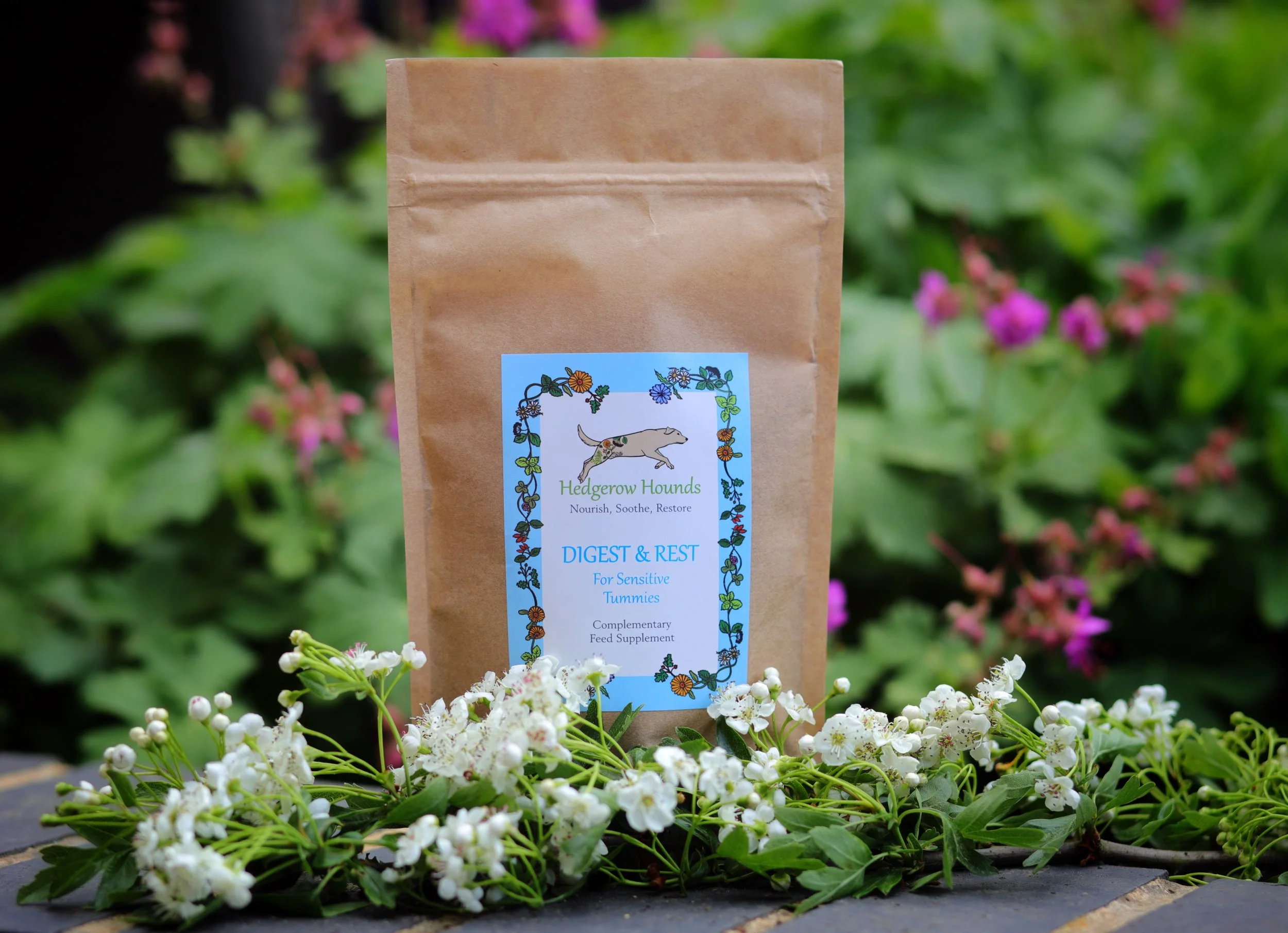
Digest & Rest is the perfect blend for tummy troubles, managing reflux and to aid in anal gland issues.

What does Digest & Rest help with? Digest & Rest was created to help dogs that suffer from digestive upset, constipation, and nausea. It is also ideal for managing anal gland problems. If your dog has a very sensitive digestion, then this blend is ideal if you are intending to make any changes to the diet and will make any transitions much smoother.
It has a very neutral taste and smell, so it will not be off-putting to even the fussiest dog and can be “hidden” in tasty food for the really suspicious, picky eater.
Here are a list of some of the ingredients in Digest & Rest and why they were specially chosen.
Marshmallow - Marshmallow root contains around 35% mucilage, which is a slippery substance to ease irritation of the mucous membranes. This makes it ideal to soothe an irritated throat, gut discomfort or tummy troubles. It is also invaluable for managing reflux and hunger nausea, which can occur just after eating or in the early hours of the morning when the dog’s stomach is empty. Marshmallows’ strongest affinities are with the digestive system, respiratory and urinary tracts.
Chamomile - Chamomile is chosen for its antispasmodic properties as well stimulating digestion as it is quite bitter tasting. Chamomile is also relaxing, so helps if the upset tummy is caused by an anxious, excitable, stressed mind.
Slippery Elm - Slippery elm has been used for centuries to ease digestive upset and soothe the whole digestive tract due to its mucilage properties once it becomes wet.
Fennel - Fennel is useful for expelling intestinal gas and helping to ease stomach cramps.
Psyllium husks - Psyllium are husks from the Plantago ovata species. They provide a form of soluble fibre which when in contact with water, forms a soothing gel which passes through the digestive tract. The husks add bulk to the stools and help with constipation, diarrhoea and aids in the correct emptying of anal glands. Psyllium is also a useful prebiotic to encourage good gut bacteria.
How to use:
Digest & Rest is a very versatile blend to use and you can adapt it to suit your specific dog’s needs. The measured amount can be added to wet food and stirred in, and for dried food, it is recommended that you add a splash of water to the powder and stir it into a paste before incorporating it into the food.
For supporting nausea. If your main reason for choosing this blend is to support reflux or perhaps your dog is recovering from a cough, there are several ways to use this blend for maximum effect. If the powder is made into a thick paste with a little warm water, this starts to release the mucilage, which will coat the mouth and oesophagus as it is consumed. You can try adding this paste to the food, or alternatively, some dogs benefit from a tiny meal or snack with Digest & Rest shortly before the main meal is given, so experiment with this to see what most benefits your dog. Small snacks could include a raw egg, plain cottage cheese, natural live yoghurt or a splash of goats’ milk.
For support with hunger pukes. Some dogs can experience hunger nausea in the early hours of the morning and may bring up some frothy, slimy vomit or start to retch as they experience an uncomfortable nausea. As long as they are well in themselves and have no other symptoms to suggest something more serious is going on, then feeding a very small meal or snack in the evening, which contains the Digest & Rest, can often ease these symptoms overnight and into the early hours. Small snacks can be those listed above or a tiny portion of their main meal set aside for this purpose.
Happy Customer Review
“Our French bulldog now sleeps all night, without the constant air licking, coughing, retching and regurgitation. I never want to be without Digest & Rest” Happy dog and happy owner.
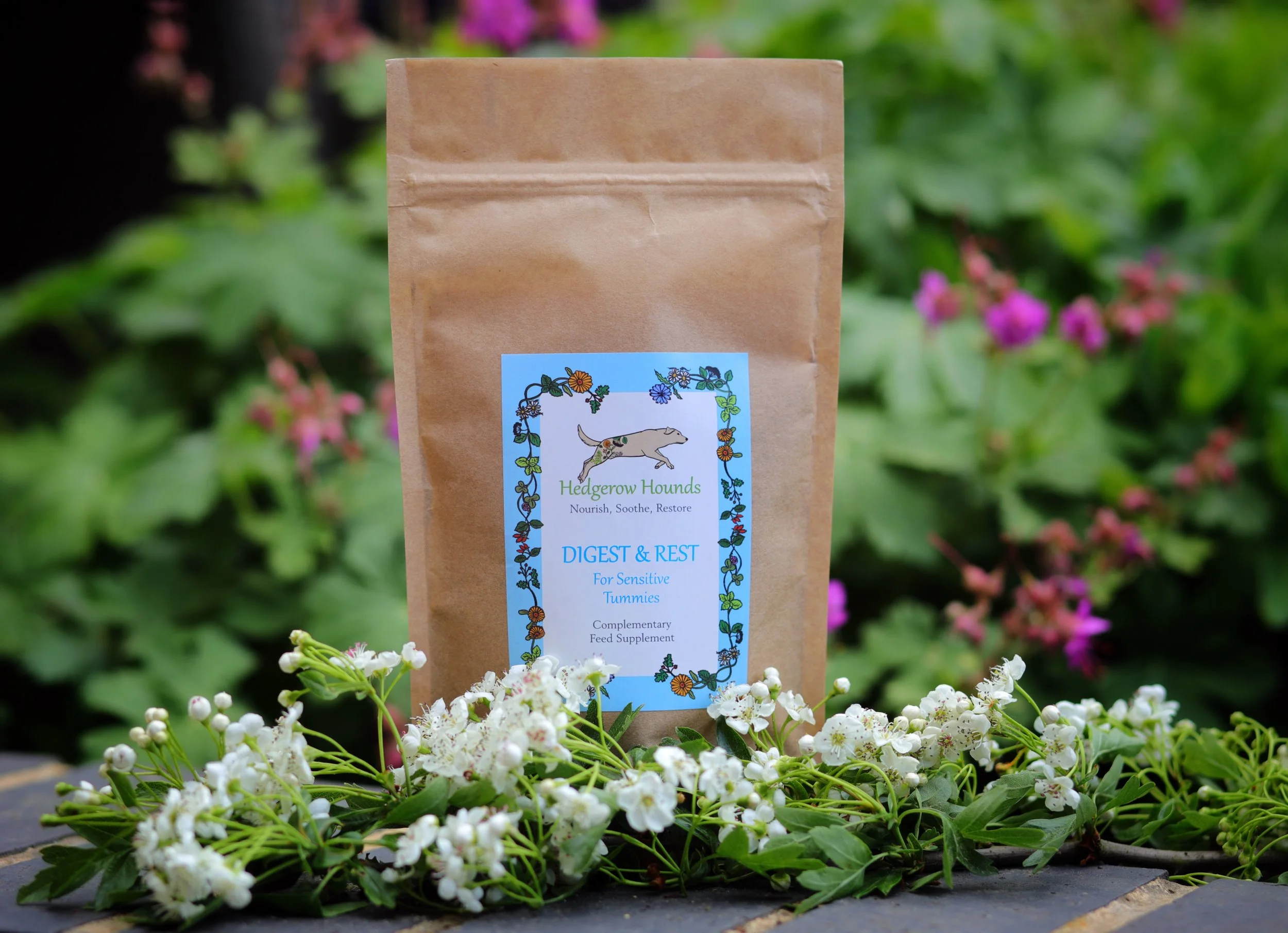
A beautiful blend of herbs, roots, and seeds specifically to soothe the gut, aid digestion, and help anal gland issues.

All our products are veterinary formulated, but should not be used instead of consulting your vet should your dog have a health problem.
Hedgerow Hounds is owned by a qualified holistic canine therapist with 30 years of experience in healthcare and nutrition, and the blends are formulated by a veterinarian.
SEASONAL FEEDING - Making the Most of Fresh Ingredients
The majority of people have lost their connection with the land, nature and the changing seasons.
Natures larder provides us with a huge variety of produce at the perfect time when it will be of most benefit to us nutritionally. With a few small changes we can all benefit from eating seasonally which is better for us, our dogs and the environment.

Spring, Summer, Autumn and Winter, seasonal feeding at its freshest and finest. Featuring Hedgerow Hounds seasonal herbal blends.
The majority of people have lost their connection with the land, nature and the changing seasons.
Natures larder provides us with a huge variety of produce at the perfect time when it will be of most benefit to us nutritionally. With a few small changes we can all benefit from eating seasonally which is better for us, our dogs and the environment.
We can utilise herbs and vegetables in the Spring, which are a perfect cleansing tonic to gently ease us out of the long winter months, where we have no doubt been overindulging and less active.
To the cooling and hydrating bounty of Summer, followed by the real bumper harvest of Autumn, which gives us all the foods we need to help boost our immunity and general health in preparation for the cold Winter months ahead.
Here at Hedgerow Hounds, we are passionate about seasonal ingredients, and if you really want to embrace seasonality, then we have a seasonal range of handmade herbal blends.
What`s so special about seasonal food?
Eating more seasonally ourselves and by including some of these foods in our dogs’ diet, we can benefit in so many ways.
. We can reconnect with the cycles of nature and really appreciate the food that is available for a short period of time.
. It is better value for money as well as kinder to the environment, to buy ingredients when they are in abundance locally and haven’t travelled halfway round the world before they even get to our kitchen.
. We can support the local communities, such as small producers, farmers’ markets, organic growers, and game dealers.
. The produce is fresher and therefore more nutritious as it is harvested when ripe or at its best, and has minimal travelling time before we can purchase it.
Could we survive without sugar snap peas from Egypt, asparagus from Peru, and eating Strawberries in January? These have travelled thousands of miles, are harvested unripe, and sprayed with chemicals, gas, or wax to stop them from deteriorating in transit.
Or could we wait until they are ready to eat locally and benefit from much more flavour and far higher nutritional value, while enjoying so many other foods in the meantime?
How does incorporating seasonal food benefit our dogs?
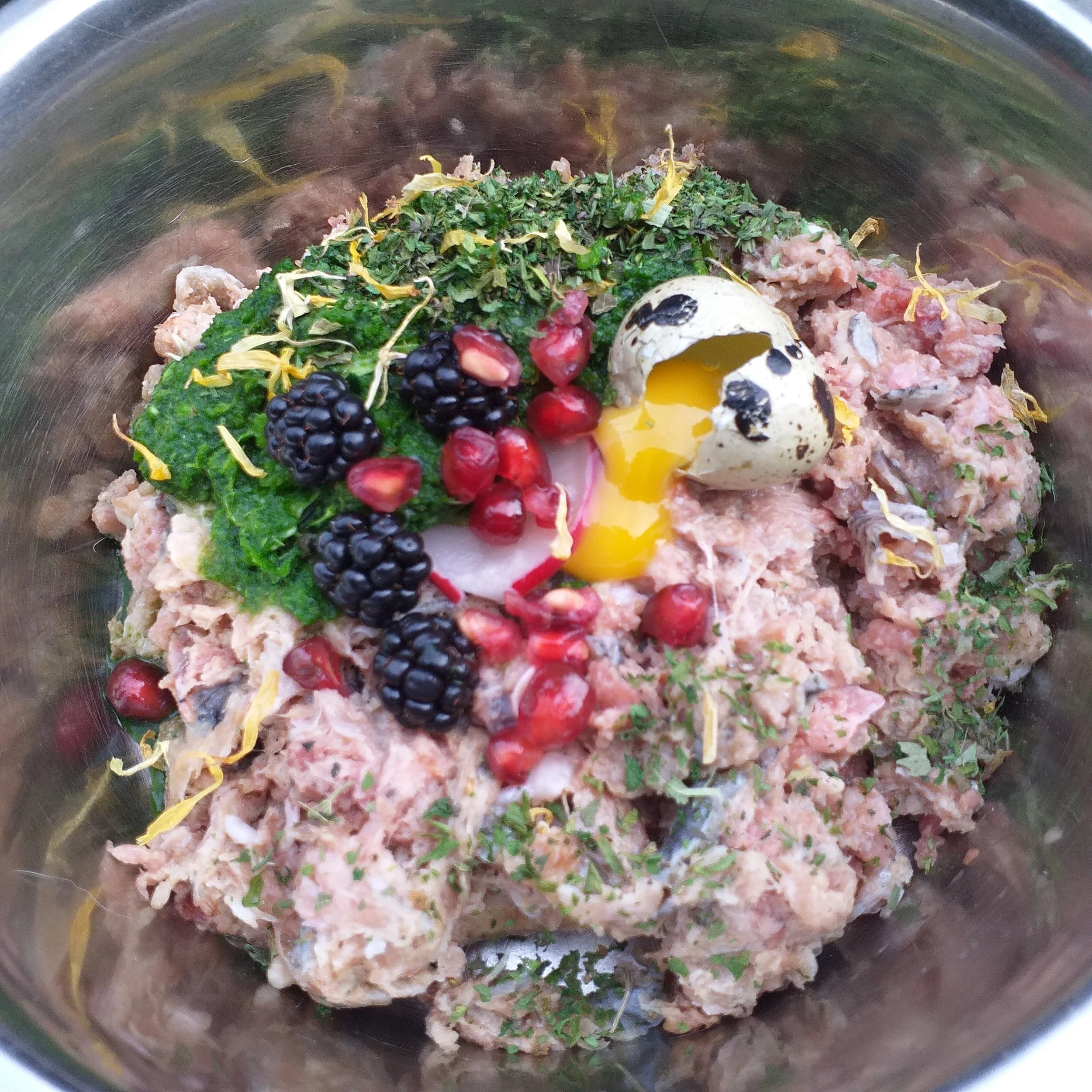
If you feed raw or home-cooked food to your dog, then it is important to offer a good variety of foods over the coming months. If you feed dried or tinned food, it is also possible to start incorporating a small amount of fresh ingredients into the bowl at feed times.
By offering variety, you can ensure your dog gets a broad range of nutrients and avoid the intolerances that can occur if the same protein and carbohydrate are fed continuously.
A wide spectrum of fresh ingredients, either animal proteins or of plant origin, nurtures a healthy gut microbiome, which is vital for a healthy immune system and overall optimal health. The more diverse the diet, the less you will have to rely on supplementation.
By feeding what is in season, you are providing food at its very best. This often means that you don’t need a large amount to benefit from the superior nutritional value.
A few local, handpicked ripe blackberries added to the food will be far superior to a larger number of blueberries that have covered many air miles. Including some free-range, wild, or organic meat whenever you can will also provide your dog with superior-quality ingredients.
Depending on your location, there is generally a good range of proteins available from Spring to Summer, but when Autumn comes, there is suddenly a whole new larder available to the raw feeder or home cook.
The game season varies by the species, but generally partridge and pheasant are available from September until February. Venison is dependent on breed, but around November to March, and Duck from September until January.
If you have been relying on beef, lamb, chicken, and fish from March until August, then this addition of free-range, often organic and minimally farmed protein is a huge bonus. You can either use in addition or temporarily replace the proteins you regularly use until the availability ends.
Putting a small amount of vegetables aside for your dog when preparing your own is a good practice. It will soon become second nature to save a broccoli stalk, steam a little extra courgette, cut off a small slice of pear or apple, or lift out the couple of squashed raspberries that are in the bottom of the punnet for your dog’s supper. You will also start to look out for seasonal bargains at the butchers’ or farmers’ market.
If you can forage for ingredients such as blackberries, dandelion leaves, cleavers, and either keep a few hens or find a local organic supplier of eggs, then that is a big win.
Adding a little fresh, local, and seasonal produce even two or three times a week will help to gradually improve your dog’s overall diet. If your dog is new to fresh ingredients, start off with very small amounts and include one new addition at a time, until they adjust to a different way of eating.
As a rule, although each dog is an individual, the majority of the meal is made up of animal protein, with anything from 5% to 15% being provided by vegetables and berries that are suitable for your dog.
Spring
Spring ingredients offer a gentle tonic to cleanse and wake up the system after less active months and a diet of heavier, warming meals. Many of these ingredients that come into their own now offer support for the kidneys, liver, and lymphatic system that can often get sluggish over the Winter months. You may observe that your dog seeks out the fresh grass shoots as they appear, which are full of energy, sweetness, and moisture.
The Nature’s Skin Tonic is perfect for a gentle Spring cleanse after the long winter months and also great for dogs that are itchy and suffer from seasonal allergies at this time of year.
Incorporate some of the following into your dog’s meals:
Spring nettle tops, Cleavers, Dandelion leaf and root, Asparagus, Watercress, Milk Thistle, Spring Greens, New season Lamb, Rabbit & Free range eggs.
Summer
Summer ingredients are cooling, hydrating, and uplifting, and we are spoilt for choice at the range of produce available. If you can grow a few vegetables yourself, such as courgette, cucumber, spinach, salad greens, chard, and parsley, then these will be bursting with flavour and goodness, and you can add a little of these freshly picked ingredients to your dog’s food. If you grow blackberries and raspberries, you will find that the dogs often help themselves to the fruit from the lower branches.
Nature’s Bounty appears on the shop in February and covers the Summer months until early November. It is a nutritious blend that contains an organic seaweed, and Bounty’s main task is to naturally repel fleas and ticks, which it has successfully done for many years.
Incorporate small amounts of the following:
Fennel, Melon, Spinach, Celery, Blueberries, Bilberries, Raspberries, Dandelion, Seaweed, Sorrel, Courgettes, Mint, Parsley, Calendula, Cucumber, Green beans, Carrot tops, Lettuce, Rabbit, Free range eggs.
Autumn
Autumn provides nourishing produce to prepare for the colder months and are typically rich in antioxidants and high in vitamin C. Many of these vegetables, fruits, and berries also lend themselves to preserving by the process of dry storage, freezing, and fermentation, which would traditionally be used to ensure a supply of nutritious foods through the lean months of Winter that lie ahead:
Incorporate small amounts of the following:
Squash, Blackberries, Rosehips, Beetroot, Pumpkin, Apples, Pear, Burdock root, Chicory, Nettle seeds, Fennel and Dill seeds, Almonds, Pumpkin seeds.
Game meat to include: Partridge, Pheasant, Grouse, Pigeon, Guinea fowl, Quail, Venison, and Duck.
Fish, including Pollack, Mackerel, Coley, and Haddock.
Winter
Winter provides us with comforting food for warmth and sustenance.
Incorporate small amounts of the following:
Ginger root, Turmeric, Kale, Celeriac, Thyme, Ruby Chard, Brussels sprouts, Winter Squash, Jerusalem artichoke, Pear, Russet apple, Turkey, Duck, Venison, Mussels.
Caroline Hearn MICHT, Dip ICAT. MIAAT
Equine and Canine Sports Massage Therapist and Canine Holistic Health Specialist
Find out more at www.hedgerowhounds.co.uk
Instagram hedgerow_hounds Facebook @HedgerowHounds
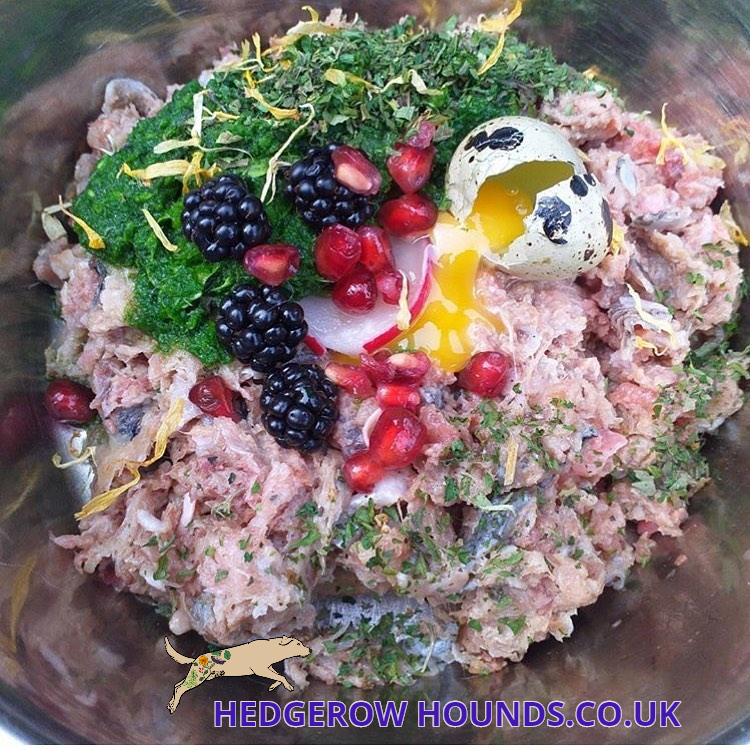
Adding Variation to Raw Diets
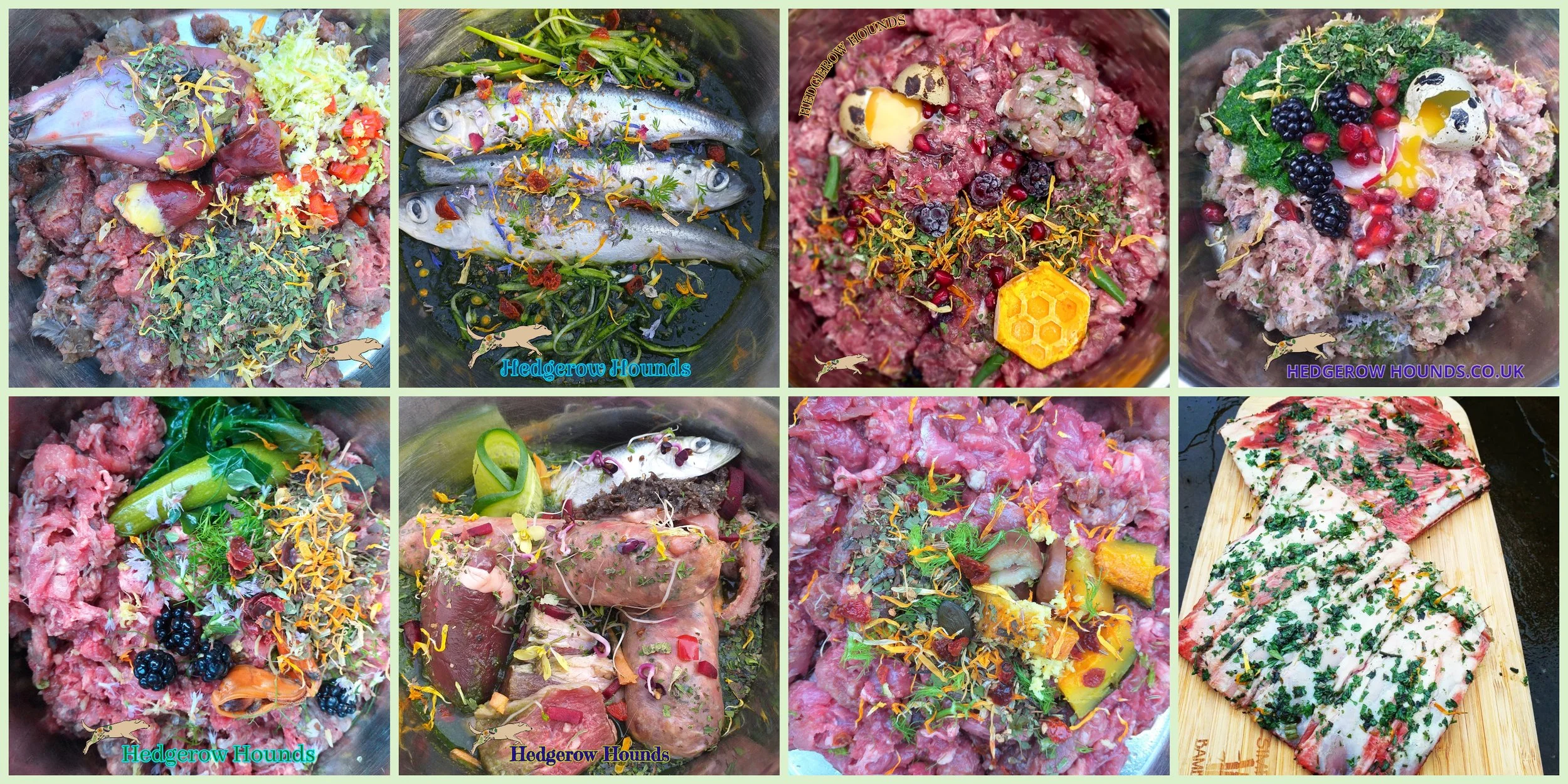
If you have been feeding raw complete minces for a while and want to start including some DIY meals, it is important to provide a variety of proteins in order to offer a broad range of nutrients and prevent any deficiencies.
Feeding a selection of fresh food and making full use of seasonal variation means that each meal is an opportunity to add nourishment, support good health, build immunity and increase vitality in our dogs.
Muscle meat
The majority of a raw diet is made up of muscle meat, and depending on which type of model you feed it could be as much as 80% as in the 80-10-10 (80% muscle meat,10% offal & 10% raw bone) or, in the Barf model 70%, allowing for the addition of vegetables.
Try and offer a selection of meat from different species, ideally 4 or 5 over a month if you can, plus an oily fish. This can include beef, chicken, turkey, pork, buffalo, venison, rabbit, tripe, guinea fowl, goat and lamb, etc.
Rotate white and red meat from different species but also vary the cuts within the same species. So, for example include chicken thighs rather than just feeding breast meat.
Replace some of the proteins with wild game when it is in season, such as pheasant, partridge, duck and venison.
If free range or grass-fed proteins can be introduced, even in small quantities, there is higher nutritional value, particularly with levels of Omega 3 fatty acids.
When making DIY meals for your dog it is important to establish the difference between what is fed as muscle meat and what is offal, that way you can calculate the 10% offal ration (5% liver, 5% other offal) into your meal plan.
Heart
Although the heart is an internal organ it is often confused as being offal when actually it is a muscle, and a very hard working muscle at that!
Where it does have its similarities is the amount in which it is fed.
It is a rich meat, high in blood content, which like liver can cause diarrhoea if fed in large amounts.
Introduce slowly and work up to between 5% and 10% until your dog can tolerate it. It is not required in large amounts or on a daily basis, but you can incorporate it into the diet within your monthly food balance plan. It is a nutrient dense addition and generally it is cheap to buy, having fallen out of fashion in our own diets over the years.
Heart is high in taurine, iron, folate, carnitine, thiamine, conjugated linoleic acid (CLA), gamma linolenic acid (GLA) selenium and B vitamins.
It is particularly high in Coenzyme Q10 (CoQ10) which is needed to optimize heart rhythm. As CoQ10 levels decrease with age, it is a valuable addition to your senior dog`s diet. Trials show that heart failure patients have low levels, and supplementation can help to stabilise the disease.
With twice as much collagen and elastin as other muscle meat it is a perfect dietary addition for working or competition dogs to prevent fatigue, as well as providing added support for the musculoskeletal system.
Tongue
This is another protein that’s regarded as muscle meat which can be a little high in fat, so is one to limit if your dog has a pancreas issue or is on a strict weight loss plan.
Gizzards
Chicken, duck and turkey gizzards have goods levels of iron, selenium, zinc, riboflavin, niacin, choline, copper and vitamin B12. Gizzards are fed as muscle meat.
Lungs
Lungs, also referred to as “lights,” have some muscle meat and some organ content, so don`t really fit into one specific category.
It can cause loose stools if fed in large amounts or if fed alongside offal, so although a worthwhile addition it is best to limit the amount fed in a single meal and not to exceed 15%.
Trachea
Great as a natural chew to clean the teeth, and particularly helpful for senior dogs who can no longer handle bones due to missing teeth or gum problems. Trachea is naturally high in glucosamine and chondroitin so supportive to joints. Lamb tracheas are better for small dogs and beef tracheas are suitable for medium to large dogs.
Offal
Offal makes up 10% of the diet, 5% of which should be liver and the other 5% made up of kidney, spleen, pancreas, testicles and brain. Offal is different from muscle meat in that they are internal organs which secrete.
The inclusion of offal in the raw or home cooked diet provides an abundance of vitamins and minerals. Just introduce into the diet very gradually and adjust to what your dog’s system can cope with to avoid stomach upsets.
Liver
Liver is the most nutrient dense of the internal organs and makes up 5% of the offal requirement in your dog’s diet.
If you are buying complete meals, you will see on the label that it states 5% liver and 5% other offal.
It provides an abundance of vitamin A, copper, vitamin D, vitamin K, vitamin C, vitamin E, folic acid, choline, vitamin B6, B12, magnesium, iron, thiamine, riboflavin, niacin, folate, selenium, biotin, calcium and phosphorous.
Some people feed liver just twice a week and others, due to the dog’s sensitivity to larger amounts, just add a small amount every day.
Kidneys
Kidney would be added to make up the other 5% of the offal requirement, possibly mixed with one of the others on the offal list.
It is a good source of vitamin B12, B6, riboflavin, carnitine, iron and folate.
Pancreas (sweetbreads or thymus)
Pancreas is not always easy to get hold of, but you can ask your butcher or food supplier to source some for you.
It contains a rich supply of digestive enzymes and is a worthwhile addition to any dog’s diet but is particularly good if you’re feeding a dog with a pancreatic insufficiency.
Spleen
Spleen is another organ that can be difficult to find but can be ordered from a butcher, or you can ask your food supplier if it is included in any of their offal mixes.
It provides good levels of iron, niacin, riboflavin, vitamins B12 & B6, selenium, zinc, and a broad range of amino acids.
Fish and Shellfish
Most modern-day diets, for ourselves and our dogs, are too high in Omega 6 and 9 due to processed grains, cereals and vegetable oils, which can lead to inflammation, faster aging and can predispose the body to disease.
In contrast, Omega 3 fatty acids offer a wealth of health benefits including anti- inflammatory properties, healthy skin & coat, normal metabolism, joint health and slowing the ageing process as well as supporting brain and cognitive function.
As you can see, this is an important addition to the diet of dogs with skin issues, joint pain, and is an essential for senior dogs in particular.
Feeding the actual fish has far more benefits than fish oil, which can quickly go rancid, causing the inflammation we were trying to prevent.
Pollution is also a consideration when choosing fish. The cleanest are:
· Sardines, mackerel, pilchards, herring, sprats, halibut, anchovies, whitebait and trout.
· Mussels and green lipped mussels are good for joint health.
Other forms of Omega 3 are hemp oil, chia seeds, flax seed oil, seaweed, eggs, pumpkin seeds and phytoplankton.
Should your dog hate raw fish and completely refuse to eat it, then the tinned sardines, pilchards or mackerel are a good substitute in either spring water or tomato juice which can be gently rinsed off or drained.
Try and include an oily fish into your dog’s diet two to three times a week.
Eggs
Eggs provide a high quality, complete source of amino acids which are the building blocks of protein.
A good source of vitamin A, vitamin B12, riboflavin, iron, folate, zinc, selenium, fatty acids, choline, fat soluble vitamin E, D and K.
Just one egg will provide 13 essential vitamins and minerals, including lutein which is essential for eye health.
Free range eggs offer far greater levels of nutrition as the birds would have benefited from a natural lifestyle of foraging and have had sunlight on their backs.
Duck eggs have a larger yolk to white ratio and are higher in protein, fat and contain more Omega 3.
Quail have larger amounts of vitamin B1 and 5 times as much iron and potassium as hen’s eggs. Their protein value is 13% compared to 11% in hen’s eggs. Quail eggs rarely cause allergies, so certainly worth a try if your dog can`t usually tolerate hens’ eggs.
Bones
Raw edible bones will make up on average 10% of your dog’s meals but sometimes as much as 30% and are an important requirement of the diet.
Bones provide calcium, phosphorous, magnesium, potassium and, depending on the type of bone fed, a supply of fat, cartilage and collagen.
They are also needed in the diet to keep the stools firm, and while most dogs will be fine with 10% bone, occasionally you will come across dogs who require more to keep their faeces firm, and others who will always need offal or vegetables in their diets in order to cope with 10% or they become constipated. Therefore, it is important to feed each dog as an individual.
Raw bones are regarded as either edible, which add to the calcium quota, or recreational, which provide very little calcium but give mental stimulation and teeth cleaning benefits.
Edible bones are raw bones that are completely consumed, usually in one sitting. Examples would be chicken and duck wings, lamb ribs, chicken backs, chicken and duck feet, chicken necks and pigs trotters.
Vegetables and Berries
The inclusion of vegetables, herbs and berries in the diet provide, phytonutrients which are compounds found in plants with health giving properties, anti-oxidants which protect cells from free radicals and dietary fibre that acts as a prebiotic to stimulate the growth of beneficial gut bacteria.
Look to add some vibrant leafy green to your dog’s meals, such as kale, spinach, parsley, broccoli, chard, dandelion leaves and red and purple berries including raspberry, blueberry and blackberry.
Start off with a small amount and build up to approximately 10-15% of the meal, if this suits your dog. Vegetables need to be either lightly steamed or feed raw and put into a blender to make a thick puree, this will break down the tough cellular wall in the vegetables and make them more digestible.
Caroline Hearn - Hedgerow Hounds
www.hedgerowhounds.co.uk