Adding Variation to Raw Diets
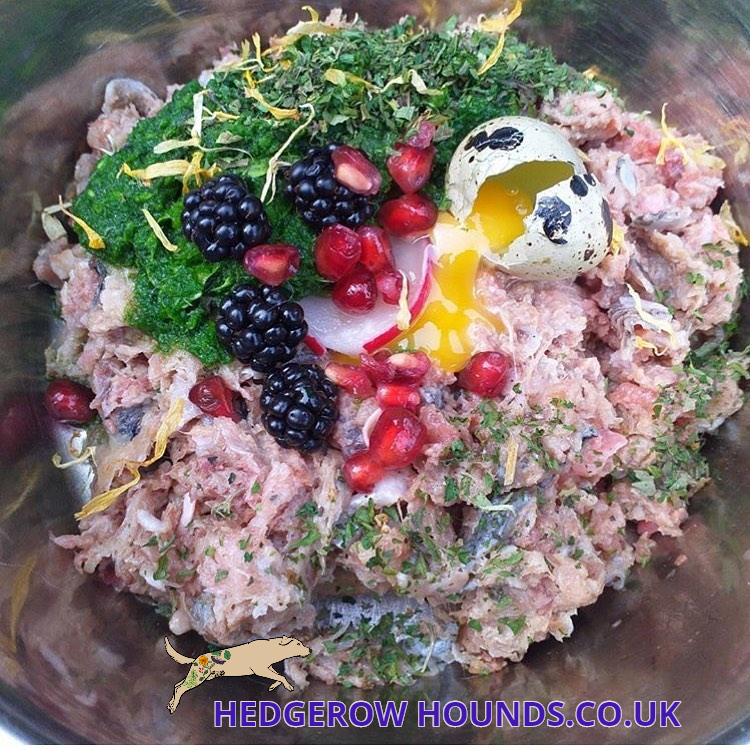
If you have been feeding raw complete minces for a while and want to start including some DIY meals, it is important to provide a variety of proteins in order to offer a broad range of nutrients and prevent any deficiencies.
Feeding a selection of fresh food and making full use of seasonal variation means that each meal is an opportunity to add nourishment, support good health, build immunity and increase vitality in our dogs.
Muscle meat
The majority of a raw diet is made up of muscle meat, and depending on which type of model you feed it could be as much as 80% as in the 80-10-10 (80% muscle meat,10% offal & 10% raw bone) or, in the Barf model 70%, allowing for the addition of vegetables.
Try and offer a selection of meat from different species, ideally 4 or 5 over a month if you can, plus an oily fish. This can include beef, chicken, turkey, pork, buffalo, venison, rabbit, tripe, guinea fowl, goat and lamb, etc.
Rotate white and red meat from different species but also vary the cuts within the same species. So, for example include chicken thighs rather than just feeding breast meat.
Replace some of the proteins with wild game when it is in season, such as pheasant, partridge, duck and venison.
If free range or grass-fed proteins can be introduced, even in small quantities, there is higher nutritional value, particularly with levels of Omega 3 fatty acids.
When making DIY meals for your dog it is important to establish the difference between what is fed as muscle meat and what is offal, that way you can calculate the 10% offal ration (5% liver, 5% other offal) into your meal plan.
Heart
Although the heart is an internal organ it is often confused as being offal when actually it is a muscle, and a very hard working muscle at that!
Where it does have its similarities is the amount in which it is fed.
It is a rich meat, high in blood content, which like liver can cause diarrhoea if fed in large amounts.
Introduce slowly and work up to between 5% and 10% until your dog can tolerate it. It is not required in large amounts or on a daily basis, but you can incorporate it into the diet within your monthly food balance plan. It is a nutrient dense addition and generally it is cheap to buy, having fallen out of fashion in our own diets over the years.
Heart is high in taurine, iron, folate, carnitine, thiamine, conjugated linoleic acid (CLA), gamma linolenic acid (GLA) selenium and B vitamins.
It is particularly high in Coenzyme Q10 (CoQ10) which is needed to optimize heart rhythm. As CoQ10 levels decrease with age, it is a valuable addition to your senior dog`s diet. Trials show that heart failure patients have low levels, and supplementation can help to stabilise the disease.
With twice as much collagen and elastin as other muscle meat it is a perfect dietary addition for working or competition dogs to prevent fatigue, as well as providing added support for the musculoskeletal system.
Tongue
This is another protein that’s regarded as muscle meat which can be a little high in fat, so is one to limit if your dog has a pancreas issue or is on a strict weight loss plan.
Gizzards
Chicken, duck and turkey gizzards have goods levels of iron, selenium, zinc, riboflavin, niacin, choline, copper and vitamin B12. Gizzards are fed as muscle meat.
Lungs
Lungs, also referred to as “lights,” have some muscle meat and some organ content, so don`t really fit into one specific category.
It can cause loose stools if fed in large amounts or if fed alongside offal, so although a worthwhile addition it is best to limit the amount fed in a single meal and not to exceed 15%.
Trachea
Great as a natural chew to clean the teeth, and particularly helpful for senior dogs who can no longer handle bones due to missing teeth or gum problems. Trachea is naturally high in glucosamine and chondroitin so supportive to joints. Lamb tracheas are better for small dogs and beef tracheas are suitable for medium to large dogs.
Offal
Offal makes up 10% of the diet, 5% of which should be liver and the other 5% made up of kidney, spleen, pancreas, testicles and brain. Offal is different from muscle meat in that they are internal organs which secrete.
The inclusion of offal in the raw or home cooked diet provides an abundance of vitamins and minerals. Just introduce into the diet very gradually and adjust to what your dog’s system can cope with to avoid stomach upsets.
Liver
Liver is the most nutrient dense of the internal organs and makes up 5% of the offal requirement in your dog’s diet.
If you are buying complete meals, you will see on the label that it states 5% liver and 5% other offal.
It provides an abundance of vitamin A, copper, vitamin D, vitamin K, vitamin C, vitamin E, folic acid, choline, vitamin B6, B12, magnesium, iron, thiamine, riboflavin, niacin, folate, selenium, biotin, calcium and phosphorous.
Some people feed liver just twice a week and others, due to the dog’s sensitivity to larger amounts, just add a small amount every day.
Kidneys
Kidney would be added to make up the other 5% of the offal requirement, possibly mixed with one of the others on the offal list.
It is a good source of vitamin B12, B6, riboflavin, carnitine, iron and folate.
Pancreas (sweetbreads or thymus)
Pancreas is not always easy to get hold of, but you can ask your butcher or food supplier to source some for you.
It contains a rich supply of digestive enzymes and is a worthwhile addition to any dog’s diet but is particularly good if you’re feeding a dog with a pancreatic insufficiency.
Spleen
Spleen is another organ that can be difficult to find but can be ordered from a butcher, or you can ask your food supplier if it is included in any of their offal mixes.
It provides good levels of iron, niacin, riboflavin, vitamins B12 & B6, selenium, zinc, and a broad range of amino acids.
Fish and Shellfish
Most modern-day diets, for ourselves and our dogs, are too high in Omega 6 and 9 due to processed grains, cereals and vegetable oils, which can lead to inflammation, faster aging and can predispose the body to disease.
In contrast, Omega 3 fatty acids offer a wealth of health benefits including anti- inflammatory properties, healthy skin & coat, normal metabolism, joint health and slowing the ageing process as well as supporting brain and cognitive function.
As you can see, this is an important addition to the diet of dogs with skin issues, joint pain, and is an essential for senior dogs in particular.
Feeding the actual fish has far more benefits than fish oil, which can quickly go rancid, causing the inflammation we were trying to prevent.
Pollution is also a consideration when choosing fish. The cleanest are:
· Sardines, mackerel, pilchards, herring, sprats, halibut, anchovies, whitebait and trout.
· Mussels and green lipped mussels are good for joint health.
Other forms of Omega 3 are hemp oil, chia seeds, flax seed oil, seaweed, eggs, pumpkin seeds and phytoplankton.
Should your dog hate raw fish and completely refuse to eat it, then the tinned sardines, pilchards or mackerel are a good substitute in either spring water or tomato juice which can be gently rinsed off or drained.
Try and include an oily fish into your dog’s diet two to three times a week.
Eggs
Eggs provide a high quality, complete source of amino acids which are the building blocks of protein.
A good source of vitamin A, vitamin B12, riboflavin, iron, folate, zinc, selenium, fatty acids, choline, fat soluble vitamin E, D and K.
Just one egg will provide 13 essential vitamins and minerals, including lutein which is essential for eye health.
Free range eggs offer far greater levels of nutrition as the birds would have benefited from a natural lifestyle of foraging and have had sunlight on their backs.
Duck eggs have a larger yolk to white ratio and are higher in protein, fat and contain more Omega 3.
Quail have larger amounts of vitamin B1 and 5 times as much iron and potassium as hen’s eggs. Their protein value is 13% compared to 11% in hen’s eggs. Quail eggs rarely cause allergies, so certainly worth a try if your dog can`t usually tolerate hens’ eggs.
Bones
Raw edible bones will make up on average 10% of your dog’s meals but sometimes as much as 30% and are an important requirement of the diet.
Bones provide calcium, phosphorous, magnesium, potassium and, depending on the type of bone fed, a supply of fat, cartilage and collagen.
They are also needed in the diet to keep the stools firm, and while most dogs will be fine with 10% bone, occasionally you will come across dogs who require more to keep their faeces firm, and others who will always need offal or vegetables in their diets in order to cope with 10% or they become constipated. Therefore, it is important to feed each dog as an individual.
Raw bones are regarded as either edible, which add to the calcium quota, or recreational, which provide very little calcium but give mental stimulation and teeth cleaning benefits.
Edible bones are raw bones that are completely consumed, usually in one sitting. Examples would be chicken and duck wings, lamb ribs, chicken backs, chicken and duck feet, chicken necks and pigs trotters.
Vegetables and Berries
The inclusion of vegetables, herbs and berries in the diet provide, phytonutrients which are compounds found in plants with health giving properties, anti-oxidants which protect cells from free radicals and dietary fibre that acts as a prebiotic to stimulate the growth of beneficial gut bacteria.
Look to add some vibrant leafy green to your dog’s meals, such as kale, spinach, parsley, broccoli, chard, dandelion leaves and red and purple berries including raspberry, blueberry and blackberry.
Start off with a small amount and build up to approximately 10-15% of the meal, if this suits your dog. Vegetables need to be either lightly steamed or feed raw and put into a blender to make a thick puree, this will break down the tough cellular wall in the vegetables and make them more digestible.
Caroline Hearn - Hedgerow Hounds
www.hedgerowhounds.co.uk
ADDING FRESH FOOD TO THE BOWL
Peak health starts with good nutrition, here are a few ideas to get you started
It is important to have fresh food in our diets in order to reach optimal health and the same goes for our dogs too.

There are a number of ways you can increase the nutritional value of the food you are feeding your dog. It is also an ideal way of starting to introduce fresh food if you are thinking of changing over to either a raw or home cooked diet.
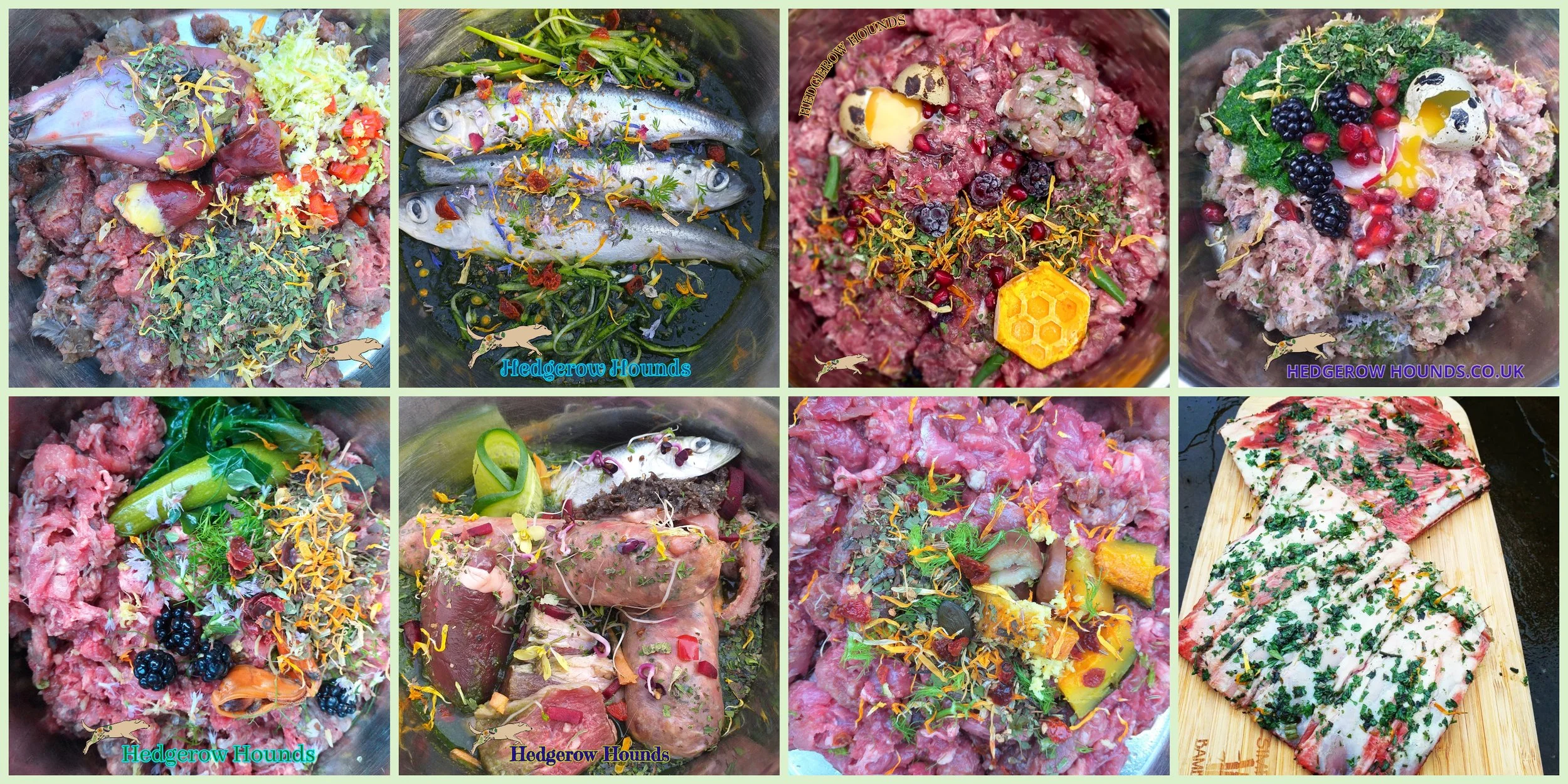
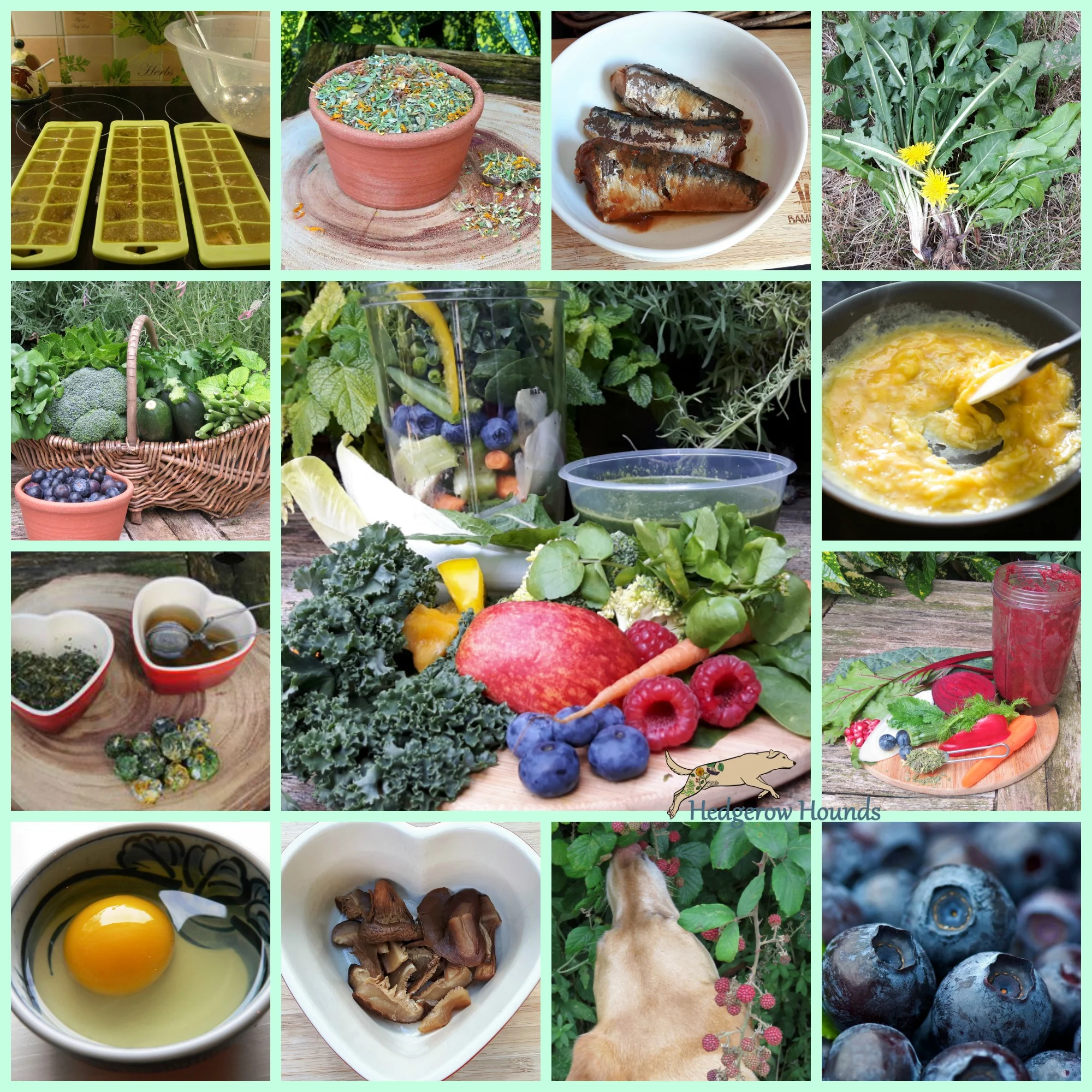
Starting from the top left photo (clockwise) shows homemade Bone Broth which can be frozen in ice cube trays. It is a great source of glucosamine and chondroitin for joint health and very soothing for the gut.
The Hedgerow Hounds herbal blends are a quick and easy way to add a vast array of vitamins, minerals, antioxidants and fibre. They are of the highest quality and have been approved by our holistic vet. There is a blend to suit every dog and every season throughout the year. They can be fed dry, re-hydrated or as a tea. Great to use in your treat recipes or in a vegetable smoothie.
Oily fish is a real treat for some dogs but others are not so keen. If they don't like raw or lightly cooked fish then tinned mackerel or sardines will still provide a good source of Omega 3 fatty acids. Most dogs love these and they are perfect to have in the store cupboard.
Throughout the year there are a number of wild growing ingredients you can pick for your dog such as a few dandelion leaves, cleavers, chickweed, rosehips and blackberries. These can be added to their vegetables or treat recipes. Just make sure you always know exactly what you are picking and it is from an area free of traffic pollution and agricultural sprays.
Eggs - Either raw or very lightly cooked will provide a huge range of nutrients all in one perfect package. Talking of the shell, the inner opaque membrane can be removed and fed, providing extra nutrition for joints and ligaments.
If you want to add vegetables and berries to your dogs meals then a good way to do it is by making a smoothie which will assist the digestion of vegetables by breaking down the tough cellulose wall that plants naturally have. The ingredients shown are packed full of anti-oxidants for a real boost to health and the immune system. Make a tea with one of the Hedgerow Hounds herbal blends and add that to the veg before blitzing in a blender. The inclusion of pulped vegetables also adds welcome moisture to dry food.
You can set aside some vegetables when you are preparing your dinner and either blend or steam them to add to you dogs meals. Broccoli stalks, green beans, courgette, kale are all good choices rather than starchy root veg. Rotate the vegetables fed and include seasonal variations.
In Autumn you can pick your own blackberries or my dogs actually help themselves from the low branches. Freeze some for later in the year or you can add a few blueberries or raspberries for a vitamin C boost.
Medicinal mushrooms such as Reishii, Shiitake, Chaga, Coriolus have immune bosting and anti inflammatory properties and recent studies have shown them to have positive anti- tumour benefits. If you cant find fresh then the dried versions can be re-hydrated with hot water.
Kibble, tinned and home cooked meals can be improved on by adding a few berries, soaked seeds, Hedgerow Hounds Herbal Blends and vegetables. Little changes at the speed your dog can easily adjust to is a big step in improving the health and wellbeing of our dogs.
www.hedgerowhounds.co.uk

Carnivore or Omnivore?

Whether dogs are carnivores or omnivores seems to spark many a passionate debate.
All their anatomical attributes point to them being facultative (scavenging) carnivores. Which in general terms means that they are predominately meat eaters but they can, if needed survive on plant matter.
One way to explore what our dogs are designed to eat is to look at their anatomical and physiological features and what nature has given them in order to survive to the best of their abilities.
Dogs come in a vast array of shapes, sizes and specific breed types but basically their anatomy and how their bodies work has barely changed over thousands of years.
The natural wild survival and behavioural traits may have lessened over the centuries but there are still many attributes that our pet dogs have in common with their distant ancestors.
Scenting ability
Nature has given the dog the most exceptional sense of smell for a very good reason. Dogs dedicate 33% of their brain for the very important task of following a scent, which is essential if you need to track and kill your own dinner or seek out something tasty to scavenge.
Their ability to recognise a scent is exceptionable and with 300 million olfactory receptors compared to our 5 million they are in a different league to most other mammals when it comes to scenting ability.
A dog can quickly use his nose to gain lots of information about his environment and also to detect species that have travelled through the surrounding area. They also have the physique to run at speed with their nose a matter of centimetres from the ground and to follow a scent over many miles, even when the “prey” has long since passed by.
Dew Claws
Dogs have a pointed dew claw on the inner aspect of their front legs which does not come into contact with the ground until they are moving through the faster paces, then it provides a very important role.
Many people think that dew claws have no purpose, but if you have ever observed a dog eating a raw bone you will see that they dig the dew claw into the meat or sinew to position and prevent movement of the bone while eating.
Dew claws also have a vital role in stabilising the lower leg and in particular when cornering at speed, as there are five tendon attachments coming off it leading to muscles that prevent twisting of the limb when it comes into contact with the ground. This can prove essential in injury prevention when travelling over uneven terrain at high speed, such as the chasing of prey or needing to flee a source of danger.
Head
Carnivores have very big jaws in relation to the size of their heads. Although they have reduced facial muscles to allow for the opening of the mouth, the primary muscles that operate the jaws are the large, developed temporalis muscle on their skull and combined with powerful neck and shoulder muscles, overpower, hold prey , crush bones and have the strength to carry away items that have been scavenged so they can be eaten in a safe environment.
Teeth
The teeth of the dog are probably the biggest clue as to what canines are designed to eat. Like a Swiss army knife, each group of teeth have a very specific job to do in order to deal with capturing, puncturing and devouring almost a whole carcass. None of the structure or function of the dogs teeth and jaws lend themselves to eating or grinding cereals.
Incisors are the small teeth at the front of the mouth, they are used to nibble and strip away sinew and meat from the bone.
Canine teeth also referred to as fangs or cuspids are the long pointed teeth used for holding and puncturing flesh. There are two canines in the upper jaw (maxilla) and two in the lower jaw (mandible). They are single rooted teeth and the upper canine tends to be longer and more pointed than the lower.
Premolars are designed to crush and slice due to their uneven surface and scissor like action. There is a modified molar called a Carnassial which you will see as the largest and most jagged premolar. It has three roots and is a heavy-duty tool to crush bones and meat. A dog will often tilt their head to one side to gain full use of this tooth when gnawing on a bone or to slice through a large chunk of meat for easier swallowing. The top jaw has two molars each side and the bottom jaw has three which are used for crushing.
Mouth
Dogs do not have any side to side action in their jaws so unlike ourselves or herbivores they can’t grind their food before swallowing. Their jaw is a simple hinge joint and has a chomping up and down movement and a strong, muscular tongue which can manipulate food to where it can be crushed by the powerful jaws.
They do not possess any salivary amylase, which is a specialised digestive enzyme that herbivores and omnivores produce in their mouth and together with the chewing and grinding action of the molars starts to immediately break down starchy carbohydrates before we even swallow.
The oesophagus is capable of allowing the passage of large pieces of meat, after all the dog isn't capable of breaking the meat down by chewing or salivary amylase, so it needs to get the food to where that can happen, which is in the stomach.
Stomach and Digestive tract
Dogs have a short digestive tract so they can expel waste quickly which is particularly important if they have been eating food that is covered in bacteria.
We have all seen dogs eat the most disgusting and decaying of items, which if eaten by ourselves would have us omitted to hospital, yet at worst they may have a slight upset tummy for 24 hours.
They have an incredibly strong stomach acid of around pH1 which is needed to break down large amounts of protein, to dissolve bone and as a protection against any decaying food that may have been scavenged. The walls of their stomach are covered in a thick mucosa to provide protection from the corrosive acid and to literally stop the stomach from digesting itself.
Dogs produce amylase in their pancreas which is passed into the blood stream to assist in digesting carbohydrates.
All the leading dog food companies state that dogs have no nutritional need for carbohydrates in their diet, yet they appear in very large amounts in the majority of processed foods.
Recent studies have shown that there has been some adaptation over the years in dogs’ ability to digest starch. One study comparing wolves to our domestic dogs showed that dogs of today had between 4 – 30 copies of a gene code for amylase while wolves had 2 copies. This shows that dogs may now find it easier to digest carbohydrates, but with such a large gap between 4 and 30 copies it also shows that some dogs will not thrive as well as others on a high carbohydrate diet. It comes back to the importance of treating a dog as an individual and just like ourselves, what is ideal for one person can be very detrimental to the health of another.
Behaviour traits
Dogs still exhibit some of the behaviour traits of their ancestors and in certain breeds this will be particularly noticeable.
Man has taken full advantage of these natural behaviours and over many hundreds of years, through selective breeding have created companions to work alongside them. This can be anything from using their natural herding instinct to manage sheep, tracking and bringing down prey to feed the owners family and retrieving shot game.
Many dogs are keen diggers and will bury food and in particular bones as if storing them for a time when food is scarce.
Heightened senses and prey drive
All their senses are heightened, eyesight, hearing and in particular sense of smell so they can continually analyse who is approachable and where any potential food source may be.
This strong prey drive is still noticeable today in the gundog, terrier and hound groups who are just primed to follow a scent or in the case of sight hounds to chase sudden movement.
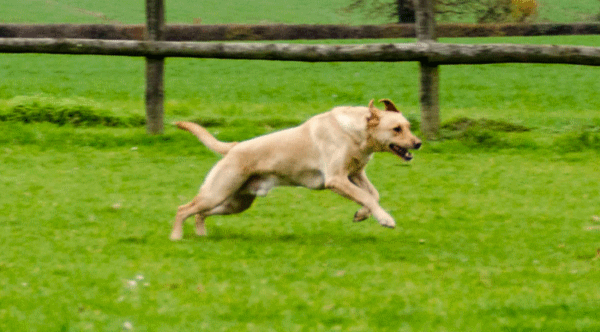
Instinctively driven to eat seasonal berries, grasses and herbivore droppings.
ling an empty stomach and go some way to enriching the life of a highly sensory being that is our beloved If dogs are given a large, natural environment to wander over it is surprising how much time they spend exploring, sniffing, experimenting what is edible and generally foraging. This can include a particular type of grass, seasonal berries, herbs, plant roots or tubers, clay soil or rotting wood. This could be for medicinal use, to ease a stomach upset, rid the body of parasites, provide additional fibre and moisture or to top up on minerals that are lacking in their diet.
Studies of wild canine populations demonstrate the wide variety of food stuffs that they will eat over the changing seasons. This is also dependant on location and if there is access to fallen fruit, nuts, berries, fish, small mammals or waste food from human inhabitation nearby in which to supplement the diet.
Dogs particularly favour the droppings of herbivores such as horses, cows and deer. Although this is only digested, fermented grass and possibly hay in the case of domesticated animals, it does provide enzymes, fibre, moisture and have probiotic qualities.
What are dogs?
Set aside for a moment your views on what dogs should be eating and look instead at what Canis Lupus Familiaris, aka our dogs, actually are?
They are highly intelligent, inquisitive, scavengers, exploring their world primarily by scent. They investigate aroma, taste, texture and edibility with all their senses. They are foragers, trackers, diggers, chewers, adventurers, opportunists and hunters. They are playful, problem solvers that adapt to their environment and not only the food source that is available at that given time but also the volume and frequency of that food.
Nature has given them the anatomy and physiology to eat a vast array of food types and if it was absolutely necessary, the ability to track, catch or at least scavenge their own dinner.
Baring all this in mind, are we not doing them a major disservice by serving up the same beige pellets in a bowl, every single day for a lifetime?
I am certainly not suggesting that you encourage or allow your dog to chase and catch wildlife, but could you offer some more enrichment at mealtimes?
This could be by adding a little steamed or pureed vegetables into their meals, a sprinkling of herbs or blackberries, offering some appropriate fresh cooked food, rotating the flavour or type of food you offer, the use of interactive food toys, snuffle mats, games in the garden that involve tracking and finding their favourite treats or food.
Feeding your Dog during the Coronavirus
During these unexpected and worrying times we may have to adapt the way we feed our dogs, at least until life gets back to normal again.

Tinned, Raw and Dried Food, enhanced with a few fresh ingredients, can make meal times go a little further.
It is a very difficult time for all of us at the moment and without the freedom to nip to the shops to purchase our usual supplies or in many cases finding the supermarket shelves bare when we get there, can be a stressful situation.
While many pet food suppliers are carrying on trading, you may find that there are certain considerations in place when you come to order. My local store had to close but they are taking orders over the phone and either delivering locally to your door or you are allocated a slot where you can collect from outside the shop. If you are concerned, then contact your usual supplier to see what their procedure is for ordering food. I am sure they will be more than happy to help you. The situation with the virus escalated quickly and some panic buying was reported, which now has even out, as people start to adapt to living differently.
The other issue I have found, is that I only have one small freezer, which generally has more dog food in it than human food. This has never been a problem up until now but I need to claim some freezer space back for my own food so I am stocked up for a couple of weeks with essentials.
If you are struggling to get the normal volume of your dogs food and are looking for ways to make what you have last a bit longer or maybe you want to add a little fresh food into your dogs diet and are unsure of what to use, then the following information should help.
Firstly, have an honest look at your dogs current weight and condition, are they carrying too much weight and would they benefit from losing a few pounds?
Has their routine changed since the movement restrictions? ie: they are used to having an hours exercise off lead in the fields but at the moment they are getting a 15 minute walk around the block on a lead, so therefore need fewer calories.
Do they have a major health issue or specific dietary requirements? If so, this may not be the time to make major changes without expert guidance.
If you have never added any fresh food before or made any major changes to your dogs diet, start off with small amounts of green leafy vegetables which have been lightly boiled, steamed or pulped in a blender. Then gradually increase over a number of days, until a quarter (15%) of your dogs meals have been replaced by fresh food. Feeding a variety of the foods listed below will avoid excess or deficiencies and keeping it to 15% maximum will not upset the balance.
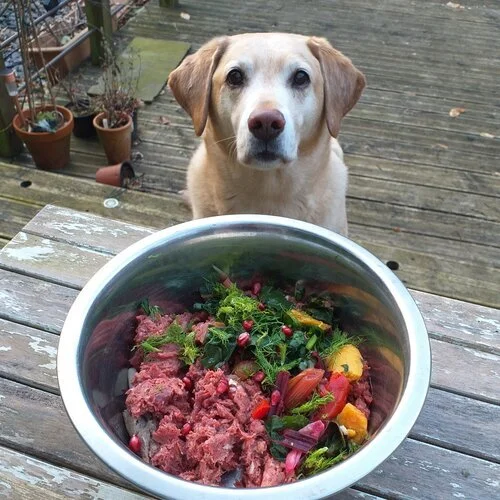
Try to offer a small selection, so for example in the photos above, I have included a single tinned pilchard, some greens, a slice of cooked sweet potato, a couple of blueberries and a tablespoon of cooked quinoa which adds up to approximately 15% of the meal. The easiest way is to set a few bits and pieces aside in a separate bowl as you prepare you own meals.
These are a few ideas to make their meals go a little further, bulk up the food you do have and add volume to prevent hunger pangs.
Items to consider adding:
Eggs: A raw or lightly cooked free range egg, 3 times a week are a fantastic source of protein. If your dog isn’t a fan of vegetables you could make them an omelette and sneak a little cooked veg in the pan as well.
Rice or Pasta: Brown or wild rice is preferable but if white rice is all you can find then this is acceptable in small amounts for the short term. Rinse well, before cooking thoroughly.
Buckwheat, Quinoa, Millet: It is important to thoroughly cook grains before you feed them to your dog so they can digest them easily. Out of the grains available these are gluten free and better suited to dogs.
Sweet Potato: Sweet potato is not a member of the nightshade family but is actually from the Bindweed family. This means that dogs who can`t tolerate normal potatoes are often fine when fed small amounts of sweet potato.
Tinned sardines or pilchards: These are a great item to have in the store cupboard and can used to replace some meat or kibble in the diet. They are cheap, tasty and an excellent source of Omega3. Try and find them in spring water or failing that tomato juice, which you can drain away before feeding.
Green leafy vegetables: Green vegetables are an ideal way to start to incorporate a little fresh food into your dogs meal times. Kale, spinach, courgette, broccoli florets and stalks, green beans, coz lettuce are all good additions. Vegetables do need to be steamed or alternatively fed raw but blitzed in a blender to form a thick puree. This allows the cellulose in the plants to be broken down for easier digestion. This means your dog can gain nutrients from the vegetables and are less likely to get an upset stomach.
Cottage cheese or plain natural yoghurt: If dairy suits your particular dog then small amounts of natural live yoghurt or natural cottage cheese can be added to your vegetable mix.
Kibble or dried food: I am not a fan of kibble, but if needs must then there are a few out there which have nice ingredients and are not made using harsh cooking methods. It`s a good idea to look on the website All about Dog food, which compares and gives ratings to the brands on the market. You can always limit the volume fed by measuring out a set amount and placing it in treat dispenser toys, snuffle mats or use for interactive scent games in the garden. As an example of a better quality dried food there is a company called Akela that sell cold pressed as well as the regular kibble that score highly on the All about Dog food website. It has a high percentage of meat so you need to feed less of it than the standard kibble.
Tinned food: There is a good choice of quality tinned foods available such as Natures Menu which are stocked in most pet food stores. Tins have the advantage of a long shelf life and can be stored anywhere cool.
Dehydrated or Freeze-dried foods: While this isn’t a cheap option there are many good products of this type on the market. They have a long shelf life and do not need fridge or freezer space in order to store it.
Recreational bones: Large raw bones or beef tracheas can provide hours of entertainment and the act of chewing releases feel good hormones. I find after my dogs have chewed on a bone for a period of time they are so tired that they sleep soundly for hours afterwards, they are often so satisfied that they don’t miss not having a second meal that particular day. Beef tracheas can be stuffed with a portion of your dogs daily meal so they have to work a bit harder to consume it.
Of course, not all dogs can be given raw bones due to resource guarding or issues within a multi dog household, so this may not be an option.
What to avoid: Do not feed grapes, raisins, chocolate, onions, gravy which contains high levels of salt, garlic and onions, anything that contains sweeteners such as Xylitol and cooked fat.

Other ways to keep your dog entertained and to make feed time last a bit longer, is to make them work for their treats. Hiding dried food in snuffle mats, using boxes in the undergrowth of your garden to place treats in or stuffing a trachea or Kong with a portion of their daily food.
If you need additional help with your dogs diet or they have special requirements due to ill health or sensitivities then our canine nutritional specialist Katie McCaul can advise you. She can be contacted by email at the following address katiemccaul@hotmail.com