
Canine Enrichment Herb Garden
Everything is covered to help you easily build your enrichment garden. Important topics include the choice of herbs, adding interactive items such as snuffle mats, choosing planters and pots, soil health, the importance of a chemical-free lawn, and ways to embrace nature with your dog throughout the seasons.
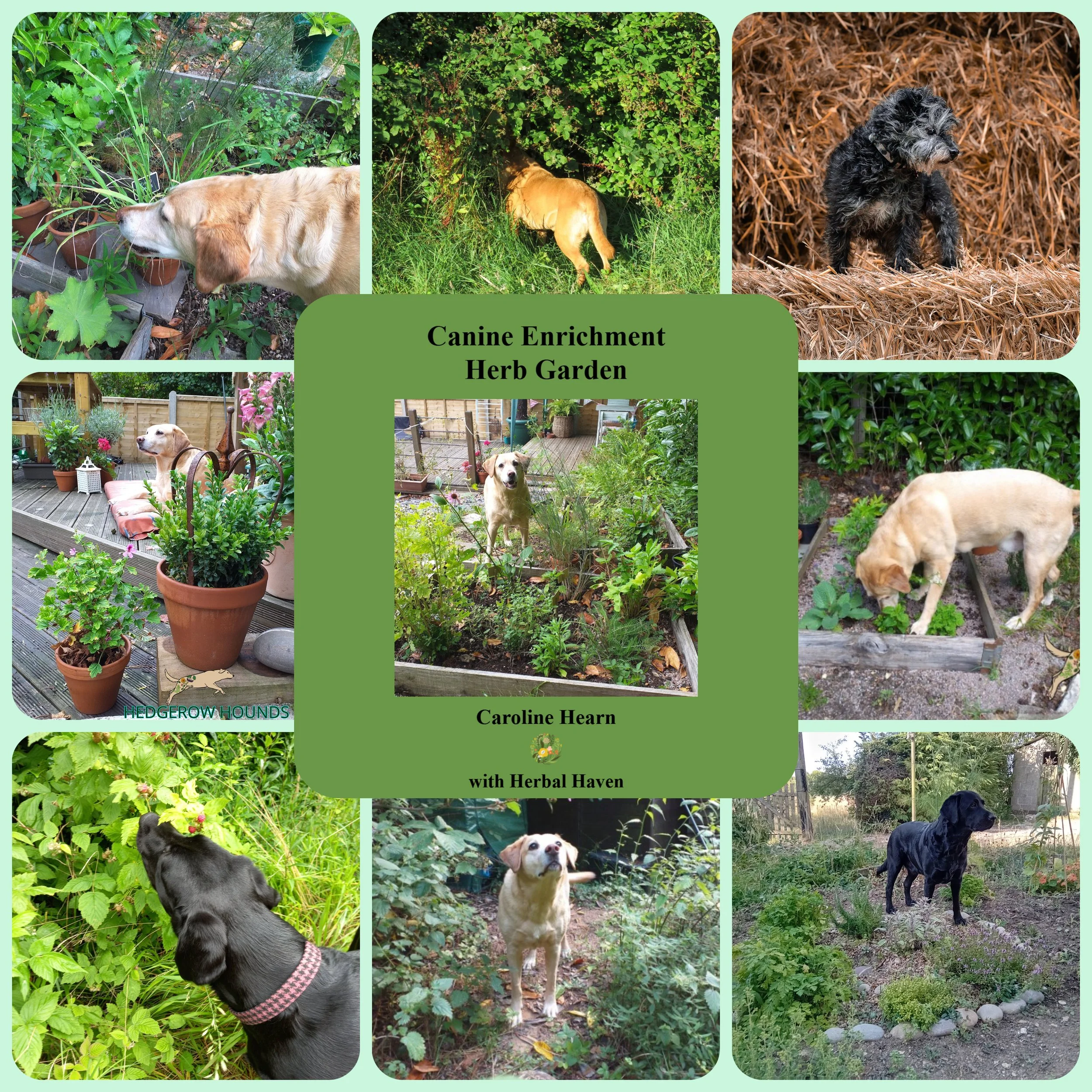
A book celebrating the love of dogs, the beauty of herbs, and the wonders of nature.
My first book is about a topic I am deeply passionate about and that has been an interest of mine for many years. It is written from a holistic approach to creating an enrichment space, using knowledge gained over the past 35 years and given to me by my greatest teachers: the dogs themselves.
So, what exactly is an enrichment garden, and why should we create one?
An enrichment garden offers dogs the freedom to move and explore at their own pace, without human interference or direction. This can be a dedicated space or incorporated into our existing garden. It encourages natural behaviours and curiosity, rather than learned responses, allowing dogs to be themselves without pressure to respond to our expectations of what they should be doing. The space will include herbs, textures underfoot, and aromas for the dog to interact with, as well as to move their body in a therapeutic way to calm the nervous system and improve mobility.
There is a section on providing enrichment for dogs with specific needs, such as the elderly, blind, or disabled dogs, as well as puppies.
Importantly, there is a chapter on ways we can benefit from this beautiful space, too.
The area we are going to create for our dogs can provide the following:
An outlet for instinctual behaviours such as sniffing, foraging, grazing, problem solving, digging, and exploring; all fantastic for reducing stress, frustration, and lowering anxiety.
Mental stimulation with scent from the environment and additional items such as snuffle mats and interactive toys.
A sensory experience with scent, sound, and texture underfoot. The garden will constantly change because of plant growth, weather conditions, seasonal changes, and what wildlife has visited the garden. Every day will offer something a little different.
Encouragement of natural movement without our influence or expectations.
Building confidence in themselves as the effects of sniffing and exploring lower the stress hormones and make the world seem a less scary place.
By going through a natural range of movements over varying textures and terrains, we are encouraging the dog to work all their body systems.
Enhanced well-being and quality of life.
A space that is appealing to look at, and that we enjoy spending time in with our dog.

We explore the many herbs that are suitable and safe for the herb garden, whether you choose to plant them in pots or directly into the ground.
With so many dog-friendly herbs to choose from, there is an extensive list in the book, as well as plants to avoid. Many are hardy and evergreen, so will provide interest all year round. If you have a small space and want to create an enrichment area in pots, then that is covered too.
Providing texture and varying terrain is also important, and how the dog’s body adapts and processes the information that is being fed back to them as they travel over hard and soft ground, slopes, and step over small obstacles.

Adding in texture, such as shingle, wood chippings, moss, mat-forming herbs, textured pathways, and sand, all add to the sensory experience.
Everything is covered to help you easily build your own enrichment garden. Important topics such as the choice of herbs, adding interactive items like snuffle mats, choosing planters and pots, soil health, the importance of a chemical-free lawn, and ways to embrace nature with your dog throughout the seasons.

Learn how simple adaptations in your garden can provide a sensory experience as well as therapeutic movement.
The book is available on Amazon as an e-Book or paperback on the link below: Here is the link https://www.amazon.co.uk/dp/B0FHKYK5T9
Or there are often paperbacks on the shop to buy. https://www.hedgerowhounds.co.uk/products/canine-enrichment-herb-garden-book
If you are looking for more help in creating your own enrichment garden for your dog or perhaps your dog has specific needs then I do offer a consultation to support and advise you. Here is the link: https://www.hedgerowhounds.co.uk/products/p/canine-enrichment-garden
The book also talks about enjoying the changing seasons and appreciating the way nature adapts throughout the year.
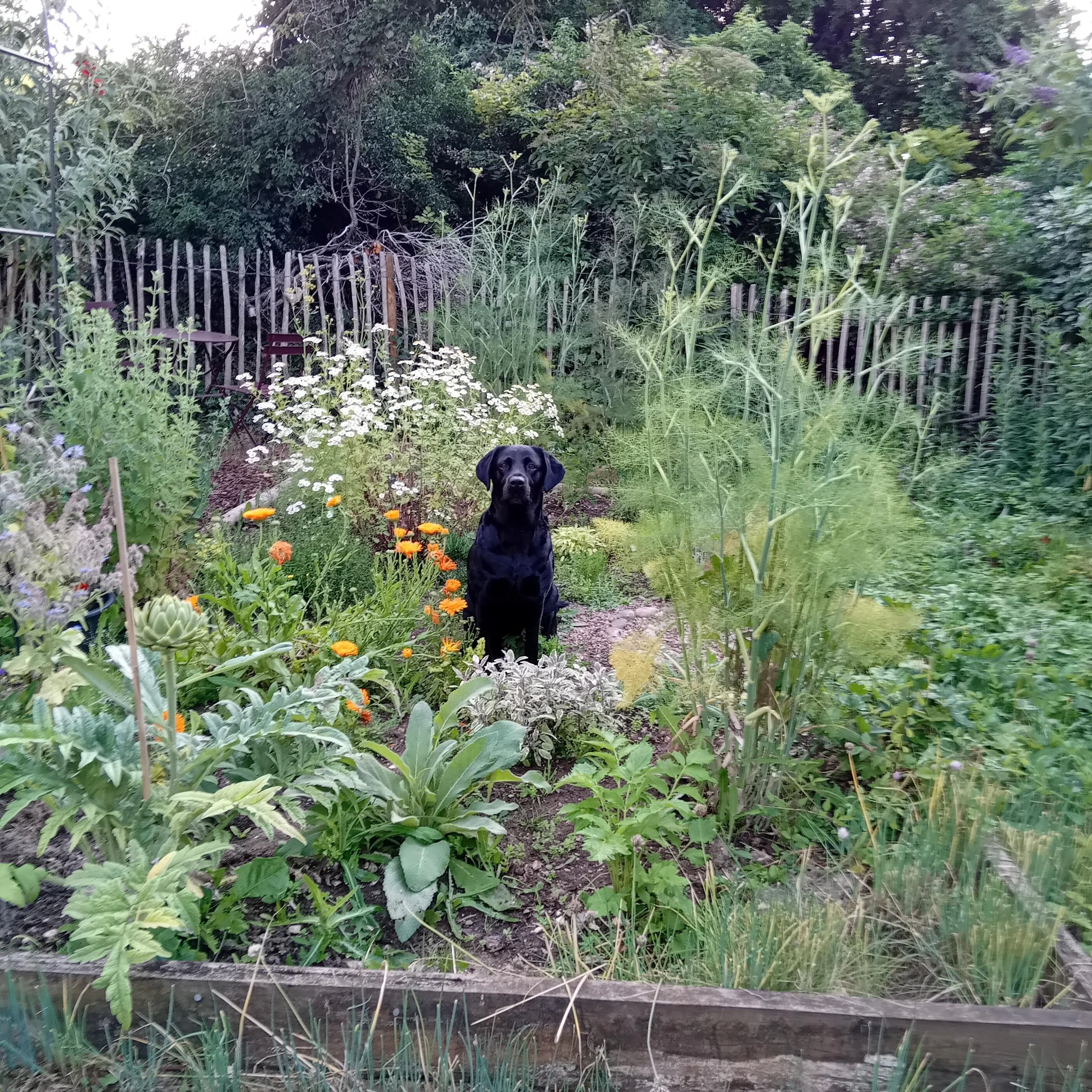
Which herbs are suitable for a dog friendly garden?
Would you love to create a dog friendly enriching outdoor space for your dog? This blog will explore which dog friendly herbs you can grow either in a herb garden or in pots.
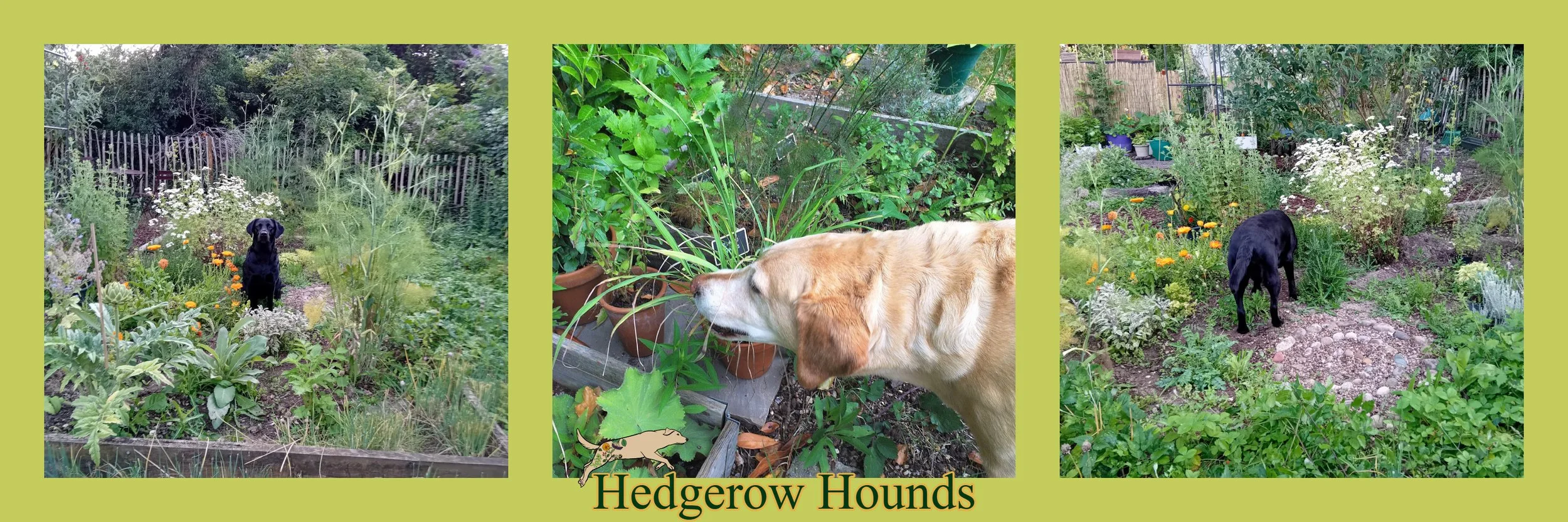
Making the most of your outdoor space and creating a sensory area to enrich the life of your dog.
If you want to learn more about planting a herb garden which will be safe for your dog to explore, sniff, wander through, walk over or even possibly nibble on then here are a few great herbs to get you started. These can be grown in the ground, troughs or pots.
These are some of my favourites:
Barley grass (Hordeum vulgare )
Barley grass is easy to grow in pots, and your dog may well eat the fresh shoots as they appear. It can be quickly grown from seed, and you will find it at most garden centres. It is often called “cat grass”. I usually rotate the grass I grow with wheatgrass, oat grass and lemongrass.
Calendula (Calendula officinalis)
Calendula, also known as pot marigold, is a hardy annual, with the most glorious orange daisy-like flowers that last well into the autumn months. Not to be confused with the summer bedding plant Tagetes, it makes a very effective balm or cream to ease and soothe many skin complaints. Regularly deadhead after flowering to prolong the flowering season.
Catmint (Nepeta cataria)
Nepeta is a hardy perennial with highly aromatic foliage and pretty mauve flowers. It is a huge hit with cats who will often nibble on the leaves and roll on the plant. Catmint is a good choice to plant as edging and looks beautiful spilling out onto a pathway.
Chamomile
Chamomile is a delicate and aromatic herb traditionally used for calming the digestion and nervous system. It can easily be grown in pots or planted into the soil. It will release a beautiful calming scent when your dog sniffs or walks through its leaves and flowers.
Fennel (Foeniculum vulgare)
Fennel is a fabulous herb. The vibrant green and bronze varieties are great if you want to create some height in your herb garden and perhaps disguise an unsightly fence. Fennel grows between 3-5 feet in height and forms long feathery plumes followed by umbels of yellow flowers in the summer and autumn. Every part of this herb smells and tastes of aniseed. It is a nice one for your dog to brush by or walk between if you plant two side by side.
I will often pick some and finely chop it before adding a sprinkle into my dog’s food. You can harvest and dry the seeds at the end of summer for winter use.
Lavender (Lavandula angustifolia)
There are so many varieties of lavender to choose from; the smaller English lavender has a very good aroma, while the flamboyant French lavender with the cute “rabbit ears” petals popping out of the top is very lovely too. There isn’t much difference in terms of scent between them all, so pick whichever variety makes you happy.
Lavender has so much to offer in the enrichment garden as it is evergreen, very fragrant, has a calming aroma, and is beautiful while being a huge hit with pollinators.
Lemon Balm (Melissa officinalis)
Lemon balm has a citrus taste and smell and is traditionally used for calming the mind and gut. Like its cousin, mint, it is very invasive, so ideally needs to be contained in a pot, or it will spread everywhere.
Lemon grass (Cymbopogan citratus)
You can grow lemon grass in pots for the summer, but it is unlikely to survive winter, so you will need to bring it inside. I have known a couple of my dogs to eat the young shoots of lemon grass, which are more tender and have a stronger citrus taste than the older leaves, which can become tough and fibrous as the plant ages.
I usually have wheat grass, oat grass and lemon grass together in pots, should the dogs want to help themselves to the moist shoots.
Mint (Mentha piperita)
There are so many species of mint to choose from, so go with the one you like, but don’t be tempted to plant it directly in the soil, as it will soon invade your entire herb bed. Instead, plant it in a large pot or trough and pick regularly to stop it from becoming tall and leggy.
Marjoram (Origanum marjorana)
Marjoram is such a great but underrated herb. It has a fantastic, strong aroma with pretty leaves, and the variegated variety is particularly nice. It has a dense growing habit and grows fairly low to the ground, a maximum of 50cm tall, which makes it robust enough to withstand paws walking over the top of it.
Parsley (Petroselinium crispum)
Parsley is a must-have in the garden as it’s so versatile. There are flat leaf and curly leaf to choose from, and the flavour is very similar, so stick to the one you prefer. I will often go into the garden and pick parsley, finely chop it and add it to the dog’s meals.
Rosemary (Rosmarius offininalis)
What a joy Rosemary is, with an aroma that cannot fail to lift the spirits. Can you walk past a rosemary bush without running your hands through the leaves and inhaling the scent? I certainly can’t!
It is evergreen, hardy, and has beautiful flowers that pollinators adore. In recent studies, rosemary has also been shown to improve memory. It will grow happily in a large pot or planted in well-drained soil, and there is also a trailing rosemary if you want to use it more as a ground cover plant.
Sage (Salvia officinalis)
Sage is another must-have for the garden. The leaves are soft but also somewhat leathery to the touch, which makes them tough enough to withstand a dog walking over them and survive to tell the tale. There are varieties with blue-green, dark purple, and variegated leaves, adding a bit of colour throughout the autumn and winter months as well. It has a wonderful pungent smell and strong flavour.
Thyme (Thymus vulgaris)
Thyme is a hardy perennial that loves the sun and is tough as old boots. It is another one which only grows to around 60cm in height and provides good ground cover. There are many varieties on sale, and the lemon and orange thymes have a fantastic smell and taste, with the golden thyme adding a splash of colour. Thyme is also another herb that is robust enough to survive dogs walking through it.
Want to learn more?
To learn more about which herbs to plant in your dog friendly garden and enrichment space then my book Canine Enrichment Garden will guide you on how to make a fantastic space for your dog to enrich all their senses.
Or there are paperbacks on the shop to buy. https://www.hedgerowhounds.co.uk/products/canine-enrichment-herb-garden-book
If you prefer an eBook then pop over to Amazon The book is available on Amazon as an e-Book or paperback on the link below: Here is the link https://www.amazon.co.uk/dp/B0FHKYK5T9
Another blog all about the book is here to explore further: https://www.hedgerowhounds.co.uk/blog/canine-enrichment-herb-garden
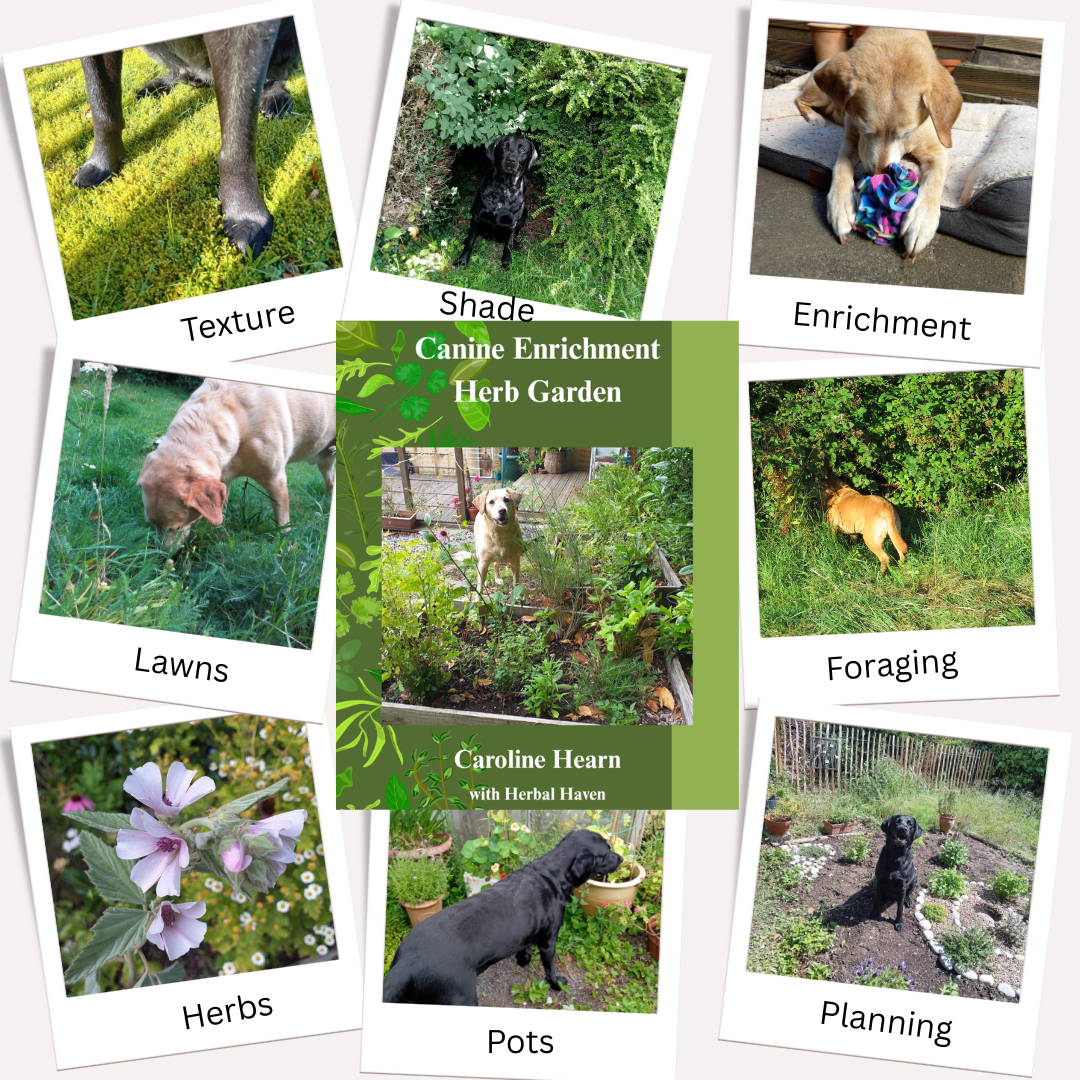
Some of the topics covered within the book.

Emotions and the Gut
The gut is very sensitive to emotions, and I am sure we have all experienced the butterflies in the stomach, stomach cramps, that tight feeling in our guts, or acid indigestion which can come on in a split second when we are nervous, excited, fearful or anticipating a particular event. And our dogs are just the same.
The gut is very sensitive to emotions, and I am sure we have all experienced the butterflies in the stomach, stomach cramps, that tight feeling in our guts, or acid indigestion which can come on in a split second when we are nervous, excited, fearful or anticipating a particular event. And our dogs are just the same.
If this is a brief episode, it is unlikely to have any lasting health effects, if on the other hand, it is a regular occurrence with little respite then the impact on the gut and therefore the health is huge.
There is a major factor in the link between gut health and emotions in the form of the enteric nervous system also referred to as the ENS.
The ENS consists of millions of nerves lining the gut and specialists often call it the “second brain” as it has complex pathways to relay information back and forth from the gut to the brain as they interact.
It is capable of shutting down digestion in times of acute stress such as in a fight or flight situation.
Stress can be caused by many factors such as separation anxiety, excessive ball throwing so the dog is on a constant adrenaline high, inappropriate exercise for the dog’s age or mobility, picking up on the owner’s emotional stress, inability to cope in a noisy or stressful household and pain, illness or disease.
Whilst these are mainly emotionally based reactions that can be witnessed as the dog exhibiting certain behaviours, a poor quality, inappropriate diet, and exposure to toxins or chemicals can also cause the body stress, which may not show any visible signs immediately but develop over time into disease or outwardly noticeable changes in health and behaviour.
A gut that isn`t functioning correctly can manifest as the dog showing anxious, edgy, or reactive behaviour, which in turn triggers the release of stress hormones into the bloodstream such as adrenalin, and in the case of cortisol increases the level of glucose in the blood and will over time adversely affect the adrenal glands.
Time to chill. Having time-out or chill-out days can be very beneficial to anxious, reactive, or even very active dogs, to bring them back into some sort of balance and down from their constantly stimulated state of mind.
A dog that is in a heightened state of fear, stress, panic and self-preservation will not physically be able to process and learn what is being asked of them. So by bringing down their stress levels, they will be in a better frame of mind to learn new skills, cope with their stress, and grow in confidence to make better decisions that are not fuelled by fear.
When dogs are over-excited, anxious or constantly alert to potential dangers their autonomic nervous system releases the fight or flight chemical adrenaline into the bloodstream, over time this becomes very damaging to the whole body and the gut in particular. The other subdivision of the autonomic nervous system is the parasympathetic which is sometimes called the “rest and digest system” and creates calm, relaxation, and a happy gut and this is what we are hoping to nurture on these quiet, restful days.
Anxiety can present itself in many ways, here are a few to look out for:
• Digestion problems - IBS, Diarrhoea
• Over excitability
• Reactive behaviour (aggression)
• Excessive barking
• Noise sensitivities
• Humping
• Resource guarding
• Chewing or scratching the body
• Inappropriate toileting in the house
• Excessive licking
• Ball obsession
• Pacing
There are several products on the shop to help relax and support nervous, anxious, and reactive dogs
Tranquil is an herbal blend created specifically with the nervous, anxious, reactive & stressed dog in mind https://www.hedgerowhounds.co.uk/products/tranquil-relax-calm
Digest & Rest https://www.hedgerowhounds.co.uk/products/digest-and-rest
Other blogs to help stressed and anxious dogs:
https://www.hedgerowhounds.co.uk/news/snuffle-mats-and-balls
https://www.hedgerowhounds.co.uk/news/anxious-dog
https://www.hedgerowhounds.co.uk/news/feeding-raw-bones
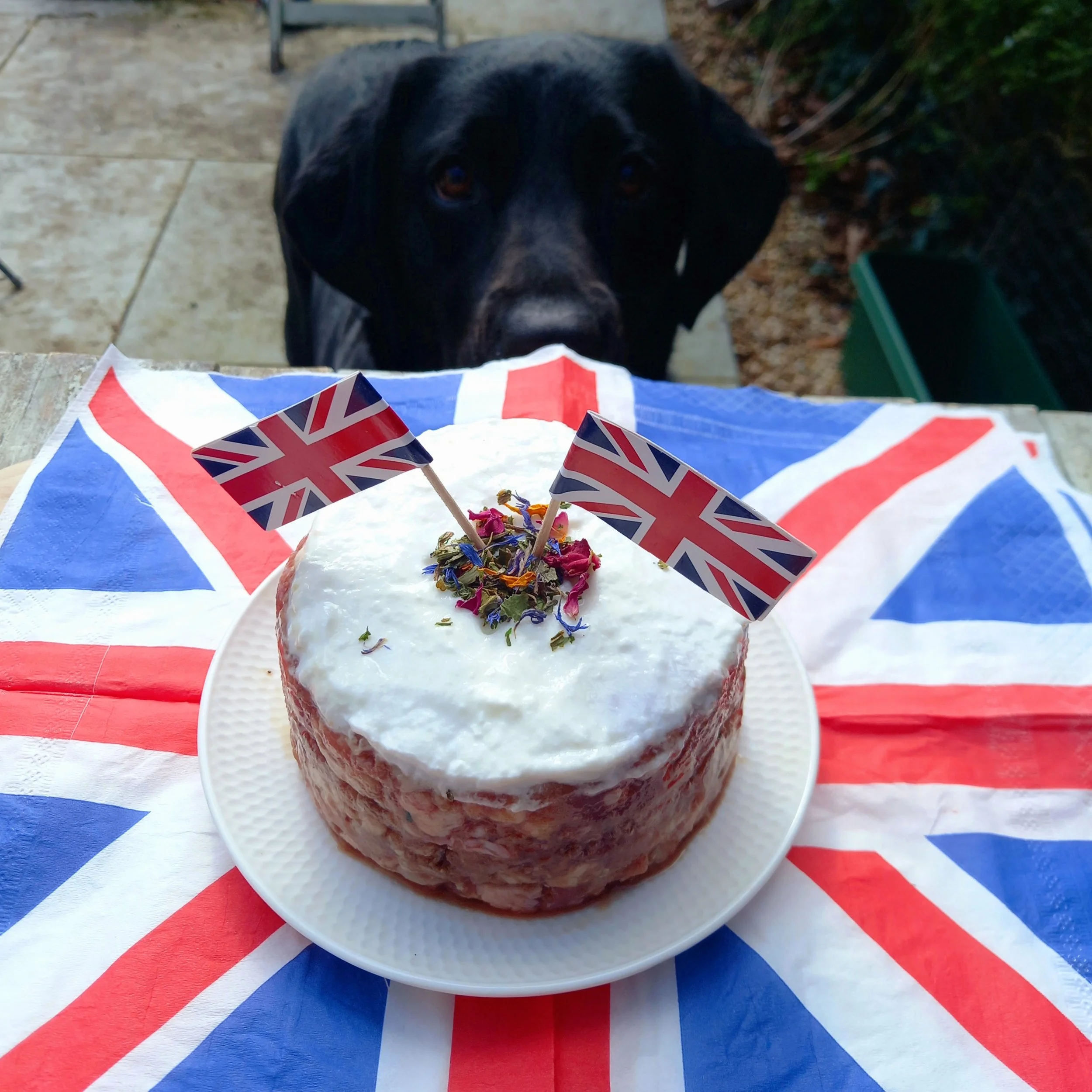
Crowning Glory - The Coronation Blend
A beautiful, colourful blend of herbs, berries and petals to celebrate the Crowning of King Charles III.
Here are some of the ingredients and why they were chosen:
Lemon Balm is uplifting and calming in its nature
Nettle is incredibly nutritious as well as providing comfort for seasonal allergies, ideal as we come into peak allergy season.
Parsley is used to ease intestinal gas and freshen breath as well as offering vitamin C, fibre, calcium, iron and magnesium.
Spearmint A lovely, fragrant herb to lift the spirits, help the respiratory system, ease tummy troubles and bad breath.
Dandelion Leaf Is a natural diuretic, stimulates salivation and improves digestion due to its bitter tasting qualities and makes a great liver tonic in the spring
Calendula The petals have anti-inflammatory properties, are antibacterial and very soothing to all the mucous membranes in the body.
Rosehips & Petals Rosehips are particularly rich in vitamin C and also Biotin which is great for promoting a healthy coat and strong claws. Rose lowers adrenaline levels and helps to balance the hormones. Roses are of course also a symbol of love, commitment and they bring comfort in times of stress, which when you think about it, so do our dogs.
How to use:
You can simply stir a generous pinch (around 1 level teaspoon) into your dogs moist food or if feeding a dry food rehydrate the same amount of herbs with a little warm water, leave for a few minutes , then add to your dogs food.
The “Crowning Glory” blend can be made into a tea using a tea diffuser or natural teabag. Make a brew with a level tablespoon of the herbs, pour on hot water, leave to steep for 5 minutes and then when luke warm, offer to your dog, pour onto their food or use in a treat recipe. You can also use the liquid to blend their vegetables in. The remaining rehydrated herbs can be added to meal times also.


Herbal Dog Tea

A beautiful & fragrant blend of Nettle, Lemon Balm, Chamomile, Mint, Rosehips, Passion flower, Calendula, Rose, Cornflower, Fennel seed
Why the ingredients were specifically chosen for this tea:
Nettle- rich in minerals and contains natural antihistamine properties
Lemon Balm – relaxing & calming
Mint – Refreshing and uplifting and digestive stimulant
Chamomile – calming to body and mind
Rosehips – rich in antioxidants and vitamin C
Calendula – soothing for the skin and has anti-inflammatory effects
Fennel seed – very good for the digestive system
A few ideas of how to use:
The herbs can be used to make a tea which when cool, offered as a refreshing drink.
Make a strong brew and when cool, transfer into shaped moulds and place in the freezer
Add the tea directly into your dogs meals
If you feed vegetables, add to your dogs veg or blend with raw vegetables and freeze in ice cube trays for later use.
Stir some of the tea and a sprinkling of the herbs into natural yoghurt, place into a shallow tray, level out and then pop in the freezer for a couple of hours. You`ll then have a dog friendly ice cream treat for a hot, sunny day.
Once the tea has been made, the remaining herbs, which are now rehydrated, can be placed into your dogs meals or used in treat recipes

Here`s to many relaxing, balmy days in the garden with our beloved dogs.
Top 5 Herbs for Your Dog

For centuries animals have relied upon the medicinal powers of plants to assist in the healing of many aliments. They were instinctively drawn to herbs, grasses, seeds and roots in woodland and open ground to help everything from parasite control to intestinal discomfort.
Adding fresh, homegrown herbs to your dog’s meals can provide many benefits. They offer a gentle, cleansing and balancing effect to the body, provide phytonutrients and fibre, which in turn benefit the gut bacteria and add moisture to the diet of dogs that are fed dried food.
If you can pick a few herbs then immediately prepare and add them to your dog’s food, the nutritional benefits will be at their peak. Fed like this even a little goes a long way.
The herbs and wild ingredients mentioned below can be brought as young plants, sown as seeds, or foraged for.
Even a sunny windowsill or balcony can be used to grow a few herbs. They just need a little well drained soil, water, some sun and a bit of care to give you a huge amount back.
Here are some of my favourites, which you can enjoy yourself and share with your dog.
Parsley
If you only have room for one herb, then parsley would be the one.
The most common varieties are curly and flat leaf, and the leaf, stem and root can be used. The flat leaf parsley is more closely related to the wild species.
It is traditionally used to support digestive and urinary tract issues and as a breath freshener. It is high in antioxidants such as beta-carotene and lycopene which help fight inflammation and used to support arthritic conditions.
Parsley is rich in vitamin A, C, B1, B2, K, calcium, riboflavin, potassium, iron, magnesium, manganese, niacin, phosphorous, fibre and chlorophyll.
Very finely chop the leaves and stalks or add into a blender with your dog’s normal vegetables. As a rough guide my Labradors would have a heaped tablespoon each, added in with their vegetables most days over the Summer.
Thyme
Thyme has antimicrobial, expectorant and astringent qualities and can help soothe a cough or cold by loosening mucus.
Thyme has quite a strong flavour and aroma compared with the other herbs listed, so would be used a little more sparingly. This is one to introduce initially in tiny amounts to see if your dog likes the taste. They may however just enjoy the scent if you crush a few leaves and then offer your hand to sniff if they wish. The stems are generally too woody to use so just pick off a few of the tiny leaves instead.
Dandelion
The humble dandelion is not only a friend to pollinators it is also a very good addition to our own and our dog’s diet.
The leaf has affinities with the liver, gall bladder and kidneys and act as a gentle blood cleanser, laxative and bitter tonic. Bitter tasting ingredients promote salivation which in turn improves digestion. Traditionally dandelion would be used alongside burdock root for a powerful combination.
The leaves are a rich source of vitamin A, D, K, B complex, Iron, Manganese, Phosphorous, Potassium and the flowers are a good source of Lecithin.
We can add the leaves and petals to salads or use in the same way as spinach. In spring and early summer, I pick and wash dandelion leaves and add to the dog’s vegetable blend, along with parsley, courgette, chard and a few lettuce leaves. This is all put in the blender with a tiny splash of water and whizzed to a thick smoothie consistency and makes up to 15% of the meal.
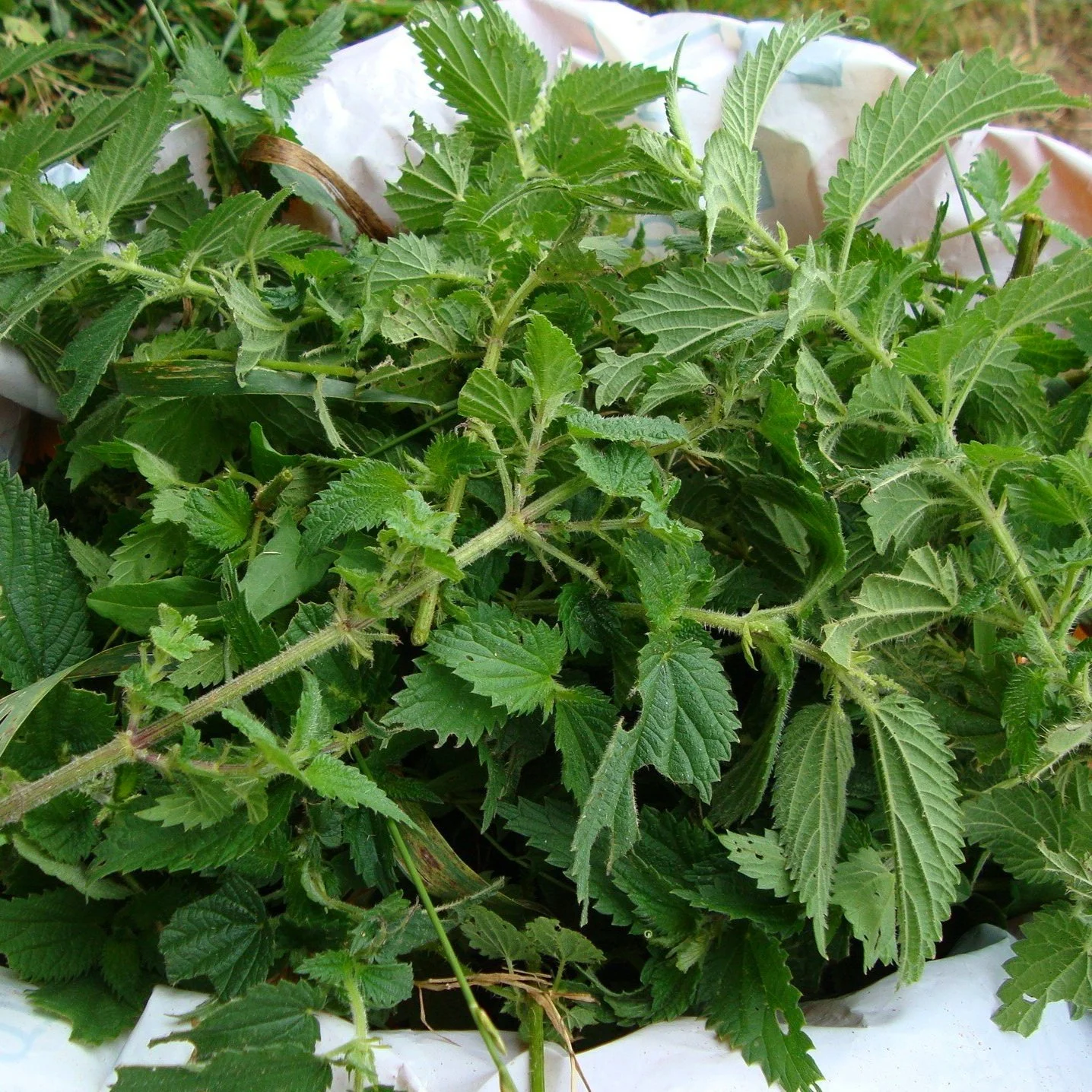
Nettle
The nettle is seen as “the enemy” to many gardeners, yet it not only provides a haven for wildlife it is also packed with nutrition and makes fantastic teas, soups, and pesto.
Rich in Iron, vitamin A, C, D and B complex, Silica, Calcium, Phosphorous, Magnesium, Beta-carotene and Potassium.
Only the tops of the nettles should be picked and used from early spring to around the end of May. As the plant matures it develops tiny crystalline particles which irritate the urinary tract and kidneys.
Nettles have natural antihistamine properties and can also be used as a coat rinse.
The process of drying or cooking the nettles neutralises their sting, although you will need gloves in order to pick them or they will definitely fight back!
Picked nettles can be dried for a couple of days on paper in the sun or if the whole stem is cut, hang upside down to dry in small bundles and just use the leaves from the tips. Once dried you can crumble them easily with your fingers.
Fennel
Fennel is similar to dill in its appearance but has a strong aniseed scent and grows large fennel bulbs. The delicate, feathery leaves, seeds and root can be used and primarily taken to improve digestion, ease bloating, reflux, mild tummy ache and increase milk flow in nursing mothers. It is rich in vitamin C, A, calcium, iron and potassium.
Safety:
When harvesting any herb or wild ingredient there are a few things to consider so you can safely use them.
Firstly, it is essential to be able to accurately identify what you are picking. This can take a little time and the use of a good identification book is extremely helpful.
Always forage away from roadsides and arable crops, which will no doubt have been sprayed with chemicals or exposed to pollutants.
Caroline Hearn MICHT. Dip ICAT. MIAAT
Canine & Equine Sports & Remedial Massage and Holistic Therapist
ADDING FRESH FOOD TO THE BOWL
Peak health starts with good nutrition, here are a few ideas to get you started
It is important to have fresh food in our diets in order to reach optimal health and the same goes for our dogs too.

There are a number of ways you can increase the nutritional value of the food you are feeding your dog. It is also an ideal way of starting to introduce fresh food if you are thinking of changing over to either a raw or home cooked diet.
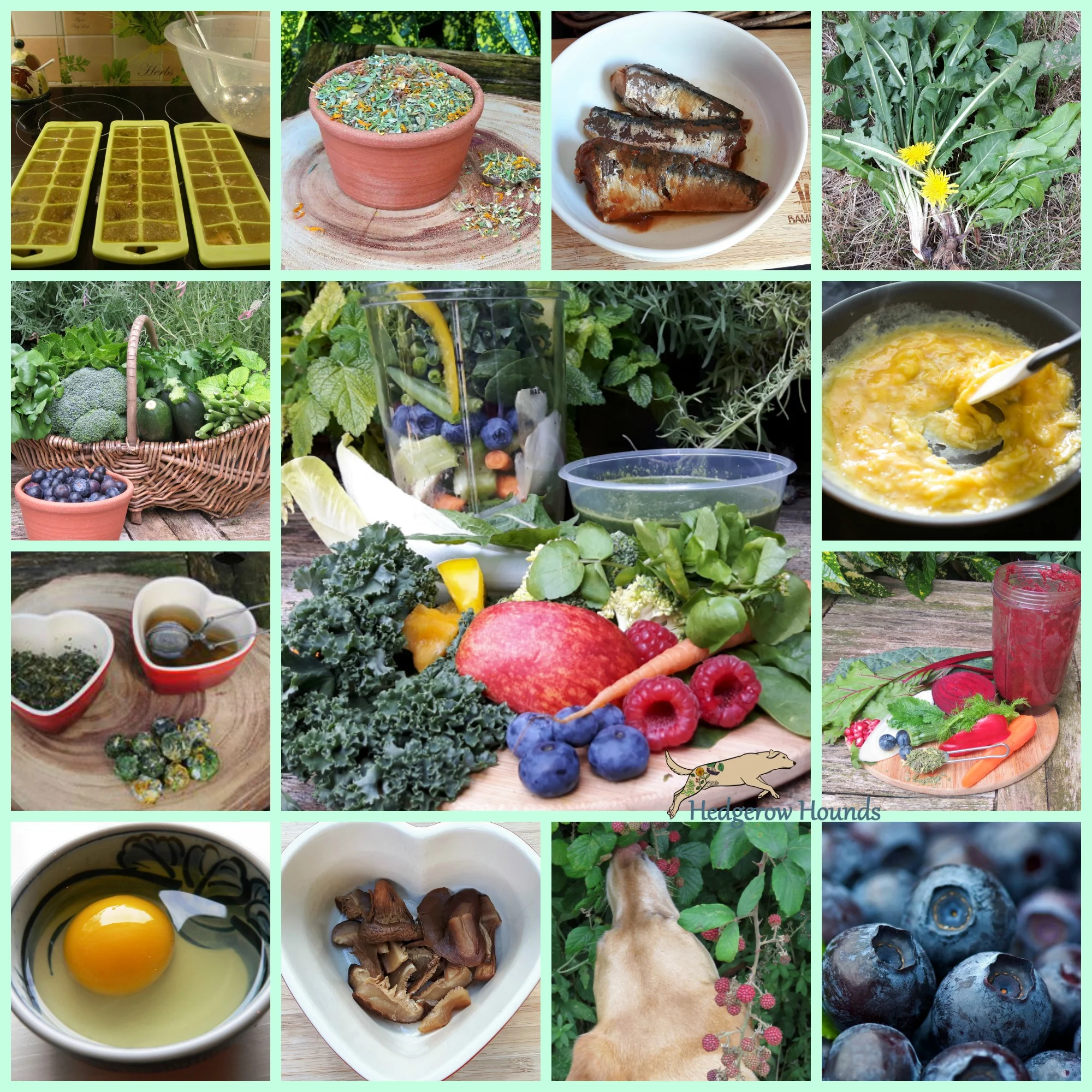
Starting from the top left photo (clockwise) shows homemade Bone Broth which can be frozen in ice cube trays. It is a great source of glucosamine and chondroitin for joint health and very soothing for the gut.
The Hedgerow Hounds herbal blends are a quick and easy way to add a vast array of vitamins, minerals, antioxidants and fibre. They are of the highest quality and have been approved by our holistic vet. There is a blend to suit every dog and every season throughout the year. They can be fed dry, re-hydrated or as a tea. Great to use in your treat recipes or in a vegetable smoothie.
Oily fish is a real treat for some dogs but others are not so keen. If they don't like raw or lightly cooked fish then tinned mackerel or sardines will still provide a good source of Omega 3 fatty acids. Most dogs love these and they are perfect to have in the store cupboard.
Throughout the year there are a number of wild growing ingredients you can pick for your dog such as a few dandelion leaves, cleavers, chickweed, rosehips and blackberries. These can be added to their vegetables or treat recipes. Just make sure you always know exactly what you are picking and it is from an area free of traffic pollution and agricultural sprays.
Eggs - Either raw or very lightly cooked will provide a huge range of nutrients all in one perfect package. Talking of the shell, the inner opaque membrane can be removed and fed, providing extra nutrition for joints and ligaments.
If you want to add vegetables and berries to your dogs meals then a good way to do it is by making a smoothie which will assist the digestion of vegetables by breaking down the tough cellulose wall that plants naturally have. The ingredients shown are packed full of anti-oxidants for a real boost to health and the immune system. Make a tea with one of the Hedgerow Hounds herbal blends and add that to the veg before blitzing in a blender. The inclusion of pulped vegetables also adds welcome moisture to dry food.
You can set aside some vegetables when you are preparing your dinner and either blend or steam them to add to you dogs meals. Broccoli stalks, green beans, courgette, kale are all good choices rather than starchy root veg. Rotate the vegetables fed and include seasonal variations.
In Autumn you can pick your own blackberries or my dogs actually help themselves from the low branches. Freeze some for later in the year or you can add a few blueberries or raspberries for a vitamin C boost.
Medicinal mushrooms such as Reishii, Shiitake, Chaga, Coriolus have immune bosting and anti inflammatory properties and recent studies have shown them to have positive anti- tumour benefits. If you cant find fresh then the dried versions can be re-hydrated with hot water.
Kibble, tinned and home cooked meals can be improved on by adding a few berries, soaked seeds, Hedgerow Hounds Herbal Blends and vegetables. Little changes at the speed your dog can easily adjust to is a big step in improving the health and wellbeing of our dogs.
www.hedgerowhounds.co.uk
