
SEASONAL FEEDING - Making the Most of Fresh Ingredients
The majority of people have lost their connection with the land, nature and the changing seasons.
Natures larder provides us with a huge variety of produce at the perfect time when it will be of most benefit to us nutritionally. With a few small changes we can all benefit from eating seasonally which is better for us, our dogs and the environment.

Spring, Summer, Autumn and Winter, seasonal feeding at its freshest and finest. Featuring Hedgerow Hounds seasonal herbal blends.
The majority of people have lost their connection with the land, nature and the changing seasons.
Natures larder provides us with a huge variety of produce at the perfect time when it will be of most benefit to us nutritionally. With a few small changes we can all benefit from eating seasonally which is better for us, our dogs and the environment.
We can utilise herbs and vegetables in the Spring, which are a perfect cleansing tonic to gently ease us out of the long winter months, where we have no doubt been overindulging and less active.
To the cooling and hydrating bounty of Summer, followed by the real bumper harvest of Autumn, which gives us all the foods we need to help boost our immunity and general health in preparation for the cold Winter months ahead.
Here at Hedgerow Hounds, we are passionate about seasonal ingredients, and if you really want to embrace seasonality, then we have a seasonal range of handmade herbal blends.
What`s so special about seasonal food?
Eating more seasonally ourselves and by including some of these foods in our dogs’ diet, we can benefit in so many ways.
. We can reconnect with the cycles of nature and really appreciate the food that is available for a short period of time.
. It is better value for money as well as kinder to the environment, to buy ingredients when they are in abundance locally and haven’t travelled halfway round the world before they even get to our kitchen.
. We can support the local communities, such as small producers, farmers’ markets, organic growers, and game dealers.
. The produce is fresher and therefore more nutritious as it is harvested when ripe or at its best, and has minimal travelling time before we can purchase it.
Could we survive without sugar snap peas from Egypt, asparagus from Peru, and eating Strawberries in January? These have travelled thousands of miles, are harvested unripe, and sprayed with chemicals, gas, or wax to stop them from deteriorating in transit.
Or could we wait until they are ready to eat locally and benefit from much more flavour and far higher nutritional value, while enjoying so many other foods in the meantime?
How does incorporating seasonal food benefit our dogs?
If you feed raw or home-cooked food to your dog, then it is important to offer a good variety of foods over the coming months. If you feed dried or tinned food, it is also possible to start incorporating a small amount of fresh ingredients into the bowl at feed times.
By offering variety, you can ensure your dog gets a broad range of nutrients and avoid the intolerances that can occur if the same protein and carbohydrate are fed continuously.
A wide spectrum of fresh ingredients, either animal proteins or of plant origin, nurtures a healthy gut microbiome, which is vital for a healthy immune system and overall optimal health. The more diverse the diet, the less you will have to rely on supplementation.
By feeding what is in season, you are providing food at its very best. This often means that you don’t need a large amount to benefit from the superior nutritional value.
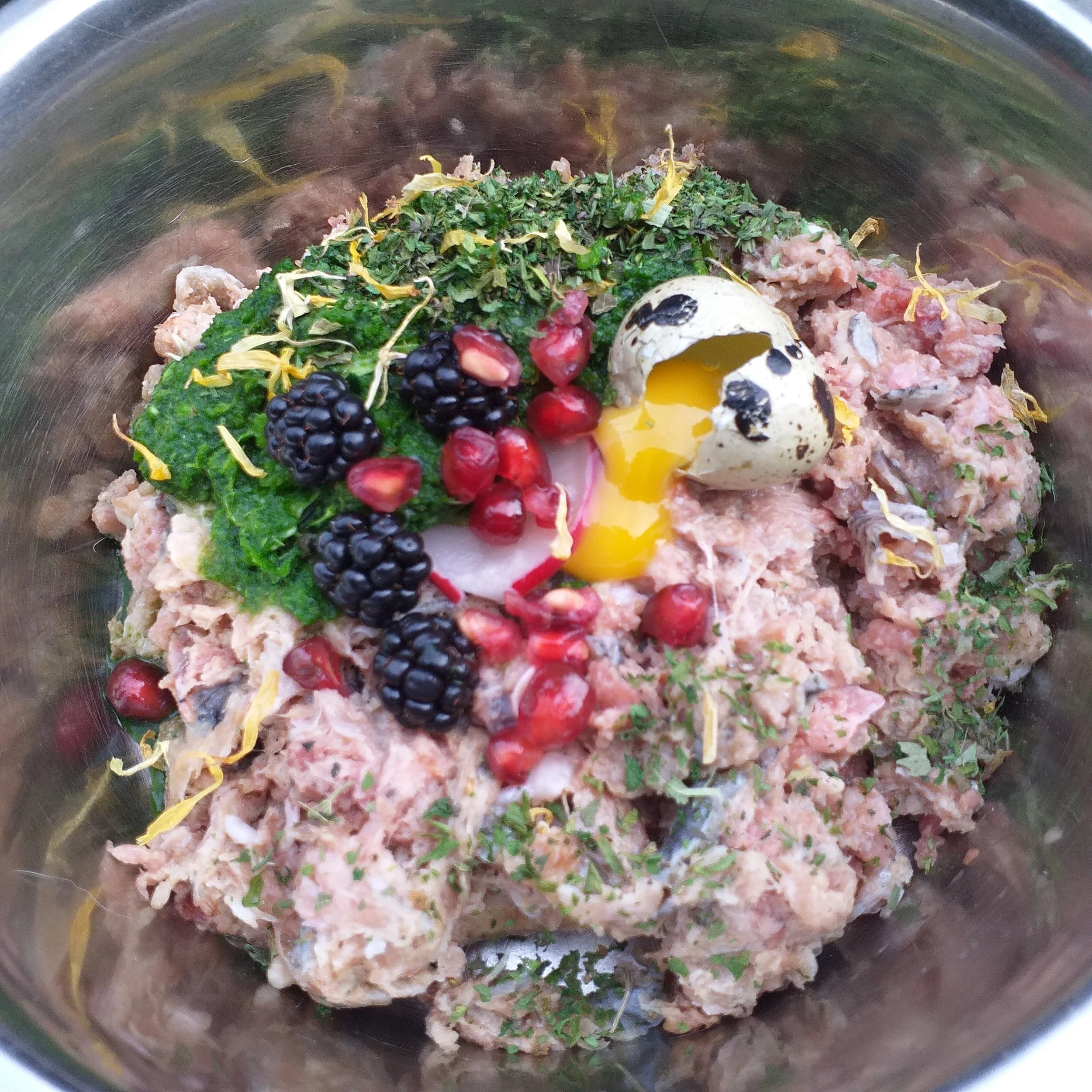
A few local, handpicked ripe blackberries added to the food will be far superior to a larger number of blueberries that have covered many air miles. Including some free-range, wild, or organic meat whenever you can will also provide your dog with superior-quality ingredients.
Depending on your location, there is generally a good range of proteins available from Spring to Summer, but when Autumn comes, there is suddenly a whole new larder available to the raw feeder or home cook.
The game season varies by the species, but generally partridge and pheasant are available from September until February. Venison is dependent on breed, but around November to March, and Duck from September until January.
If you have been relying on beef, lamb, chicken, and fish from March until August, then this addition of free-range, often organic and minimally farmed protein is a huge bonus. You can either use in addition or temporarily replace the proteins you regularly use until the availability ends.
Putting a small amount of vegetables aside for your dog when preparing your own is a good practice. It will soon become second nature to save a broccoli stalk, steam a little extra courgette, cut off a small slice of pear or apple, or lift out the couple of squashed raspberries that are in the bottom of the punnet for your dog’s supper. You will also start to look out for seasonal bargains at the butchers’ or farmers’ market.
If you can forage for ingredients such as blackberries, dandelion leaves, cleavers, and either keep a few hens or find a local organic supplier of eggs, then that is a big win.
Adding a little fresh, local, and seasonal produce even two or three times a week will help to gradually improve your dog’s overall diet. If your dog is new to fresh ingredients, start off with very small amounts and include one new addition at a time, until they adjust to a different way of eating.
As a rule, although each dog is an individual, the majority of the meal is made up of animal protein, with anything from 5% to 15% being provided by vegetables and berries that are suitable for your dog.
Spring
Spring ingredients offer a gentle tonic to cleanse and wake up the system after less active months and a diet of heavier, warming meals. Many of these ingredients that come into their own now offer support for the kidneys, liver, and lymphatic system that can often get sluggish over the Winter months. You may observe that your dog seeks out the fresh grass shoots as they appear, which are full of energy, sweetness, and moisture.
The Nature’s Skin Tonic is perfect for a gentle Spring cleanse after the long winter months and also great for dogs that are itchy and suffer from seasonal allergies at this time of year.
Incorporate some of the following into your dog’s meals:
Spring nettle tops, Cleavers, Dandelion leaf and root, Asparagus, Watercress, Milk Thistle, Spring Greens, New season Lamb, Rabbit & Free range eggs.
Summer
Summer ingredients are cooling, hydrating, and uplifting, and we are spoilt for choice at the range of produce available. If you can grow a few vegetables yourself, such as courgette, cucumber, spinach, salad greens, chard, and parsley, then these will be bursting with flavour and goodness, and you can add a little of these freshly picked ingredients to your dog’s food. If you grow blackberries and raspberries, you will find that the dogs often help themselves to the fruit from the lower branches.
Nature’s Bounty appears on the shop in February and covers the Summer months until early November. It is a nutritious blend that contains an organic seaweed, and Bounty’s main task is to naturally repel fleas and ticks, which it has successfully done for many years.
Incorporate small amounts of the following:
Fennel, Melon, Spinach, Celery, Blueberries, Bilberries, Raspberries, Dandelion, Seaweed, Sorrel, Courgettes, Mint, Parsley, Calendula, Cucumber, Green beans, Carrot tops, Lettuce, Rabbit, Free range eggs.
Autumn
Autumn provides nourishing produce to prepare for the colder months and are typically rich in antioxidants and high in vitamin C. Many of these vegetables, fruits, and berries also lend themselves to preserving by the process of dry storage, freezing, and fermentation, which would traditionally be used to ensure a supply of nutritious foods through the lean months of Winter that lie ahead:
Incorporate small amounts of the following:
Squash, Blackberries, Rosehips, Beetroot, Pumpkin, Apples, Pear, Burdock root, Chicory, Nettle seeds, Fennel and Dill seeds, Almonds, Pumpkin seeds.
Game meat to include: Partridge, Pheasant, Grouse, Pigeon, Guinea fowl, Quail, Venison, and Duck.
Fish, including Pollack, Mackerel, Coley, and Haddock.
Winter
Winter provides us with comforting food for warmth and sustenance.
Incorporate small amounts of the following:
Ginger root, Turmeric, Kale, Celeriac, Thyme, Ruby Chard, Brussels sprouts, Winter Squash, Jerusalem artichoke, Pear, Russet apple, Turkey, Duck, Venison, Mussels.
Caroline Hearn MICHT, Dip ICAT. MIAAT
Equine and Canine Sports Massage Therapist and Canine Holistic Health Specialist
Find out more at www.hedgerowhounds.co.uk
Instagram hedgerow_hounds Facebook @HedgerowHounds
Styles of Raw Feeding
There are a number of ways to feed your dog a raw food diet. Here we explore the different styles and what will suit your dog and your own lifestyle.

There are several different ways to feed your dog a raw diet.
For some people it is personal preference, what suits their individual dog or what can be fed due to the availability of certain ingredients.
BARF
The most popular way to feed a raw diet is the BARF method which stands for Biologically Appropriate Raw Food or Bones and Raw Food.
Many barf complete meals add seasonal vegetables and include supplements so be mindful if you are also adding supplementation to these meals that you are not giving an excessive amount or doubling up on one particular supplement.
They tend to follow the percentage of 70% muscle meat, 10% raw minced bone, 10% offal (5% of which is liver) and 10% vegetables although there are variations within the brands some of which omit offal altogether and others will include 20% vegetables.
It may be a case of trial and error until you find a brand that suits your dog. Most of the raw manufacturers now offer a large range of proteins making it easy to rotate the type of meat and offer a good variety.
Barf meals are usually packaged in convenient tubs or tubes and are simply defrosted and served. This is a good way to feed if the owner is hesitant to handle raw meat or alternatively there are raw meals provided in the form of sausages which are simply lifted out with a fork directly into the bowl.
80-10-10: You can buy ready made complete meals with an 80-10-10 ratio in which 80% is muscle meat, 10% raw minced bone and 10% offal.
80-10-10 is a good choice it you want to either omit vegetables or have the flexibility to add your own.
Prey Model Raw (PMR) or Whole Prey: Prey model feeders try to replicate a very natural diet and will often not add any vegetable matter. Typically, the diet follows 80% muscle meat, 10% whole raw bone, 10% offal (5% of which is liver) The muscle meat tends to be offered in large whole pieces rather than a mince. When using the whole prey method an entire prey animal is fed such as a rabbit, quail, fish, pigeon or chicken etc which has the fur and feather left on to add to the ration. It can be difficult to source many different types of whole prey in order to add variation and not every dog will eat this way.
DIY: This can be the cheapest way to feed a raw diet but it does require additional research in order to get the correct ratio of meat, bone and offal plus a reliable source of ingredients in order to rotate the proteins and provide a broad range of nutrients. Making up your own meals gives flexibility and can be useful for dogs that need certain proteins omitting from their diet due to intolerance and sensitivities, but it is important to seek advice in order to provide all the essential nutrients that your dog needs to thrive.
Caroline Hearn ISCP.Dip.Canine.Raw.Nutrition, Dip ICAT