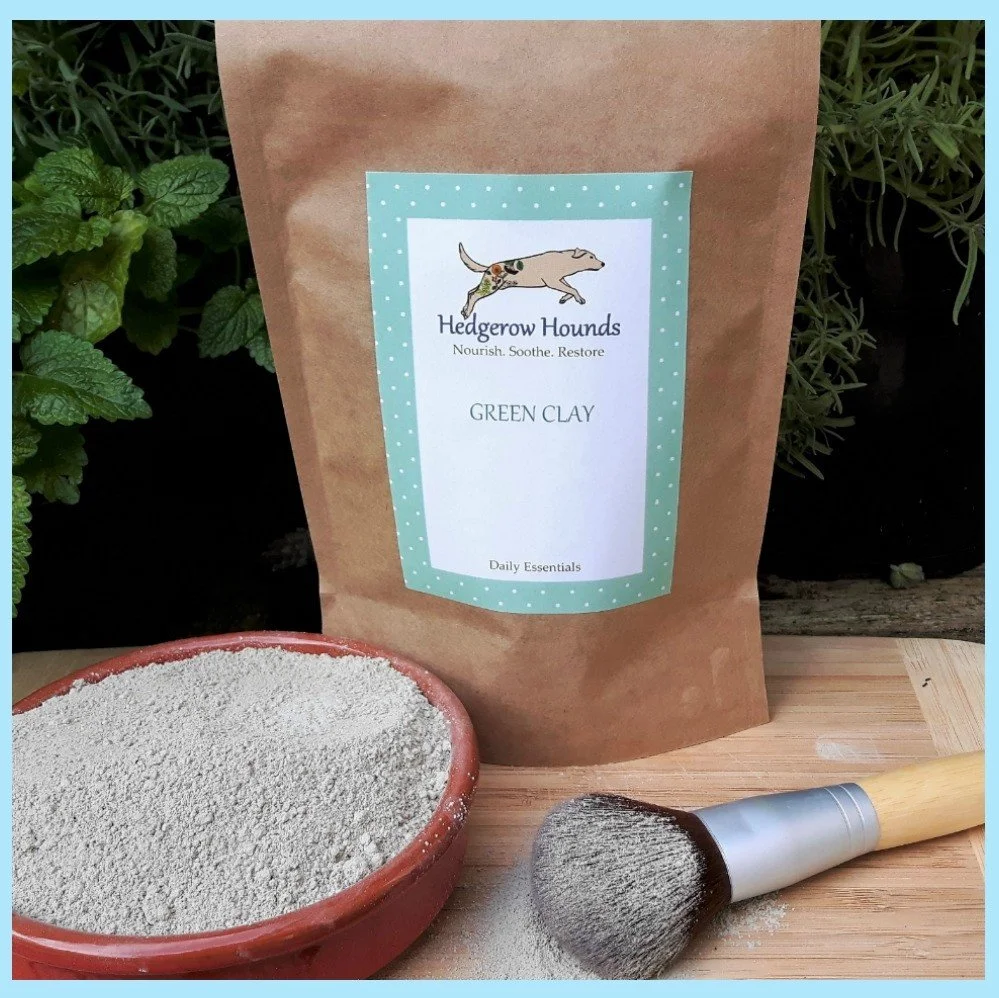
GREEN CLAY Powder - For Pets
There are so many uses for pure Green Clay. Used wet or dry, it is an absolute essential in my natural first aid kit for all the family, both four and two legged!

Our high-quality, pure Green Clay is a must-have for your natural first aid kit. Now available in a 250g bag or 650g bags for multiple dog households, horses & livestock.
Green Clay has excellent drawing properties, so it can be used for drying up wet eczema and hot spots and helping control infection in wounds and abscesses. Green Clay is so versatile and can be used for dogs, cats, horses, sheep, and other livestock. It forms a protective layer over injuries and also naturally repels insects. I have found that when treating horses and livestock that are troubled by flies, a drop of tea tree or lavender essential oil into the wet clay can further aid in repelling flies from the treated area.
It has a calming and soothing effect on a dog’s itchy or traumatized skin, breaking the itch-scratch cycle. It is completely safe if your dog accidentally licks or consumes it. The clay’s perfect partner in dealing with wounds, sores, and fragile skin is Leucillin; they complement each other brilliantly.
Green clay can be made into a thick paste with a little water and spread onto the affected area. This acts as a protective barrier for sore or fragile wounds and as the clay dries, moisture is drawn away from any wet areas of skin.

Perfect for all livestock and can be used wet or dry. A persistent wound which refused to heal, mostly caused by fly annoyance, was kept clean and protected by using the clay as a thick paste.
If used dry, it can be applied with a clean cotton ball and dusted onto the area or with a small, clean brush. This is particularly useful for instantly calming an inflamed area or itchy rash. Click here to view it on our product page: https://www.hedgerowhounds.co.uk/products/green-clay
For infected areas or those that are oozing the area should be cleaned in between applications. An excellent product for this is Leucillin antiseptic spray or dropper bottle.
This product should not replace veterinary treatment if it is needed or if a serious infection is present in a wound.

Winter Care for Your Horse - The Holistic Approach
Horses are trickle feeders and designed to have forage passing through their gut most of the time. Eating hay, not only provides warmth, as it ferments in the hind gut, but also reduces the risk of colic and gastric ulcers.
Caring for horses over the winter months brings many challenges, not least copious amounts of mud, frozen taps and bored horses confined to their stables.

Here are a few helpful tips while we eagerly await springtime, which also comes with its own issues, but that is another story!!
Forage & Hard Feed: Horses are trickle feeders and are designed to have forage passing through their guts for most of the time. Eating hay not only provides warmth, as it ferments in the hind gut, but also reduces the risk of colic and gastric ulcers.
Varying the position and ways in which hay is fed in the stable by tying haynets in different locations and also placing hay on the ground or in trug buckets, allows the horse to stretch down in a natural grazing position rather than constantly pulling at haynets, invariably from one side, causing muscle imbalance and soreness.
Senior or dentally challenged horses can still get plenty of fibre by feeding the soaked hay replacer, this tops up hydration levels too. It also provides some variation to any horse’s diet if they are confined to the stable for most of the day.
If your horse lives out then it may be necessary to provide hay, particularly if there is snow on the ground. If there are multiple horses then ensure there are more piles laid out than there are horses, as one horse can guard many piles at once, causing fights or stress to others.
If the horse is not being worked then the hard feed will need to be reduced and more fibre added to the diet.
Water is a particularly important consideration in the wintertime and especially for the stabled horse. Adequate hydration is essential for normal digestion and how the food moves along the gut. Limited water intake can increase the risk of impaction colic.
To encourage drinking and correct levels of hydration, make sure all troughs are clear of ice, top up indoor buckets with hot water, include un-molassed soaked sugar beet in the feed and offer steamed or soaked hay.
If your stable has automatic drinkers, put a bucket of water in as well so you can monitor the horses drinking. As a guide, a 16-hand horse will require a minimum of 6 gallons of water a day. Having free access to a salt lick is also helpful.

Providing ample clean water is just as important in Winter as it is in Summer.
Exercise: Some horses spend huge amounts of time confined to a stable, dependant on their owners to ride or turn them out in a paddock. Even if your horse has daily turnout, the winter months can mean, due to floods, mud, snow and ice, that turn out is either impossible or very limited.
Movement is needed for efficient digestion, to aid circulation, maintain muscle tone and normal joint function.
If you are lucky enough to have a school then you can probably keep on riding if the surface allows or certainly work the horse in hand on the lunge or better still long reins. Allow more time for warm up before moving onto trot and canter to prevent injury.
In hand walking is very valuable and you can allow the horse to pick at some grass and weeds and stretch their heads and necks down if they spend a lot of time eating from raised mangers and haynets. Two or three short wanders a day will also break up the monotony if they are stuck in due to the weather. Make sure the conditions underfoot are safe and clear any areas of snow and ice.
Boredom: Horses are social animals that are evolved to move, and in the wild will often cover 20 miles in a day within a herd. They are foragers, browsers and capable of forming close friendships and many are kept in an unnatural environment which is geared more towards what is convenient for us rather than what is best for them.
Horses do suffer from depression and boredom if they can’t carry out some of their normal behaviour. This can be more so in the winter months as their routine changes.
We can help to relieve boredom in several ways. Including making more daily visits to them or arranging a rota with other liveries, so each horse gets attention, a treat ball or small section of hay placed in the stable. Some horses love having the radio on, classic fm is a good one, calming music and some talking seems to be a good choice.
Picking grass, herbs such as cleavers (great for lymphatic circulation) dandelion leaves (urinary health) and tucking them in the hay can add interest as can hiding carrots, parsnips and apples tucked into haynets. Swedes hanging from string can provide hours of entertainment too.

The new Hedgerow Horse seasonal blend is ideal to replace the herbs, berries and seeds that the grazing horse would normally forage for. It is available on the Hedgerow Hounds shop.
Hedgerow Horse has a seasonal range of herbs including an Autumn-Winter blend called Foragers Harvest which provides herbs and berries that a horse would naturally forage for if they had free access to them.

Horses can form lasting friendships with field companions and will miss the interaction when confined to a stable.
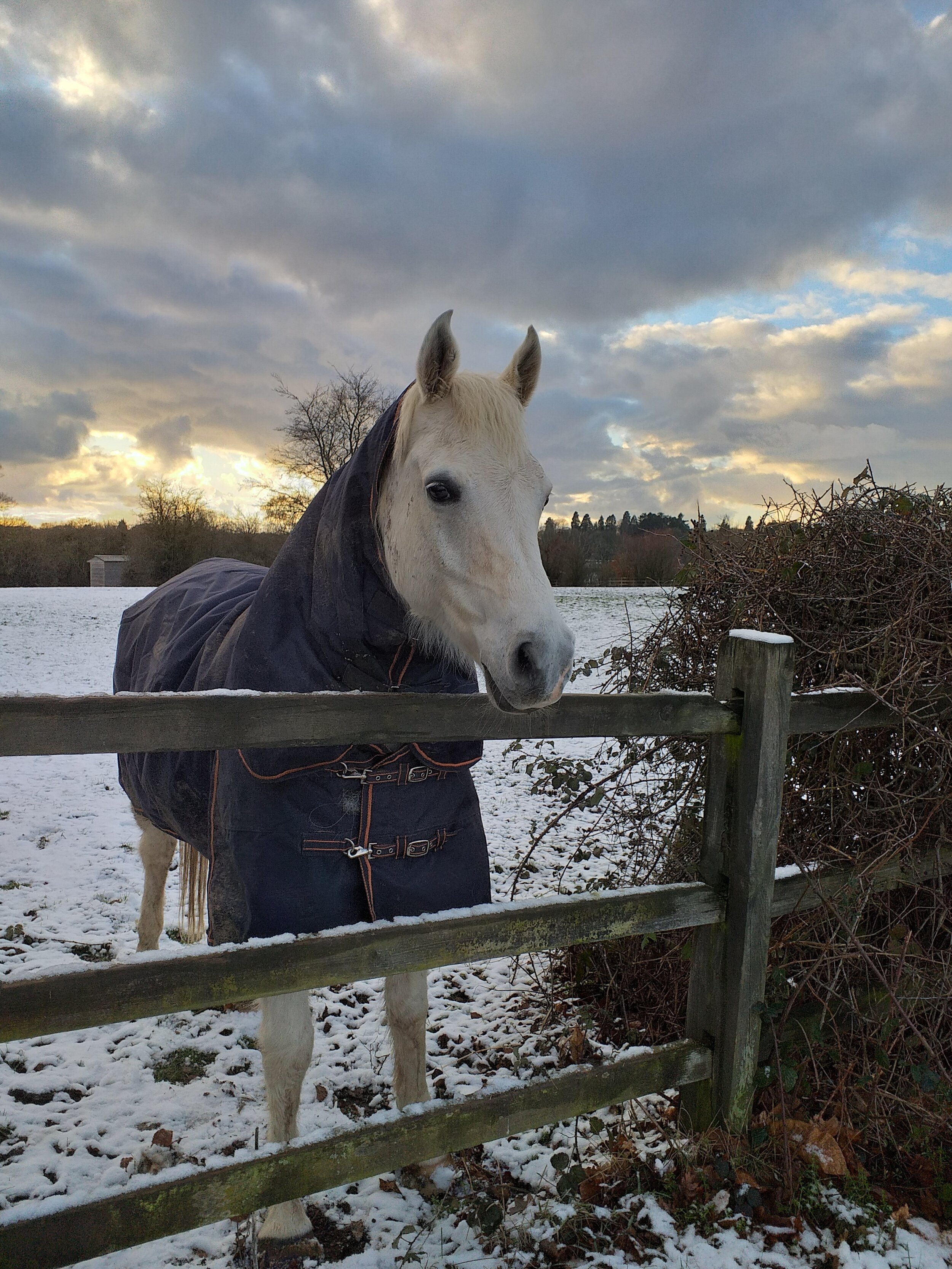
Rugs: It is important not to over rug your horse. Horses that are clipped, underweight or elderly will benefit from wearing an appropriate rug, both in the stable and also when out in the field. Make sure any rugs used are comfortable and fit well, but also remove them everyday to check they are not causing sores, particularly over the wither area. This is also a good opportunity to evaluate the overall bodily condition of the horse.
Skin issues: Unfortunately winter conditions are not kind to the skin. I have found Leucillin and Green Clay an absolute godsend for treating mud fever, minor injuries, skin complaints and preventing infection taking hold. A must have for your winter first aid kit. Both can be found on the Hedgerow Hounds shop with details on how to get the best out of using them.

Green Clay, once tried you will never want to be without it. Perfect for horses, dogs, cats and all livestock.
Hang on in there Spring is just around the corner !!
Find out more at : www.hedgerowhounds.co.uk
The Facebook page @HedgerowHorse
Or on Instagram hedgerow_horse