Skin Care Essentials
Caring for our animals in Summer & Winter brings many challenges, not least trying to maintain a healthy skin, avoiding sores and cuts and effectively dealing with skin abrasions that can occur.
There are four products that I wouldn`t be without at any time of the year but they really are an essential in the colder and wetter months in order to quickly deal with any issues and prevent infection taking hold.
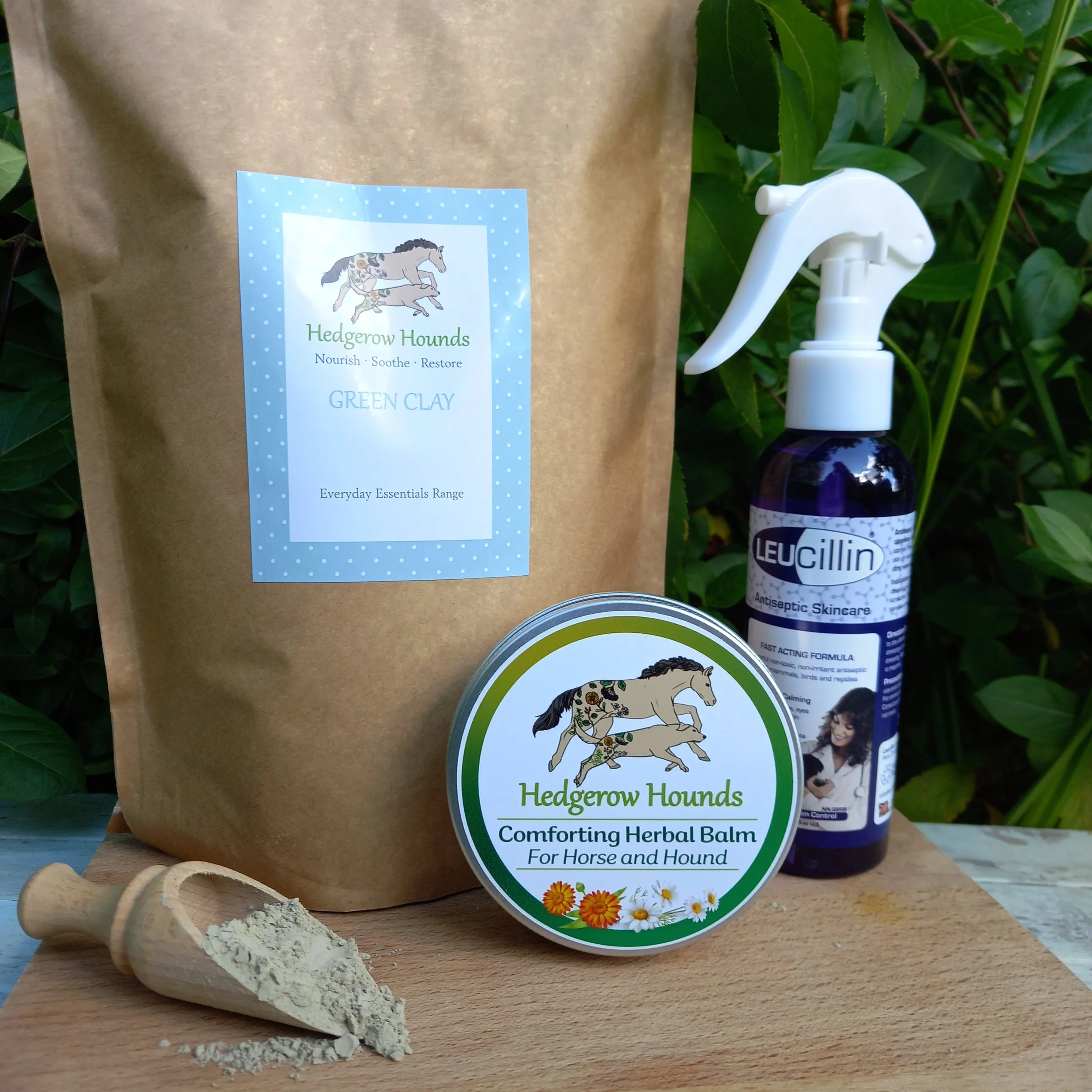
GREEN CLAY has excellent drawing properties so can be used for drying up wet eczema and hot spots and helping control infection in wounds and abscesses. Green Clay is so versatile and can be used for dogs, cats, horses, sheep and other livestock. It forms a protective layer over injuries and also naturally repels insects. I have found when treating horses and livestock which are troubled by flies, a drop of tea tree or lavender essential oil into the wet clay can further aid in repelling flies away from the treated area.
Used dry, it has a calming and soothing effect on a dog’s itchy or traumatised skin, breaking the itch, scratch cycle and is completely safe should your dog accidentally lick or consume it. The clays perfect partner in dealing with wounds, sores and fragile skin is Leucillin, they compliment each other beautifully.
Green clay can be made into a thick paste with a little water and spread onto the effected area. This acts as a protective barrier for sore or fragile wounds and as the clay dries, moisture is drawn away from any wet areas of skin. It is now available in two sizes (250g & 650g bags) on the shop https://www.hedgerowhounds.co.uk/products/green-clay
Leucillin Is an extraordinary product that I have to hand at all times. It works wonders on so many skin issues, wounds, cuts and scrapes as well as an effective and kind skin cleanser, with the added bonus that it doesn`t sting on application. It also makes a brilliant hand sanitiser!
It is available in four sizes from the small dropper bottle which is ideal for use to cleanse eyes, for tiny animals or those that are very scared by the sound of sprays, to the large 500ml spray which is great value for larger animals such as horses or livestock or a multi dog household.
Leucillin contains the active ingredient Hypochlorous, this is a naturally occurring chemical in the body produced by white blood cells. Hypochlorous is one of the most effective and efficient biocides known to man. Whilst being totally safe, it is 300 times more effective than bleach and is almost instant in its effect. Hypochlorous is a natural chemical already existing in the body, so animals that have shown a sensitivity with other products in the past, will not suffer any adverse reactions to Leucillin. It`s 100% safe to use on sensitive areas such as, cuts and open minor wounds and is completely harmless should it be licked off the treated area. https://www.hedgerowhounds.co.uk/products/leucillin-antiseptic-spray
Healing Balm A versatile healing balm that can be used on minor cuts, scrapes, sores or dry skin. Perfect as a paw balm for dry and cracked pads or for crusty noses, mud fever and general winter skin woes.
Ideal to use as a protective barrier and the perfect partnership with Green Clay & Leucillin
A beautiful blend of Sweet Almond, Coconut oil, Beeswax and a selection of herbs including Calendula for its anti-inflammatory & moisturising properties, Plantain to promote healing, Comfrey for its well known soothing & healing abilities, Yarrow as a wound healer and Rosemary for its anti-bacterial property. https://www.hedgerowhounds.co.uk/products/comfort-balm-horse-hound
The Photizo Vetcare is a valuable tool for health professionals and owners alike. Photizo has a powerful combination of pre-programed 31 second doses of pulsating red and infra red LED Phototherapy.
It is widely known for helping with arthritic and muscular conditions but it is also excellent for accelerating the healing of wounds, injuries and skin complaints. This is really important in the Winter months as even the smallest cut or wound can become infected due to wet, muddy and gritty conditions underfoot.
I have had excellent results treating a horse with severe mud fever that meant he was unable to be turned out in a paddock. The area was cleaned with Leucillin and a twice daily treatment with the Photizo meant that the healing time was greatly reduced. When the skin was healed enough to allow turn out, a thick paste of clay was applied to the area for added protection.


Caroline Hearn MICHT, Dip ICAT. MIIAT - Human, Canine & Equine Sports Therapist
www.hedgerowhounds.co.uk
Winter Care for Your Horse - The Holistic Approach
Horses are trickle feeders and designed to have forage passing through their gut most of the time. Eating hay, not only provides warmth, as it ferments in the hind gut, but also reduces the risk of colic and gastric ulcers.
Caring for horses over the winter months brings many challenges, not least copious amounts of mud, frozen taps and bored horses confined to their stables.

Here are a few helpful tips while we eagerly await springtime, which also comes with its own issues, but that is another story!!
Forage & Hard Feed: Horses are trickle feeders and are designed to have forage passing through their guts for most of the time. Eating hay not only provides warmth, as it ferments in the hind gut, but also reduces the risk of colic and gastric ulcers.
Varying the position and ways in which hay is fed in the stable by tying haynets in different locations and also placing hay on the ground or in trug buckets, allows the horse to stretch down in a natural grazing position rather than constantly pulling at haynets, invariably from one side, causing muscle imbalance and soreness.
Senior or dentally challenged horses can still get plenty of fibre by feeding the soaked hay replacer, this tops up hydration levels too. It also provides some variation to any horse’s diet if they are confined to the stable for most of the day.
If your horse lives out then it may be necessary to provide hay, particularly if there is snow on the ground. If there are multiple horses then ensure there are more piles laid out than there are horses, as one horse can guard many piles at once, causing fights or stress to others.
If the horse is not being worked then the hard feed will need to be reduced and more fibre added to the diet.
Water is a particularly important consideration in the wintertime and especially for the stabled horse. Adequate hydration is essential for normal digestion and how the food moves along the gut. Limited water intake can increase the risk of impaction colic.
To encourage drinking and correct levels of hydration, make sure all troughs are clear of ice, top up indoor buckets with hot water, include un-molassed soaked sugar beet in the feed and offer steamed or soaked hay.
If your stable has automatic drinkers, put a bucket of water in as well so you can monitor the horses drinking. As a guide, a 16-hand horse will require a minimum of 6 gallons of water a day. Having free access to a salt lick is also helpful.

Providing ample clean water is just as important in Winter as it is in Summer.
Exercise: Some horses spend huge amounts of time confined to a stable, dependant on their owners to ride or turn them out in a paddock. Even if your horse has daily turnout, the winter months can mean, due to floods, mud, snow and ice, that turn out is either impossible or very limited.
Movement is needed for efficient digestion, to aid circulation, maintain muscle tone and normal joint function.
If you are lucky enough to have a school then you can probably keep on riding if the surface allows or certainly work the horse in hand on the lunge or better still long reins. Allow more time for warm up before moving onto trot and canter to prevent injury.
In hand walking is very valuable and you can allow the horse to pick at some grass and weeds and stretch their heads and necks down if they spend a lot of time eating from raised mangers and haynets. Two or three short wanders a day will also break up the monotony if they are stuck in due to the weather. Make sure the conditions underfoot are safe and clear any areas of snow and ice.
Boredom: Horses are social animals that are evolved to move, and in the wild will often cover 20 miles in a day within a herd. They are foragers, browsers and capable of forming close friendships and many are kept in an unnatural environment which is geared more towards what is convenient for us rather than what is best for them.
Horses do suffer from depression and boredom if they can’t carry out some of their normal behaviour. This can be more so in the winter months as their routine changes.
We can help to relieve boredom in several ways. Including making more daily visits to them or arranging a rota with other liveries, so each horse gets attention, a treat ball or small section of hay placed in the stable. Some horses love having the radio on, classic fm is a good one, calming music and some talking seems to be a good choice.
Picking grass, herbs such as cleavers (great for lymphatic circulation) dandelion leaves (urinary health) and tucking them in the hay can add interest as can hiding carrots, parsnips and apples tucked into haynets. Swedes hanging from string can provide hours of entertainment too.

The new Hedgerow Horse seasonal blend is ideal to replace the herbs, berries and seeds that the grazing horse would normally forage for. It is available on the Hedgerow Hounds shop.
Hedgerow Horse has a seasonal range of herbs including an Autumn-Winter blend called Foragers Harvest which provides herbs and berries that a horse would naturally forage for if they had free access to them.

Horses can form lasting friendships with field companions and will miss the interaction when confined to a stable.
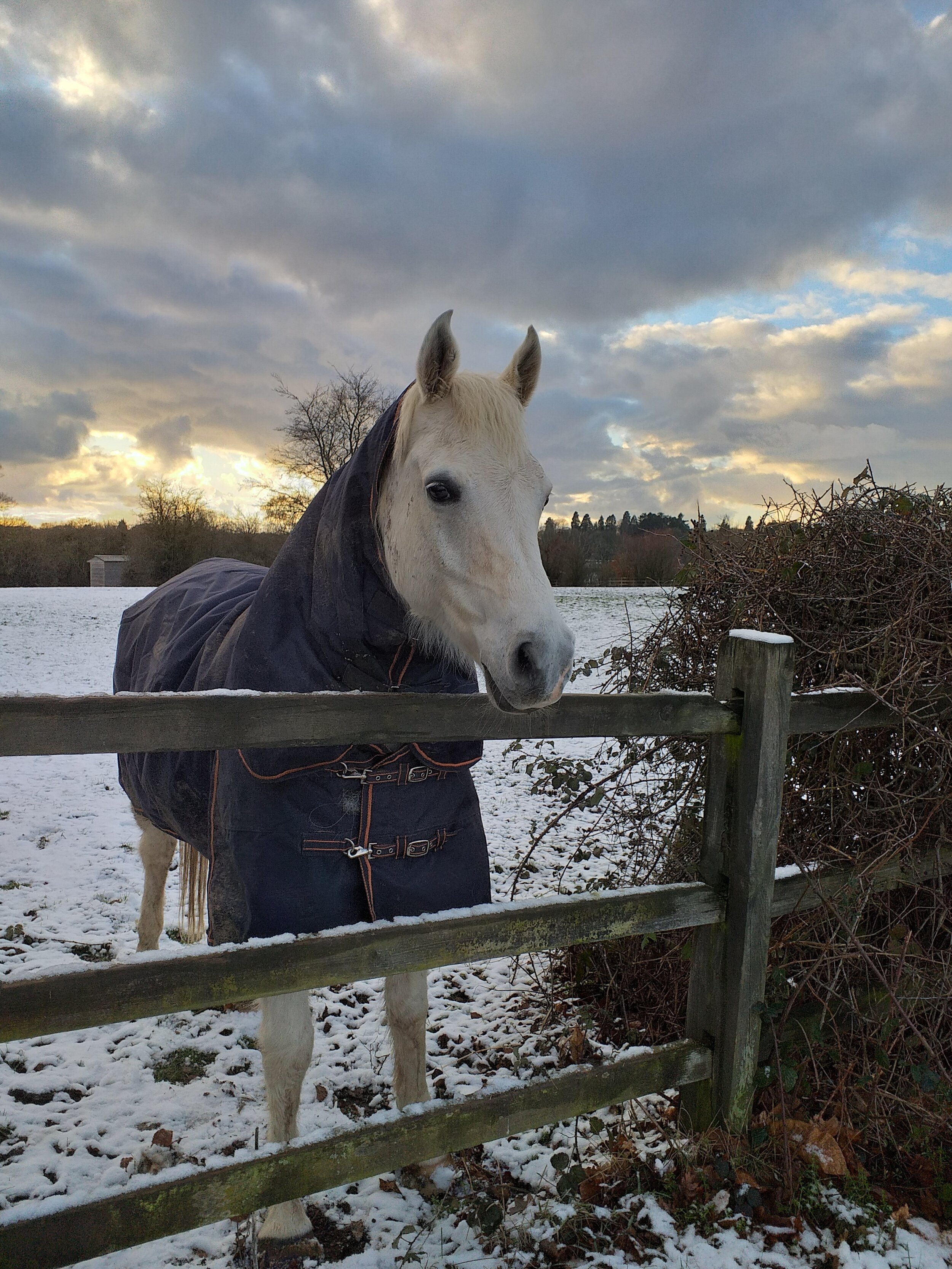
Rugs: It is important not to over rug your horse. Horses that are clipped, underweight or elderly will benefit from wearing an appropriate rug, both in the stable and also when out in the field. Make sure any rugs used are comfortable and fit well, but also remove them everyday to check they are not causing sores, particularly over the wither area. This is also a good opportunity to evaluate the overall bodily condition of the horse.
Skin issues: Unfortunately winter conditions are not kind to the skin. I have found Leucillin and Green Clay an absolute godsend for treating mud fever, minor injuries, skin complaints and preventing infection taking hold. A must have for your winter first aid kit. Both can be found on the Hedgerow Hounds shop with details on how to get the best out of using them.

Green Clay, once tried you will never want to be without it. Perfect for horses, dogs, cats and all livestock.
Hang on in there Spring is just around the corner !!
Find out more at : www.hedgerowhounds.co.uk
The Facebook page @HedgerowHorse
Or on Instagram hedgerow_horse