
Canine Enrichment Herb Garden
Everything is covered to help you easily build your enrichment garden. Important topics include the choice of herbs, adding interactive items such as snuffle mats, choosing planters and pots, soil health, the importance of a chemical-free lawn, and ways to embrace nature with your dog throughout the seasons.
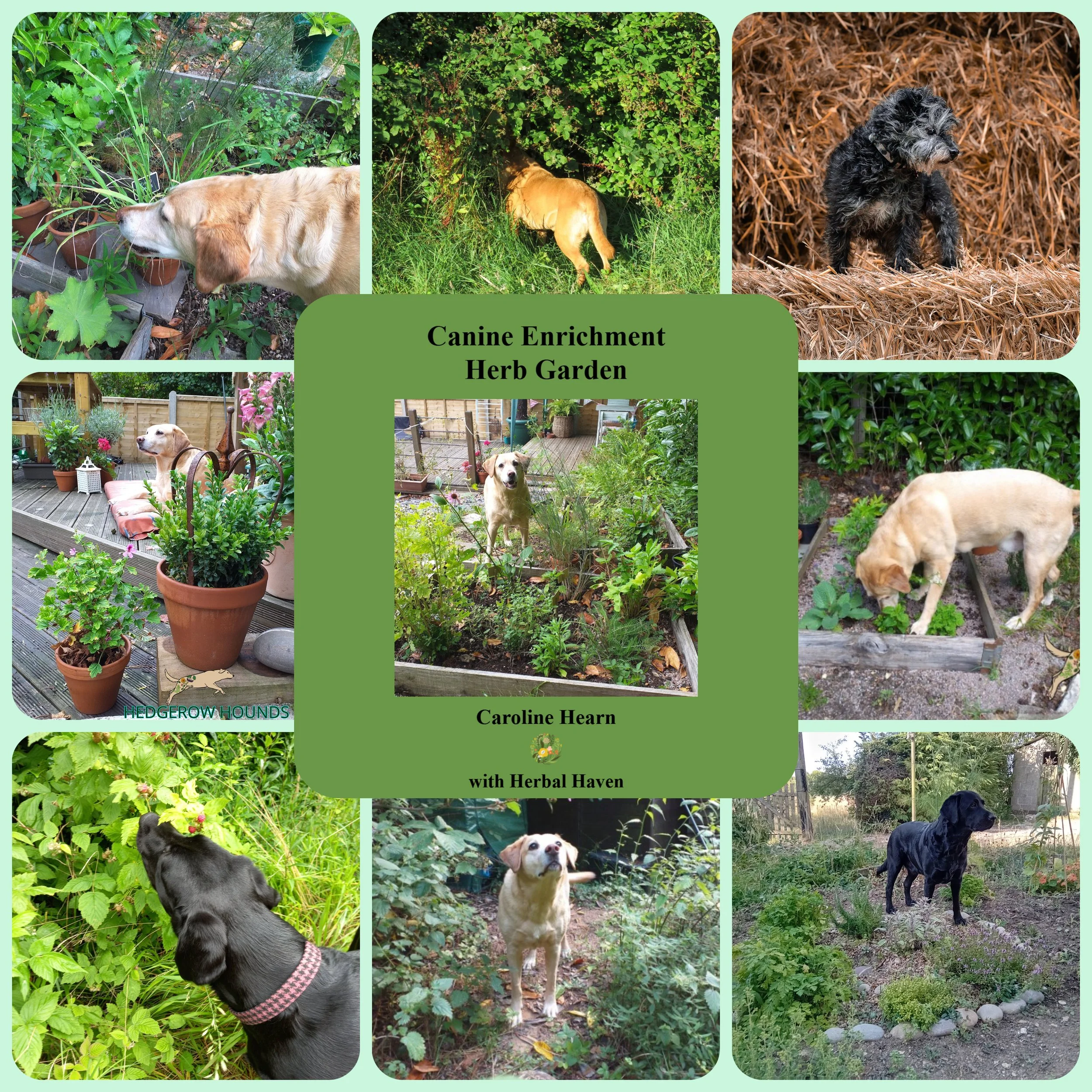
A book celebrating the love of dogs, the beauty of herbs, and the wonders of nature.
My first book is about a topic I am deeply passionate about and that has been an interest of mine for many years. It is written from a holistic approach to creating an enrichment space, using knowledge gained over the past 35 years and given to me by my greatest teachers: the dogs themselves.
So, what exactly is an enrichment garden, and why should we create one?
An enrichment garden offers dogs the freedom to move and explore at their own pace, without human interference or direction. This can be a dedicated space or incorporated into our existing garden. It encourages natural behaviours and curiosity, rather than learned responses, allowing dogs to be themselves without pressure to respond to our expectations of what they should be doing. The space will include herbs, textures underfoot, and aromas for the dog to interact with, as well as to move their body in a therapeutic way to calm the nervous system and improve mobility.
There is a section on providing enrichment for dogs with specific needs, such as the elderly, blind, or disabled dogs, as well as puppies.
Importantly, there is a chapter on ways we can benefit from this beautiful space, too.
The area we are going to create for our dogs can provide the following:
An outlet for instinctual behaviours such as sniffing, foraging, grazing, problem solving, digging, and exploring; all fantastic for reducing stress, frustration, and lowering anxiety.
Mental stimulation with scent from the environment and additional items such as snuffle mats and interactive toys.
A sensory experience with scent, sound, and texture underfoot. The garden will constantly change because of plant growth, weather conditions, seasonal changes, and what wildlife has visited the garden. Every day will offer something a little different.
Encouragement of natural movement without our influence or expectations.
Building confidence in themselves as the effects of sniffing and exploring lower the stress hormones and make the world seem a less scary place.
By going through a natural range of movements over varying textures and terrains, we are encouraging the dog to work all their body systems.
Enhanced well-being and quality of life.
A space that is appealing to look at, and that we enjoy spending time in with our dog.

We explore the many herbs that are suitable and safe for the herb garden, whether you choose to plant them in pots or directly into the ground.
With so many dog-friendly herbs to choose from, there is an extensive list in the book, as well as plants to avoid. Many are hardy and evergreen, so will provide interest all year round. If you have a small space and want to create an enrichment area in pots, then that is covered too.
Providing texture and varying terrain is also important, and how the dog’s body adapts and processes the information that is being fed back to them as they travel over hard and soft ground, slopes, and step over small obstacles.

Adding in texture, such as shingle, wood chippings, moss, mat-forming herbs, textured pathways, and sand, all add to the sensory experience.
Everything is covered to help you easily build your own enrichment garden. Important topics such as the choice of herbs, adding interactive items like snuffle mats, choosing planters and pots, soil health, the importance of a chemical-free lawn, and ways to embrace nature with your dog throughout the seasons.

Learn how simple adaptations in your garden can provide a sensory experience as well as therapeutic movement.
The book is available on Amazon as an e-Book or paperback on the link below: Here is the link https://www.amazon.co.uk/dp/B0FHKYK5T9
Or there are often paperbacks on the shop to buy. https://www.hedgerowhounds.co.uk/products/canine-enrichment-herb-garden-book
If you are looking for more help in creating your own enrichment garden for your dog or perhaps your dog has specific needs then I do offer a consultation to support and advise you. Here is the link: https://www.hedgerowhounds.co.uk/products/p/canine-enrichment-garden
The book also talks about enjoying the changing seasons and appreciating the way nature adapts throughout the year.
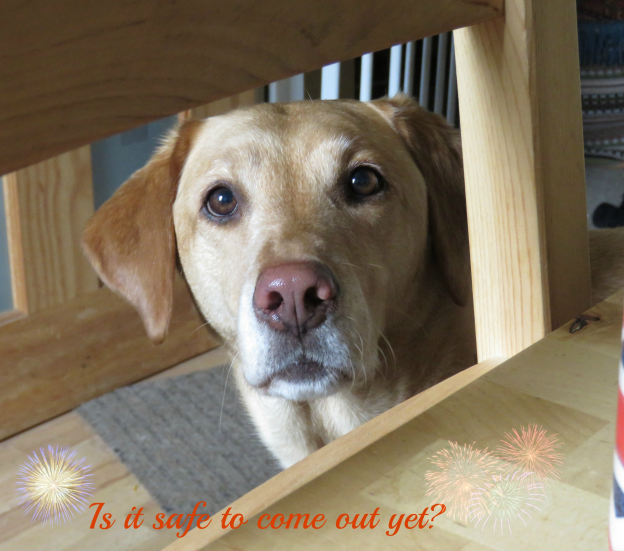
Helping your Dog Cope with the Firework Season.
What was traditionally on November 5th now seems to drag on well into the new year and can make life a misery for many dogs and their guardians.
Dogs can show their fear through obvious signs such as shaking and whining but often they also exhibit behaviours including digging and tearing at carpets and doors, excessive panting and drooling as well as vomiting and diarrhoea.

What was traditionally on November 5th now seems to drag on well into the new year and can make life a misery for many dogs and their guardians.
Dogs can show their fear through obvious signs such as shaking and whining but often they also exhibit behaviours including digging and tearing at carpets and doors, excessive panting and drooling as well as vomiting and diarrhoea.
There are a number of ways of helping your dog to cope with the stresses of fireworks and early preparation is the key to success.
Here are a few ideas to help your dog cope with firework night and beyond.
Build a Den: Many dogs like to hide away when they are frightened. This can be behind the sofa, under the bed, or in tight places. As long as it is a safe place for your dog, then adapt the area to make them feel secure and comfortable.
This can be anything from placing a heavy blanket over a table, dragging the sofa out from against the wall, or covering the dogs usual crate with a thick blanket. Build the den where your dog chooses to go and not where you think it should be. It is really important that the dog is not trapped so he must be able to move away from the den or exit the crate should he wish to.
Change of routine: You will probably have to change your dogs routine so they are taken out for a walk and fed earlier than usual. It may mean a longer walk in the morning and just a toilet break in the afternoon as fireworks can often start before it even gets dark. If you have to go out make sure your dog is kept on the lead and as a precaution use a harness in case he panics and tries to get away, you will have more control and your dog is unlikely to get loose.
If your dog is very fearful then try interactive or scent games in the house and garden instead of walking. “Nose” work can be tiring as well as giving them a sense of fulfilment and stress relief.
When in the house, close the curtains to help block out some of the noise and the flashing lights. Turn up the radio and TV a little louder than usual but try to act as if nothing is wrong or your dog will pick up on it.
Dogs sense our emotions, energy and stress levels very quickly, so It is vital to be there for your dog in a supportive and upbeat manner, keeping your own energy and stress levels down to create an atmosphere where they feel safe and protected.
Natural remedies: For dogs that suffer with anxiety, a combination of natural remedies plus adaptations to lifestyle will be necessary in order to provide comfort to the dog.
Calming herbs can be very useful, although for full effect it is advisable to start a number of weeks before a stressful event. The Hedgerow Hounds Tranquil blend, has helped many dogs that suffer with stress, nervousness and anxiety. I have also had success with the homeopathic remedy called Aconite so that is worth looking into as well.
Other remedies to try include flower remedies such as Bach or those specifically for animals including Creature Comforters.
There are also the calming sprays and diffusers which contain essential oils to promote relaxation. It must be remembered that dogs have the most extraordinary sense of smell, so it is important not to overwhelm the dog by using too much or liberally applying it onto their coat. If they cant move away from the aroma this in itself can be stressful. Instead I favour putting the spray or drops onto a piece of cloth or in an area where they can chose to inhale or move away from should they wish to. The Pet Remedy, sprays and wipes are an excellent range and available on the shop. https://www.hedgerowhounds.co.uk/products/pet-remedy-calming wipes https://www.hedgerowhounds.co.uk/products/tranquil-relax-sooth
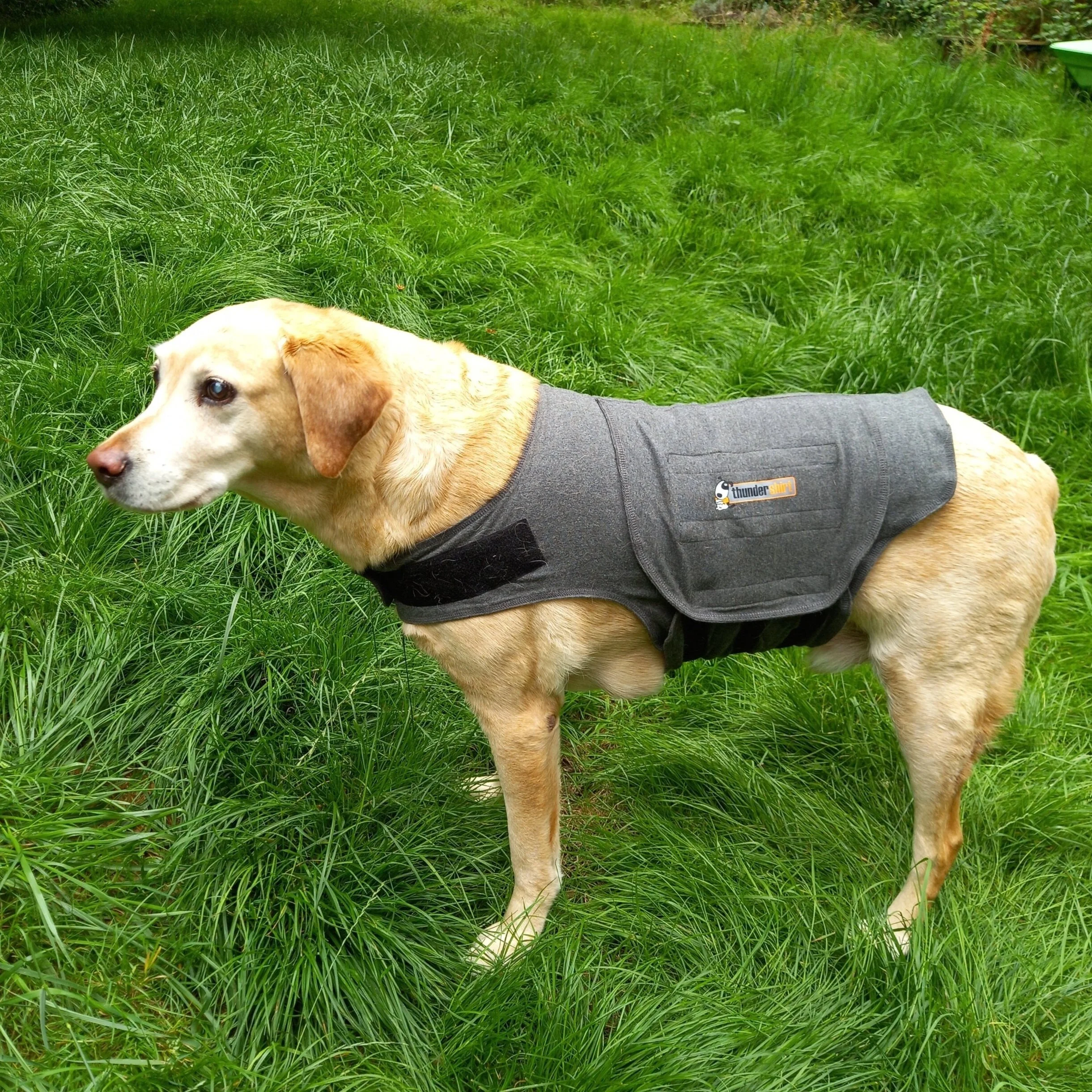
The Thundershirt can be useful for some dogs, but again it needs preparation before there is a stressful situation in place. Pressure vests work on the principle of compression, similar to the way an infant feels comfort when wrapped in swaddling. Pressure vests and correctly applied body wraps need to be used regularly before the actual event they are needed for. They have an accumulative effect and it is important that when they are worn initially that it is a very positive, calming and comforting experience. Take time to measure your dog according to the manufacturers guidelines, for a correct fit. It needs to be a snug fit but not so tight that the dog feels stressed and uncomfortable. For more detailed information on the use of pressure vests please read the blog https://www.hedgerowhounds.co.uk/news/body-wraps-pressure-vests
I asked Tom Bysouth BSc (CBT) a force-free dog trainer and behaviourist from Progressive Dogs, for some advise around firework season.
“ As the firework season draws nearer it is not too late to plan how to help your dog through this potentially stressful period. One thing that is important to remember is that you cannot make your dogs fear of fireworks worse by comforting and supporting them. If you have a puppy or young dog you can start to create positive associations around sudden, loud or unfamiliar noises. This can be done with playing a recording of fireworks at a very low volume while your dog plays a search game, eats their food or receives fuss from you. Through repetition, and the very gradual progression of raising the volume this can help teach your dog to associate these sounds with positive experiences.”
Tom can be found at www.progressivedogs.co.uk or email tom@progressivedogs.co.uk
More information on natural ways to help your dog overcome their fears can be found at:
@HedgerowHounds or our website www.hedgerowhounds.co.uk

Tranquil is a blend of herbs, roots and seeds specifically chosen to calm sensitive emotions and associated tummy upsets.

A natural, tried and tested range of products to relax body and mind and bring comfort to stressed, nervous and anxious dogs.
BODY WRAPS & PRESSURE VESTS
Pressure vests and elasticated body wraps have been in use for many years to assist anxious and fearful dogs and to aid recovery after surgery, injury and neurological conditions.

Caroline Hearn – MICHT. Dip ICAT Dip MLD
Sports, Remedial & Holistic Massage Therapist
Pressure vests and elasticated body wraps have been in use for many years to assist anxious and fearful dogs and to aid recovery after surgery, injury and neurological conditions.
The effects of the body wraps and the vests work in slightly different ways depending on their purpose of use and what results we are aiming for.
Pressure Vest (Thundershirt etc).
Probably the best known of all the pressure vests is the “Thundershirt” although there are many more on the market today that work on the same principal.
They are predominately used for dogs that are anxious, reactive and fearful of a known source such as thunder, fireworks, loud noises, travelling or separation anxiety.
The reasoning behind the vests is similar to the way that swaddling an infant can bring about comfort and reassurance.
Light compression activates the parasympathetic nervous system to help create a feeling of relaxation.
Once this system is stimulated, hormones such as endorphins, serotonin and dopamine are released bringing a feeling of calm, a reduction in anxiety and a lowered heart rate.
It is important to buy the right size of pressure vest. For it to be effective, it will need to be a snug fit. The aim is to provide light pressure that is in constant contact with the body but not so tight that it restricts movement.
For the best results, it is vital not only to prepare your dog for wearing one but also to use the vest in a positive way for a period of time before the actual stressful event takes place. Each dog is an individual, so proceed at a pace they are comfortable with. Some dogs, however gently and slowly they are introduced to the vest will not respond well and will become stressed and anxious whilst wearing it, so other things will have to be put in place to help them cope (see the whole fireworks series of blogs)
Wearing the vest should be an enjoyable, stress-free event that the dog associates with pleasant experiences. That could involve a few high-value treats, light massage techniques, a feeling of security, and spending quality time with their owner. Avoid activities that are too stimulating or increase adrenaline, as we are aiming to encourage a feeling of contentment and calm associated with wearing the vest.
The effects of the pressure vest accumulate over time so it is important to carry out the initial introductions when your dog is relaxed and in a state of mind that they can process it as a positive experience. It is also advisable for your dog to wear the vest from time to time to reinforce the feel-good factor when they have it on.
As with the wrap bandages, they should not be left on unattended or for long periods of time, without a break.
If you have a male dog make sure that the wide under-belly strap does not cause discomfort near his genitals, as some of the fastenings do extend a long way back in the abdominal area.
Be aware that the Velcro can be noisy when you unfasten the chest and belly straps, so a noise-reactive dog will need to be carefully introduced so they are not startled by it.
Body Wrap Bandages:
The use of wide, elasticated bandages such as the “Ace” bandage, can be used as a method to reassure a nervous dog or more often as a useful “tool” in the rehabilitation after surgery or where there has been long periods of immobilisation or recovery from a neurological condition.
They are also useful for preparing a dog to wear a harness or coat, touch sensitive dogs, those that pull hard when walking on a lead and for dogs that lack confidence.
The wraps are commonly used in a figure-of-eight configuration, making contact with the chest, crossing diagonally over the back and finishing either near the groin or incorporating the hindquarters.
They do need to be fitted correctly so not to cause harm or discomfort and one of the best guides on applying them can be found on the Tellington T-Touch website.
If they are being used for rehabilitation after surgery or illness then it is essential that your vet, physio or canine massage therapist shows you exactly how to apply them according to your individual dogs’ condition.
It is important that the bandage is elasticated, as the sensation of the pressure against the body which expands and contracts with movement, brings about a heightened sense of awareness on just how the dog is using their body.
The self-adherent bandage that you use for first aid is not suitable for this purpose as it can pull on the hairs and is not quick to remove, should your dog become distressed.
The correct use of body wraps works on the proprioceptive system. This is why they are so useful in rehabilitation and re-training of the body, for example, after a long period of compensatory movement due to pain or a previous injury.
Proprioception, meaning “one`s own” is a sense of relative position of neighbouring body parts and the strength needed for movement.
Proprioception plays a large role in co-ordination, posture and body awareness.
We receive proprioceptive input from the sensory receptors in our skin, muscles and joints. When these receptors are stimulated, through touch or pressure, the brain is provided with the information about our body positioning, movement and speed.
The wraps are often used when performing different activities such as walking and trotting over poles placed on the ground and travelling over varying terrain, this gives an awareness of the dogs limb positions, how they are placing them on the ground and the energy that is propelling them forwards.
It can also become apparent that the dog is favouring to push off more on one hind limb or much happier and free moving in one direction over the other. In these cases, it is important to take regular breaks after 5-10 minutes of work with the wraps on as muscles will become fatigued and sore when adapting to a new movement pattern.
Both the pressure vests and body wraps are a great addition to the holistic wellbeing of your dog. However, they do not replace the expertise of a qualified behaviourist or a canine therapist should your dog need additional help in certain areas.
Your Anxious Dog
If you share your life with an anxious dog, you will know that there are many challenges to overcome and situations in everyday life that can act as a trigger resulting in fearful, frantic behaviour, reactivity towards dogs and people, excessive barking and gut issues to name a few. It can seem a lonely road to travel and that you take two steps forward one day followed by three steps back the next.
If you share your life with an anxious dog, you will know that there are many challenges to overcome and situations in everyday life that can act as a trigger resulting in fearful, frantic behaviour, reactivity towards dogs and people, excessive barking and gut issues to name a few. It can seem a lonely road to travel and that you take two steps forward one day followed by three steps back the next.
So here are a few hints, tips and links for further advice that I hope will help you and your anxious dog.
It is not just our dogs stress levels we should be mindful of! Dogs can read us like a book and are extremely sensitive to our emotions, our energy and the environment they are living in. It is important for our own health to manage stress and make some time to rewind from the stresses and strains of everyday life.
Taking even 10 minutes a day to concentrate on bringing your stress level down will have a knock on effect to your dog. Simple practises such as gentle breath work and meditation, preferably with your dog by your side, really do help. There is a free 12 minute guided meditation which is particularly lovely by Holly Husler. It can be found at the top of her page on this link FREE OFFERINGS — Holly Husler Sit somewhere quiet with your dog, slow your breath and completely unwind with your best friend.
Diet. Feeding a more natural, minimally processed diet, without excess carbohydrates and sugars will help in creating a more even temperament and put them in a mindset where it is easier to learn a better way of living. Here is a blog to help get you started introducing fresh food into your dogs diet https://www.hedgerowhounds.co.uk/news/improve-your-dogs-diet
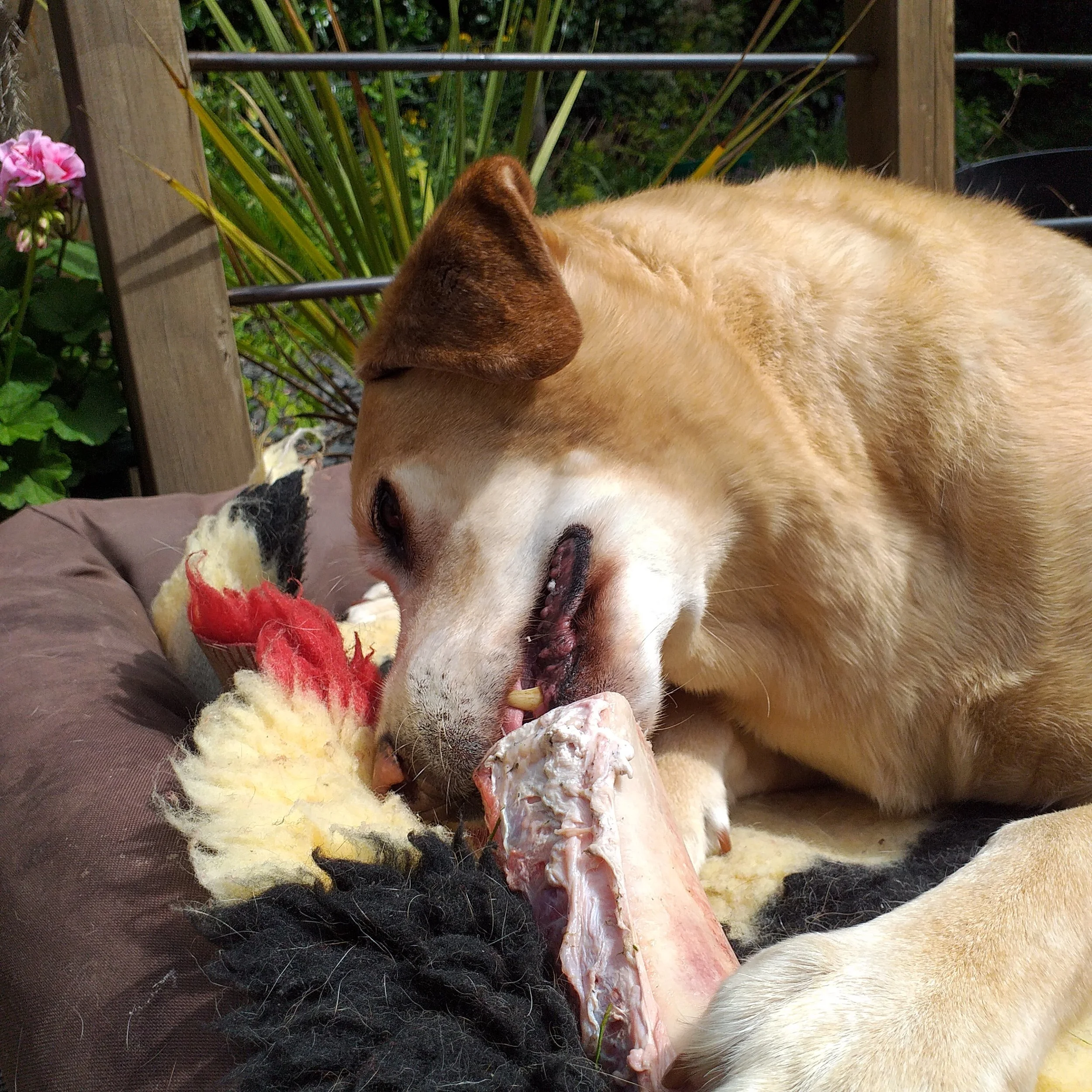
Dogs love to sniff, lick & chew. Giving your dog something suitable to chew has huge psychological benefits as chewing releases serotonin, dopamine and oxytocin which are all calming and feel good hormones. If raw bones aren`t suitable for your dog then there are lots of healthy, natural chews available as well as providing Kongs and tracheas stuffed with tasty ingredients.
Allowing your dog to sniff when out on a walk or perhaps setting up an area in the garden where they can freely explore is incredibly beneficial to anxious dogs. Dogs are natural seekers of food so both the house and garden provides lots of opportunity to introduce scent games and hide and seek their favourite treats.
Dogs need to move and be in a safe place to unwind to process the stress they are feeling. They need to ground themselves on the earth, not carpet, laminate, concrete or synthetic lawn but actually on the earth itself. Creating a peaceful environment in your garden is a perfect place to do this and it`s somewhere to relax with your dog too. Just as pottering around the garden is very relaxing for us it is equally valuable to your dog.
Using snuffle and Lick-it mats, and interactive toys can be used in the house and handy to have when the weather limits time outside or maybe your dog is particularly stressed and needs some time away from the triggers of being outside. We have some gorgeous snuffle balls available here: https://www.hedgerowhounds.co.uk/products/snuffle-balls
Read the Snuffle Mat Blog here: https://www.hedgerowhounds.co.uk/news/snuffle-mats-and-balls
Calming herbs can also help, plus concentrating on easing any gut discomfort which undoubtedly goes hand in hand with a stressed, anxious mind. There is a link below with a few suggested products that could help. Both the Tranquil blend and Digest & Rest are particularly valuable in these situations.
Time to chill. Having time out or chill out days can be very beneficial to anxious, reactive or even very active dogs, to bring them back into some sort of balance and down from their constantly stimulated state of mind.
A dog that is in a heightened state of fear, stress, panic and self preservation will not physically be able to process and learn what is being asked of them. So by bringing down their stress levels they will be in a better frame of mind to learn new skills, cope with their stress and grow in confidence to make better decisions that are not fuelled by fear.
When dogs are over excited, anxious or constantly alert to potential dangers their autonomic nervous system releases the fight or flight chemical adrenaline into the bloodstream, over time this becomes very damaging to the whole body and the gut in particular. The other subdivision of the autonomic nervous system is the parasympathetic which is sometimes called the “rest and digest system” and creates calm, relaxation and a happy gut and this is what we are hoping to nurture on these quiet, restful days.
Finding a trainer or behaviourist that has experience with nervous dogs is invaluable. They will help you and your dog to learn skills at home which will help them cope with stressful situations when they arise in the future.
The old advice of just keep talking your dog out and they will get used to it” just doesn`t work and you will find that each outing will just top up the stress levels, adding fuel to the situation. Having as many chillout days as the dog needs, where there are no triggers or unnecessary demands made on the dog, is often a necessary step forward.
If you are looking for a private enclosed field to exercise or train in then there is a website where you can search for one in your area. https://www.dogwalkingfields.co.uk
There is a particularly good Facebook group that offers support, set up by Niki French called Pup Talk and she has recently released a book called Stop Walking Your Dog which has invaluable advice to help with anxious dogs. https://www.puptalk.co.uk
Sleep: Adult dogs require 16-18 hours of sleep a day, so it is important that your anxious dog gets enough rest and has a quiet space where they feel safe. This could be a crate with the door left open, a comfortable bed in an area where they are not disturbed by other dogs or people passing or observing where they always choose to sleep and make a cosy bed there.
Anxiety can present itself in many ways, here are a few to look out for:
• Digestion problems - IBS, Diarrhoea
• Over excitability
• Reactive behaviour (aggression)
• Excessive barking
• Noise sensitivities
• Humping
• Resource guarding
• Chewing or scratching the body
• Inappropriate toileting in the house
• Excessive licking
• Ball obsession
• Pacing
There are a number of products on the shop to help relax and support nervous, anxious and reactive dogs
Tranquil is a herbal blend created specifically with the nervous, anxious, reactive & stressed dog in mind https://www.hedgerowhounds.co.uk/products/tranquil-relax-calm
Digest & Rest https://www.hedgerowhounds.co.uk/products/digest-and-rest
Gentle massage and body work such as Tellington Touch can be really helpful but do be mindful that for some dogs, touch is not a positive experience. If they are fearful of hands they may be happy with a soft brush or cloth initially.
Body wraps and pressure vests such as the Thundershirt can be very useful for comforting an anxious and stressed dog, read the following blog which covers the topic in detail https://www.hedgerowhounds.co.uk/news/body-wraps-pressure-vests
Walking anxious & reactive dogs: Walking anxious, fearful and reactive dogs can be incredibly difficult and stressful for both dog and owner. I can clearly remember a daily walk at 5am for many months on the arrival of a particularly reactive rescue dog and having to drive to areas that were very quiet in order to keep their stress levels down.
Rehabilitating an anxious dog can be a long process, so as well as getting support from a compassionate trainer I would suggest joining a group on Facebook that supports anxious dogs and their owners and also looking up Sarah who started her business My Anxious Dog after her Spaniel became very stressed and reactive around other dogs and discovered just how difficult it was to inform others that her dog wasn`t nasty but just frightened and it would help if they just gave her space.
So, Sarah from My Anxious Dog has created a national #dogsinyellow day on the 20th March 2022 to raise awareness and to really educate others to understand the meaning of dogs wearing yellow. So please spread the word!
Sara says “Yellow warning or yellow space awareness products are used when walking an anxious, nervous or reactive dog.
Walking reactive or anxious dogs in public is challenging, especially when strangers and dogs walk over to say “Hi” to your fearful dog. Sometimes avoiding scary triggers is impossible, so we use yellow dog warning products or yellow space awareness products to let people know that our dogs need space or to be ignored”.
You can download your free awareness pack, shop for the fantastic products and make contact with Sarah via the website http://www.myanxiousdog.co.uk
www.hedgerowhounds.co.uk
Caroline Hearn MICHT. Dip.ICAT. MIAAT
Your Reactive Dog
Dog-dog reactivity is a very common behaviour difficulty dog professionals are contacted for help about. We often see it as a problem if our dog doesn’t get on with every dog they see – but did you know this is ENTIRELY NORMAL?
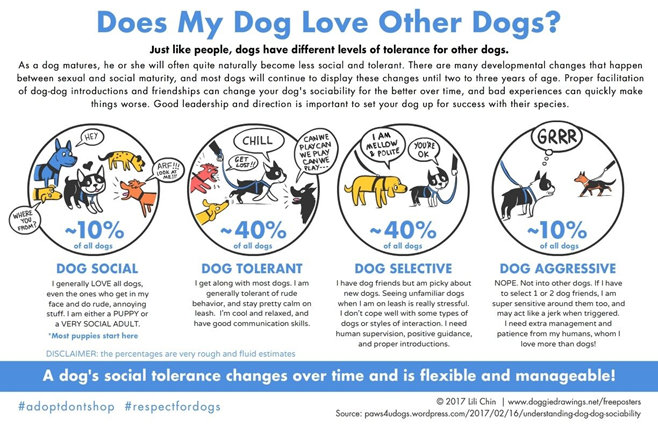
Dog-dog reactivity is a very common behaviour difficulty dog professionals are contacted for help about. We often see it as a problem if our dog doesn’t get on with every dog they see – but did you know this is ENTIRELY NORMAL?
The problem dogs have is that we guardians expect our dogs to do what we do not: accept and embrace everybody we come across in a friendly and unconditional manner. If we are honest with ourselves, we cannot hold ourselves to that standard of perfection – yet we so adamantly hold our dogs to it!
Yes, dogs are social beings but typically this means they like to have friendships with other dogs well matched for their play style and activity choices. This does not automatically mean they like to be thrown into a dog park with 30 other dogs all clumsily communicating to each other in a heightened state of excitement. If you have a dog that can enjoy situations involving a lot of stranger dogs then YOU are in the minority! Most people find their dogs, especially once matured past puppyhood, are more picky and reserved.
Furthermore, “reactive” is a very vague unhelpful label in that a “reactive” dog may be struggling with a variety of things. Their behaviours may look the same: growling, barking, lunging, snapping and so on but the underlying cause of these behaviours can differ.
Perhaps they are easily aroused and get over stimulated at the sight of other dogs because they just want to go say hello and play. Dogs can really struggle with their on-lead behaviour as a result of this overstimulation.
Perhaps they are very immature in social skills due to a “not good enough” socialisation period
Perhaps they have had a traumatic experience with a number of dogs, or just one, and are now highly anxious about interacting with others
Perhaps they struggle to read certain dog breeds and that makes them feel defensive; for example, brachycephalic dogs or those covered with an abundance of curly fluff.
Perhaps they are mature now and tolerating rude/bolshy young dogs is no longer possible for them.
Perhaps they are struggling with pain in their hips/back/neck and are very sensitive to other beings in their personal space for fear an interaction may make the pain worse.
And more…!
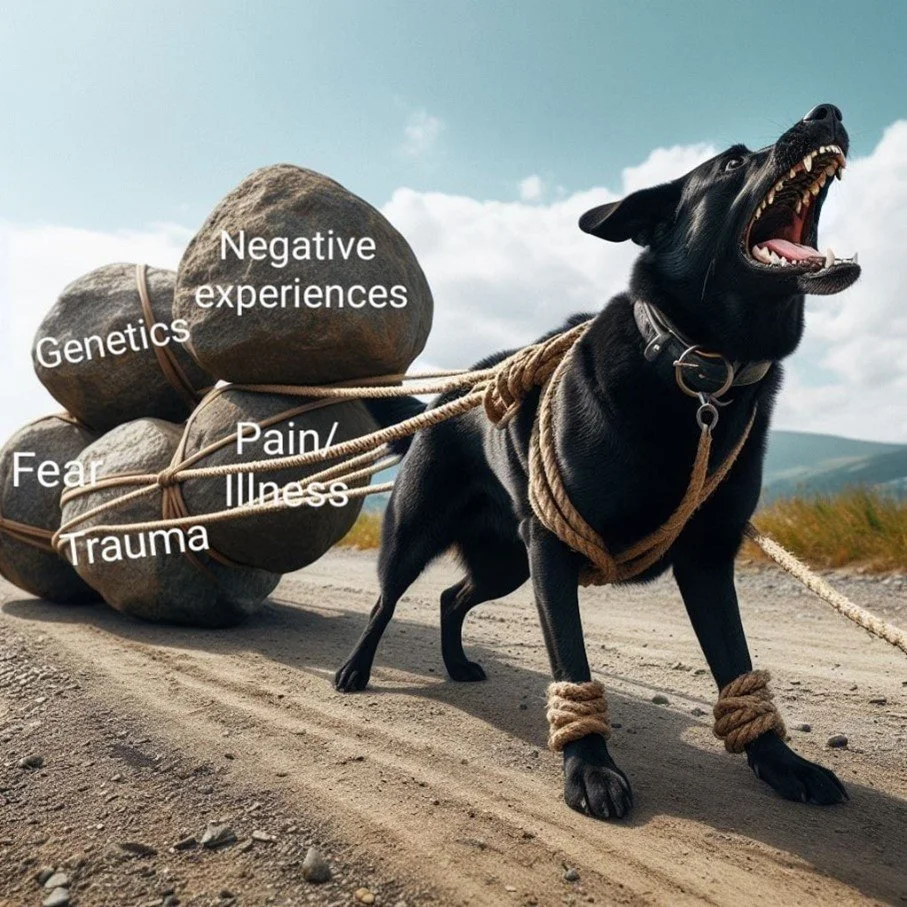
There can be a hundred and one different reasons why your unique dog before you is showing reactive behaviours at the sight of/whilst in interaction with another dog. This is why there is no blanket answer for dog reactivity and no quick fix. How it can be remedied depends on what is the underlying motivation for the reactivity – in short – is it to get the trigger to go away? Or is it to get closer to the stimuli? What if I also add that it is rare for the dog to be feeling ONE emotion! I often see dogs who come across as struggling with frustration because they just want to go over to that dog as soon as possible to play, but are actually highly anxious in their interactions with other dogs as well, further compounding their initial reactivity. Dogs are complex beings just as we are, and we need to appreciate this when dealing with their reactivity.
Typically, every dog I see for “reactivity” training and behaviour modification I recommend goes on a calming supplement such as Hedgerow Hounds Tranquil Blend. Alongside looking at the dog’s diet, their daily activities, the quality of their walks outside of the home and more, the calming supplement helps to put the dog in the best position to learn that the world doesn’t have to be as scary or frustrating (or both!) as they currently believe it to be.
It is highly important to get the right behaviour help though for your dog as some interventions can be truly harmful. If your chosen professional is recommending you “correct” the dog through various methods such as a flick of the wrist with a slip lead, shaking a can of pennies at them, or other aversive tools such as vibration collars, choke chains, prong collars and even shock collars, please be aware there is significant fallout of relying on these corrective methods to alleviate your dogs’ problem behaviour. In the same way children in schools are not punished for getting things wrong, dogs are emotional beings who also can be negatively affected by punishment-based interventions.

Studies have shown that positive based training is more effective and does not cause any unwanted fallouts like corrective training does (1)(2)(3)(4). If you are reading this then you are concerned about your dogs’ emotional welfare and that is the concern of all good behaviour professionals as well. The important part of a reactive dog’s journey isn’t their behaviour, it’s their emotional world! Emotions cannot be corrected; only recognised, understood, and soothed.
Most importantly, oftentimes living with a reactive dog involves compromise. It involves respecting their genuine likes/dislikes with regards to other dogs (some dogs genuinely don’t want to play, or are too little to want to be around large breeds and so on), so they can learn to be less over-reactive on exposure to dogs in general. We often place high expectations on our dogs and when these can’t be fulfilled we blame the dog, when really we need to ask ourselves “is this expectation fair?”
(1) Vieira de Castro AC, Fuchs D, Morello GM, Pastur S, de Sousa L, Olsson IAS. Does training method matter? Evidence for the negative impact of aversive-based methods on companion dog welfare. PLoS One. 2020 Dec 16;15(12):e0225023. doi: 10.1371/journal.pone.0225023. PMID: 33326450; PMCID: PMC7743949.
(2) Blackwell, E.J., Bolster, C., Richards, G. et al. The use of electronic collars for training domestic dogs: estimated prevalence, reasons and risk factors for use, and owner perceived success as compared to other training methods. BMC Vet Res 8, 93 (2012). https://doi.org/10.1186/1746-6148-8-93
(3) Ziv, Gal. (2017). The Effects of Using Aversive Training Methods in Dogs – A Review. Journal of Veterinary Behavior: Clinical Applications and Research. 19. 10.1016/j.jveb.2017.02.004.#
(4) Cooper JJ, Cracknell N, Hardiman J, Wright H, Mills D (2014) The Welfare Consequences and Efficacy of Training Pet Dogs with Remote Electronic Training Collars in Comparison to Reward Based Training. PLoS ONE 9(9): e102722. https://doi.org/10.1371/journal.pone.0102722

Jen Leslie is a canine behaviour specialist based in Buckinghamshire. Originally completing a psychology degree to work with people, she moved across to dealing with the emotional worlds of dogs instead following a period of volunteering at a dog rescue with the dogs hard to rehome due to behaviour difficulties.
Jen has four dogs of her own, ranging from her 3kg chorkies to her 30kg Doberman/shepherd cross. She advocates primarily for little dogs and their misunderstood experience in this big world.
You can read more from Jen at her website www.calvertcanines.com and on her facebook page www.facebook.com/CalvertCanines
LAMENESS AND REPETITIVE STRAIN IN DOGS
While supplements can be a big help in supporting joint health and controlling inflammation they will be of limited benefit unless there are positive exercise & lifestyle changes.
Caroline Hearn MICHT. MIAAT. Dip.ICAT Dip MLD Dip. Myofascial Release.
Human, Equine & Canine Sports & Holistic Therapist
As a canine massage therapist I see many dogs with injuries and lameness caused by repetitive strain, which can easily be avoided or kept to a minimum with some lifestyle changes. The main causes seem to crop up time and time again so here are the most common factors and ways to avoid injury to your dog.
Ball and Frisbee throwing:
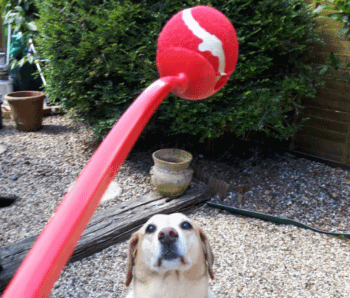
Constant chasing after a ball or combined with leaping in the air to catch a frisbee is probably one of the main causes of injuries, lameness and strain that I see. The action of a burst of energy followed by a sudden stop, a skid then a rapid turn will put huge strain on the dogs shoulders, forelegs, neck, pelvis and spine.
Like us, dogs will favour one side of their body so will always prefer to turn in the same direction causing over use of muscles and joints. This repetitive action is very unnatural for a dog and if left to chase and hunt in the wild they would never continuously sprint with a sudden halt afterwards.
Also ball throwing for some dogs can mean they are on a constant adrenaline high so causing emotional as well as physical stress. This sort of exercise can cause micro trauma often not shown by the dog at the time of chasing as the sheer thrill they get can often mask any discomfort. But with time the dog will compensate for the discomfort elsewhere in their body and become lame. Instead, encourage hunting for a hidden ball or a treat in some undergrowth and reward with either giving the dog the ball to carry or a single retrieve of a ball placed ahead. Keep it to an absolute minimum and find other ways to interact with your dog . Always warm your dogs muscles up with at least 5 minutes on the lead before letting them off to run at speed.
2. Jumping out of cars, off furniture and down stairs:
All these activities put a lot of strain on your dogs shoulders and forelegs. The added problem with jumping out of the boot of cars is that your dogs muscles will be cold and it is often from a great height onto a hard surface, usually followed by immediately running off to start a walk. Teaching your dog to use a ramp will save so much strain on their body. Read our blog https://www.hedgerowhounds.co.uk/news/teaching-your-dog-to-use-a-car-ramp for more advice
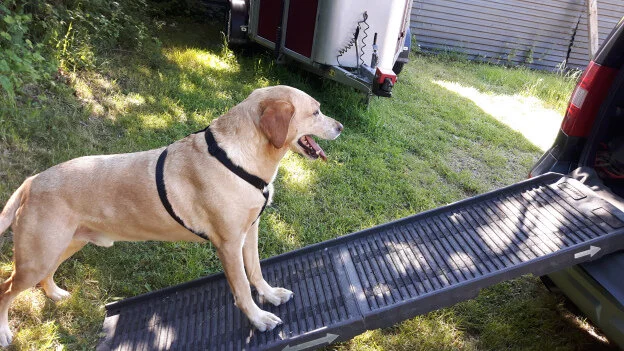
Teaching your dog to calmly go up and down a car ramp is so important. Invaluable for young dogs, elderly or frail dogs or those recovering from injury or surgery. Saves a lot of strain on your own back too if you are currently lifting them in and out of the boot!
Stair gates are really useful for preventing dogs running up and down stairs and providing a comfortable and supportive bed for them near to you to encourage them not to lay on the furniture. Small dogs can be lifted off the sofa or a ramp used for larger dogs.
3. Slippery Flooring :
Dogs falling and slipping on laminate or tiled floors can cause so many injuries and really make an older dog lose their confidence. Use non slip mats and rugs in the areas that the dog uses and also around their bedding and in particular food and water bowls. Dogs with arthritis or mobility problems are better eating and drinking from raised bowls and make sure they are on a non slip mat. They find lowering their head difficult so often splay their legs in order to reach, this can cause really nasty falls and make them nervous at feed times.

Raised bowls for water and food can be made cheaply by stacking bowls together until you reach the ideal height for your dog. Always place on a non slip surface.
4. Inappropriate Exercise:
Problems can occur when dogs exceed their fitness levels or are taken beyond their capability due to age or mobility.
Some dogs have to make do with a quick stroll round the block in the week but are taken out for hours at the weekend and become exhausted making them more susceptible to injury such as cruciate ligament strain or tears.
Puppies and young dogs should be exercised very carefully as their bones, joints and growth plates are prone to injury causing lifelong issues.
Senior dogs should not be forced to walk but allowed to go at a pace that they are comfortable with and which improves their mobility. It is so upsetting to see old dogs being made to walk beyond their comfort zone and it causes pain, crushes their spirit and is detrimental to their long term welfare.
Dogs that pull hard on the lead and lean right over to one side almost scrabbling along are heading for joint and muscular damage. Use a harness and teach your dog to walk calmly at heel or enlist the help of a reputable trainer or behaviourist . It will be money well spent and save a fortune in vets fees long term.
Adapting your dogs routine will ensure many years of injury free activity and ease of movement in their senior years. There are some good supplements available to help support joint pain and inflammation and used in conjunction with long term lifestyle changes they can be really beneficial. Although the use of supplements can be helpful, they have limited value unless they are used in conjunction with lifestyle changes and there has been an accurate diagnosis as to the source of the pain and mobility problem.

A Dogs Digestive System- Immunity, Emotions and Microbiome
The more the gut is studied the more we realise the vital role it plays in achieving optimum health, disease prevention and stabilising our dogs emotional state.
At first glance the digestive system appears to have a very simple task of taking in food, digesting it, absorbing nutrients and then excreting the waste, and while everything is in good working order, we never even give it a second thought.
It is in fact an incredibly complex structure with a vast number of tasks to undertake. The more the gut is studied the more we realise the vital role it plays in achieving optimum health, disease prevention and stabilising our dogs emotional state.
Digestive process
Although the teeth are needed to some extent to bite, crush and tear off food the actual process of digestion doesn`t really start until it reaches the stomach. With no digestive enzymes in the saliva to kick start it off, food needs to quickly get where the real work begins, which is in the stomach.
Oesophagus:
Is a long muscular tube that runs down the neck, passes through the diaphragm and uses strong contractions to push food directly into the stomach.
Stomach:
The stomach lies at the front of the abdominal cavity, tucked just behind the liver and acts like a big mixing bowl.
Any incoming food is first subjected to an acid bath of around ph1, this immediately gets to work breaking down protein and also killing any harmful bacteria.
The walls of the stomach are lined with a thick mucous which provides protection from the strong acid as well as stopping the stomach from literally digesting itself.
As the stomach expands with food, a peptide hormone called gastrin is released, which in turn triggers more hydrochloric acid and digestive enzyme production.
To aid digestion even further the surface of the stomach is a mass of wrinkles and folds which expand and contract to grab food particles and perform a churning or chewing like action.
At this point the thick soup like constancy of partly digested food and secretions is known as chyme.
The food has now been in the dogs stomach for anywhere between five and ten hours and its next destination is the duodenum, the first section of the small intestine.
Pancreas
The pancreas is a small gland, which sits next to the stomach and is attached to the small intestine, here it transports digestive enzymes through two excretory ducts into the duodenum.
The enzymes it produces are amylase to help digest starch , lipase to digest fats and trypsin and chymotrypsin to deal with the protein.
Enzymes are needed to break down food into tiny molecules and allow the absorption of nutrients into the cells of the intestines which then go on to be released into the bloodstream.
It also produces and secretes the hormones insulin and glucagon that regulate blood sugar levels. The higher the concentration of sugar in the diet the more insulin is secreted into the bloodstream and the harder the pancreas has to work.
Liver
The liver is the largest gland in the body and the only organ that has the potential to regenerate after disease or injury.
Its many crucial jobs include producing bile to assist the small intestine in breaking down and absorbing fats and to process the nutrients that are absorbed by the small intestine.
Its other roles include storing vitamins and minerals, acting as a filter for toxins in the bloodstream and as a glycogen store for when extra energy is needed.
Small intestine
The small intestine is made up of three sections, Duodenum, Jejunum (longest) and the ileum (shortest)
On receiving the nutrient rich chyme from the stomach, it is joined by secretions from the liver, gallbladder and pancreas to further assist in the digestion process.
The small intestine is lined with millions of tiny finger like projections called the Villi, these act to increase the surface area in order to trap and absorb as many nutrients as possible.
Most of the absorption of nutrients takes place in the small intestine, which are then released into the bloodstream to travel throughout the body to be utilised by the cells.
The final and shortest part of the small intestine is called the Ileum, here the food gets broken down even further in preparation to enter the cecum, the first section of the large intestine.
Large intestine :
The large intestine is made up of the cecum, colon and rectum.
Its purpose is to remove water from the faeces, keep electrolytes in balance and to prepare and temporarily store any indigestible matter for excretion.
But there is much more activity going on in the colon than just that and although not a glamorous area of interest, it does deserve our full care and attention.
The large intestine has a high concentration of bacteria referred to as the Microbiome.
Microbiome.
The microbiome is a collection of microbes made up of bacteria, viruses and fungi that we all have in our gut for efficient digestion, absorption of vital nutrients and to build a strong immune system.
Our dogs would have acquired their unique bugs from their mother at birth and developed others depending on the environment they lived in and the food they ate.
The delicate balance of the microbiome can easily be disrupted by medication such as antibiotics, periods of stress and anxiety and a poor, unsuitable diet.
When everything is in balance these good bugs work hard to extract as much nutrition as possible out of the food that is consumed and to ensure the smooth running of the whole gastrointestinal tract.
The bacteria are also responsible for assisting in hormone production such as serotonin, which occurs in the highest concentration thorough out the lining of the gut.
A thriving, balanced microbiome is absolutely essential for the dogs ability to resist or fight disease, control inflammation in the body and for a positive influence on their mental wellbeing.
Rectum and anal glands.
The faeces are then ready to be expelled along with the indigestible matter and dead red blood cells that it contains.
Ideally the dogs stool will be quite firm, which will press on the anal glands as it is passed, causing the glands to naturally empty.
Emotions and the Gut
The gut is very sensitive to emotions, and I am sure we have all experienced the butterflies in the stomach, stomach cramps, that tight feeling in our guts or acid indigestion which can come on in a split second when we are nervous, excited, fearful or anticipating a particular event.
If this is a brief episode, it is unlikely to have any lasting health effects, if on the other hand it is a regular occurrence with little respite then the impact on the gut and therefore the health is huge.
There is a major factor in the link between gut health and emotions in the form of the enteric nervous system also referred to as the ENS.
The ENS consists of millions of nerves lining the gut and specialists often call it the “second brain” as it has complex pathways to relay information back and forth from the gut to the brain as they interact.
It is capable of shutting down the digestion in times of acute stress such as in a fight or flight situation.
Stress can be caused by many factors such as separation anxiety, excessive ball throwing so the dog is on a constant adrenaline high, inappropriate exercise for the dogs age or mobility, inability to cope in a stressful household and pain, illness or disease.
Whilst these are mainly emotionally based reactions that can be witnessed as the dog exhibiting certain behaviours, a poor quality, inappropriate diet, exposure to toxins or chemicals can also cause the body stress, which may not show any visible signs immediately but develop over time into disease or outwardly noticeable changes in health and behaviour.
A gut that isn`t functioning correctly can manifest as the dog showing anxious, edgy or reactive behaviour which in turn triggers the release of stress hormones into the blood stream such as adrenalin and in the case of cortisol increase the level of glucose in the blood and will over time adversely affect the adrenal glands.
Immunity and the Gut
The gut forms between 70 - 80% of the immune system and has a vital role in regulating immunity, protecting our bodies from invaders such as allergens and pathogens and controlling inflammation.
The food we choose for our dogs and the lifestyle choices we make for them will have either a negative or positive effect on their overall gut health, ability to utilise the nutrients in the food they eat, the essential fuel to grow and repair their body and to thrive well into their senior years.
Caroline Hearn MICHT. Dip. ICAT MIAAT- Canine & Equine sports & holistic therapist