
Canine Enrichment Herb Garden
Everything is covered to help you easily build your enrichment garden. Important topics include the choice of herbs, adding interactive items such as snuffle mats, choosing planters and pots, soil health, the importance of a chemical-free lawn, and ways to embrace nature with your dog throughout the seasons.
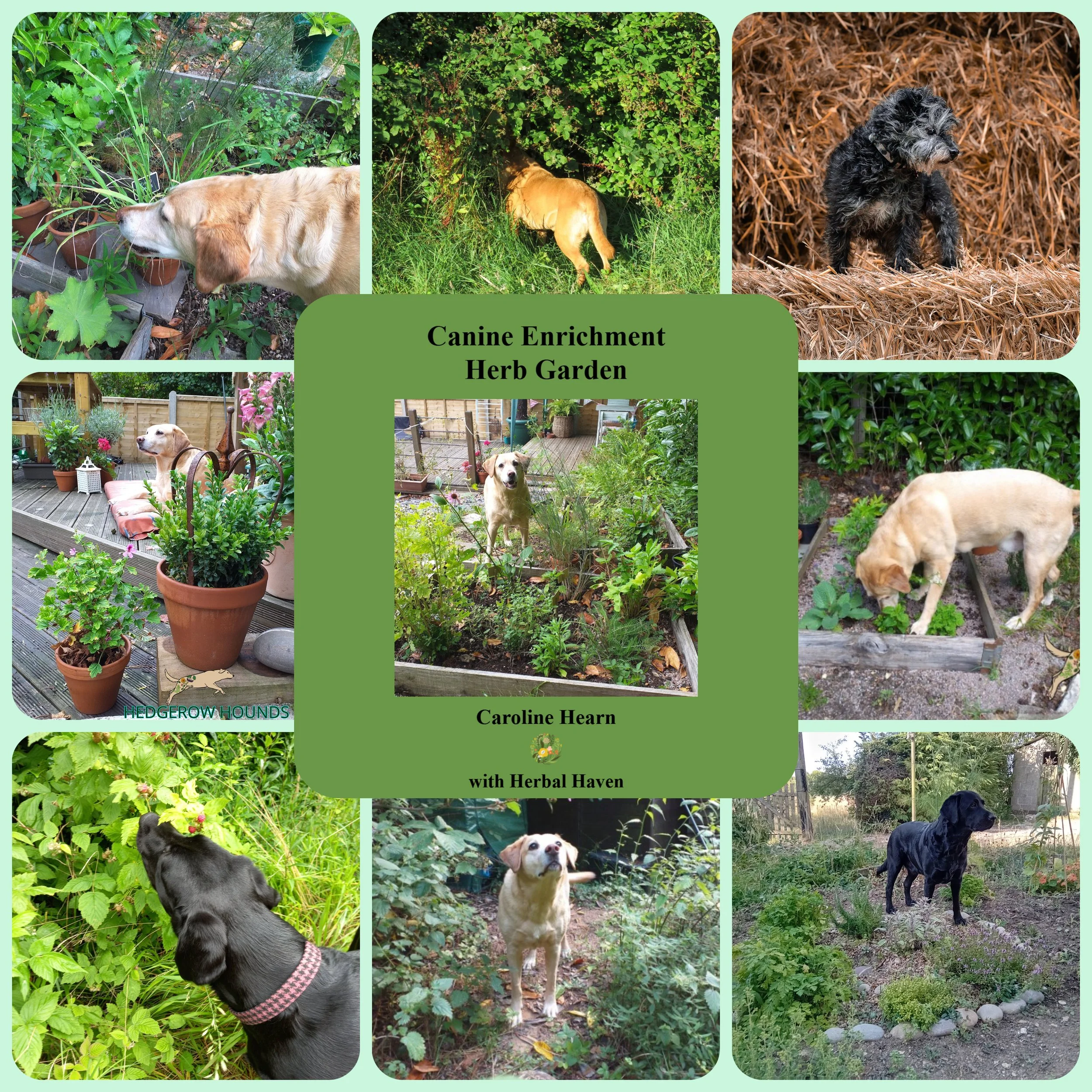
A book celebrating the love of dogs, the beauty of herbs, and the wonders of nature.
My first book is about a topic I am deeply passionate about and that has been an interest of mine for many years. It is written from a holistic approach to creating an enrichment space, using knowledge gained over the past 35 years and given to me by my greatest teachers: the dogs themselves.
So, what exactly is an enrichment garden, and why should we create one?
An enrichment garden offers dogs the freedom to move and explore at their own pace, without human interference or direction. This can be a dedicated space or incorporated into our existing garden. It encourages natural behaviours and curiosity, rather than learned responses, allowing dogs to be themselves without pressure to respond to our expectations of what they should be doing. The space will include herbs, textures underfoot, and aromas for the dog to interact with, as well as to move their body in a therapeutic way to calm the nervous system and improve mobility.
There is a section on providing enrichment for dogs with specific needs, such as the elderly, blind, or disabled dogs, as well as puppies.
Importantly, there is a chapter on ways we can benefit from this beautiful space, too.
The area we are going to create for our dogs can provide the following:
An outlet for instinctual behaviours such as sniffing, foraging, grazing, problem solving, digging, and exploring; all fantastic for reducing stress, frustration, and lowering anxiety.
Mental stimulation with scent from the environment and additional items such as snuffle mats and interactive toys.
A sensory experience with scent, sound, and texture underfoot. The garden will constantly change because of plant growth, weather conditions, seasonal changes, and what wildlife has visited the garden. Every day will offer something a little different.
Encouragement of natural movement without our influence or expectations.
Building confidence in themselves as the effects of sniffing and exploring lower the stress hormones and make the world seem a less scary place.
By going through a natural range of movements over varying textures and terrains, we are encouraging the dog to work all their body systems.
Enhanced well-being and quality of life.
A space that is appealing to look at, and that we enjoy spending time in with our dog.

We explore the many herbs that are suitable and safe for the herb garden, whether you choose to plant them in pots or directly into the ground.
With so many dog-friendly herbs to choose from, there is an extensive list in the book, as well as plants to avoid. Many are hardy and evergreen, so will provide interest all year round. If you have a small space and want to create an enrichment area in pots, then that is covered too.
Providing texture and varying terrain is also important, and how the dog’s body adapts and processes the information that is being fed back to them as they travel over hard and soft ground, slopes, and step over small obstacles.

Adding in texture, such as shingle, wood chippings, moss, mat-forming herbs, textured pathways, and sand, all add to the sensory experience.
Everything is covered to help you easily build your own enrichment garden. Important topics such as the choice of herbs, adding interactive items like snuffle mats, choosing planters and pots, soil health, the importance of a chemical-free lawn, and ways to embrace nature with your dog throughout the seasons.

Learn how simple adaptations in your garden can provide a sensory experience as well as therapeutic movement.
The book is available on Amazon as an e-Book or paperback on the link below: Here is the link https://www.amazon.co.uk/dp/B0FHKYK5T9
Or there are often paperbacks on the shop to buy. https://www.hedgerowhounds.co.uk/products/canine-enrichment-herb-garden-book
If you are looking for more help in creating your own enrichment garden for your dog or perhaps your dog has specific needs then I do offer a consultation to support and advise you. Here is the link: https://www.hedgerowhounds.co.uk/products/p/canine-enrichment-garden
The book also talks about enjoying the changing seasons and appreciating the way nature adapts throughout the year.
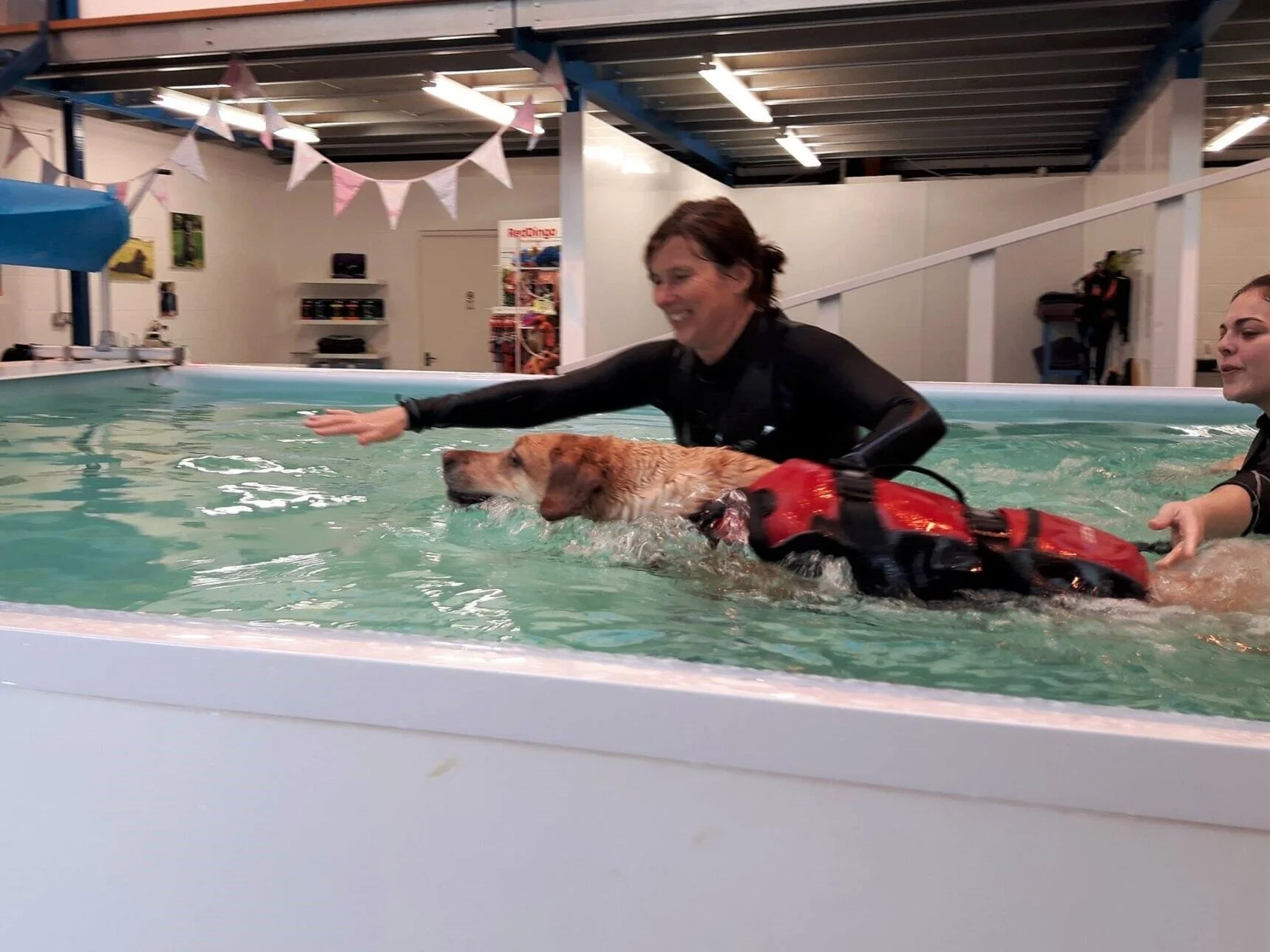
Canine Hydrotherapy, Underwater Treadmill verses Swimming
Hydrotherapy for Dogs
What is Hydrotherapy?
Hydrotherapy is a water-based therapy that provides prescriptive exercise which is functional without being painful. It can be used as a means of supporting dogs in a non weight bearing or partially weight bearing environment to allow movements that would not be possible on land, perhaps because of weakness or injury. To facilitate rehabilitation and conditioning, hydrotherapy uses key water properties, including:
Buoyancy: reduces the weight and concussion going through the limbs and makes movement easier
Hydrostatic Pressure: increases circulation and reduces inflammation, swelling and pain
Resistance: assists in restoring muscle strength, endurance, and cardiovascular fitness
Turbulence: the movement of the water which can create a more challenging environment – ideal for fitness patients.
Specific gravity: The ratio of body weight compared to the ratio of water; this helps with buoyancy.
Temperature: The warmth of the water helps in reducing swelling, inflammation, and pain, increasing blood flow, reducing muscle tension and spasms, increasing tissue extensibility, and promoting relaxation.
Underwater Treadmill Versus Swimming
Hydrotherapy typically involves either swimming in a pool or exercising on an underwater treadmill (UWTM). Both of which can be effective for increasing strength, joint range of motion, muscular endurance, cardiovascular endurance, and flexibility as well as reducing pain and effusion, and promoting psychological well-being. The decision about whether an UWTM or pool is most suitable for your dog is an important one that should be made on a case-by-case basis by a qualified Veterinary Physiotherapist or Hydrotherapist. Here are a few reasons why we may recommend one over the other:

Advantages: Underwater Treadmill
· Allows for earlier rehabilitation following injury or surgery
· Ideal for gait training and speeding up gait retraining – particularly useful for neurological patients to help with gait patterning with the support of the water. Interestingly, many neurological patients walk in water before they do on land.
· Improved balance whilst walking
· More suitable for certain clinical conditions and injuries that require more controlled movement versus swimming.
· Ideal for dogs that are nervous about swimming – dogs often feel more relaxed when they can touch the floor so are less likely to panic
· More natural gait pattern
· Joint extension is more complete compared to swimming. This can be helpful in conditions such as hip dysplasia or hip arthritis whereby limb extension is often difficult for the dog.
· Encourages equal weight bearing
· Functional carry over to land is often quicker
· The water height can be adjusted to decrease/increase weight bearing and achieve movements and muscle activation that we are targeting
· Based on Wolf’s Law, weight bearing on the UWTM may encourage increased bone strength over swimming alone.
· Allows observation from all sides
· We can be more hands on to aid the dog’s gait and movement patterns
· Speed, incline, and duration can be adjusted to suit the dog
· More targeted muscle development
Disadvantages: Underwater Treadmill
· Can strengthen gait abnormalities if not properly corrected by the Hydrotherapist
· Not as suitable for amputees
· Some dogs may be unsure about the movement of the belt or being confined in a smallish space
· The retraction of the belt may cause too much strain on certain tissues if the Hydrotherapist does not provide appropriate support

Advantages: Swimming
· Enables the dog to be completely non weight bearing - this removes all the forces and concussion through the joints which is useful when weight bearing is painful.
· Great for core strengthening
· Greater cardiovascular strengthening, weight loss and increasing overall fitness
· Potentially more suitable for amputees and dogs unable to bear any weight of their own
Disadvantages: Swimming
· Not suitable for fearful or nervous swimmers
· Unsuitable for many injuries in the early stages of rehabilitation. For example, in dogs who have recently had surgery for a cranial cruciate ligament injury, swimming could place too much twisting, torque and pressure through the joint and potentially lead to further damage.
· Not as effective for improving joint extension
· Can cause dogs to hollow through the neck and back causing too much strain on these areas

Most dogs will benefit greatly from hydrotherapy; however, remember it is not a stand-alone treatment and should always be combined with physiotherapy and lifestyle/environmental changes. Lastly, always get advice from your Veterinary Surgeon before taking your animal for treatment.
Danielle Everett, PgD, BSc
Veterinary Physiotherapist & Canine Hydrotherapist
Member of NAVP, NARCH & AHPR Tel: 01932 574300 Mobile: 07824552033
Email: physiohydro@wearecoa.com Web: www.companyofanimals.com
Company of Animals Pet Centre
Ruxbury Farm, St Ann’s Hill Road, Chertsey, Surrey, KT16 9NL
