Styles of Raw Feeding
There are a number of ways to feed your dog a raw food diet. Here we explore the different styles and what will suit your dog and your own lifestyle.

There are several different ways to feed your dog a raw diet.
For some people it is personal preference, what suits their individual dog or what can be fed due to the availability of certain ingredients.
BARF
The most popular way to feed a raw diet is the BARF method which stands for Biologically Appropriate Raw Food or Bones and Raw Food.
Many barf complete meals add seasonal vegetables and include supplements so be mindful if you are also adding supplementation to these meals that you are not giving an excessive amount or doubling up on one particular supplement.
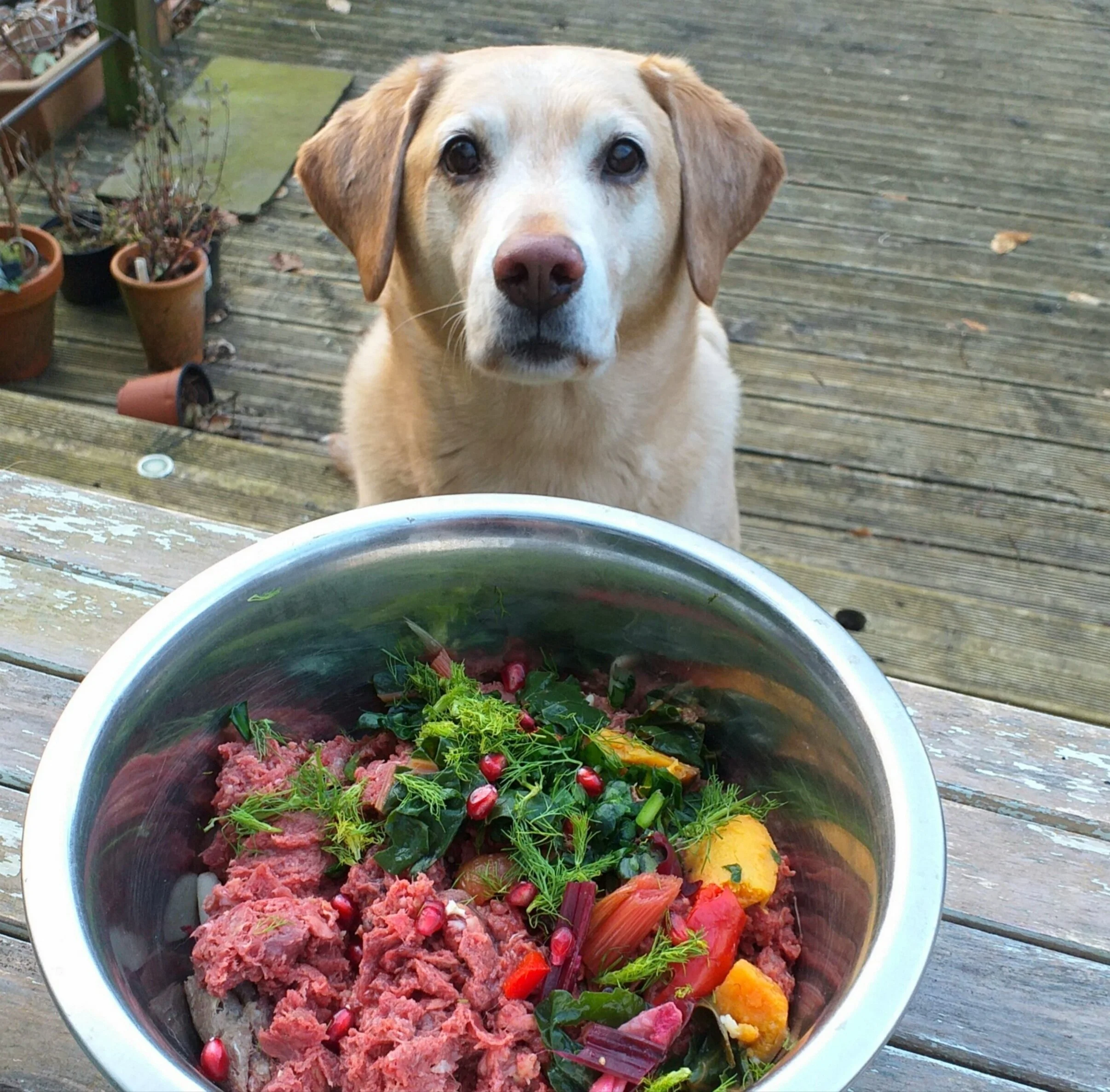
They tend to follow the percentage of 70% muscle meat, 10% raw minced bone, 10% offal (5% of which is liver) and 10% vegetables although there are variations within the brands some of which omit offal altogether and others will include 20% vegetables.
It may be a case of trial and error until you find a brand that suits your dog. Most of the raw manufacturers now offer a large range of proteins making it easy to rotate the type of meat and offer a good variety.
Barf meals are usually packaged in convenient tubs or tubes and are simply defrosted and served. This is a good way to feed if the owner is hesitant to handle raw meat or alternatively there are raw meals provided in the form of sausages which are simply lifted out with a fork directly into the bowl.
80-10-10: You can buy ready made complete meals with an 80-10-10 ratio in which 80% is muscle meat, 10% raw minced bone and 10% offal.
80-10-10 is a good choice it you want to either omit vegetables or have the flexibility to add your own.
Prey Model Raw (PMR) or Whole Prey: Prey model feeders try to replicate a very natural diet and will often not add any vegetable matter. Typically, the diet follows 80% muscle meat, 10% whole raw bone, 10% offal (5% of which is liver) The muscle meat tends to be offered in large whole pieces rather than a mince. When using the whole prey method an entire prey animal is fed such as a rabbit, quail, fish, pigeon or chicken etc which has the fur and feather left on to add to the ration. It can be difficult to source many different types of whole prey in order to add variation and not every dog will eat this way.
DIY: This can be the cheapest way to feed a raw diet but it does require additional research in order to get the correct ratio of meat, bone and offal plus a reliable source of ingredients in order to rotate the proteins and provide a broad range of nutrients. Making up your own meals gives flexibility and can be useful for dogs that need certain proteins omitting from their diet due to intolerance and sensitivities, but it is important to seek advice in order to provide all the essential nutrients that your dog needs to thrive.
Caroline Hearn ISCP.Dip.Canine.Raw.Nutrition, Dip ICAT
Eggs are great for our Dogs !
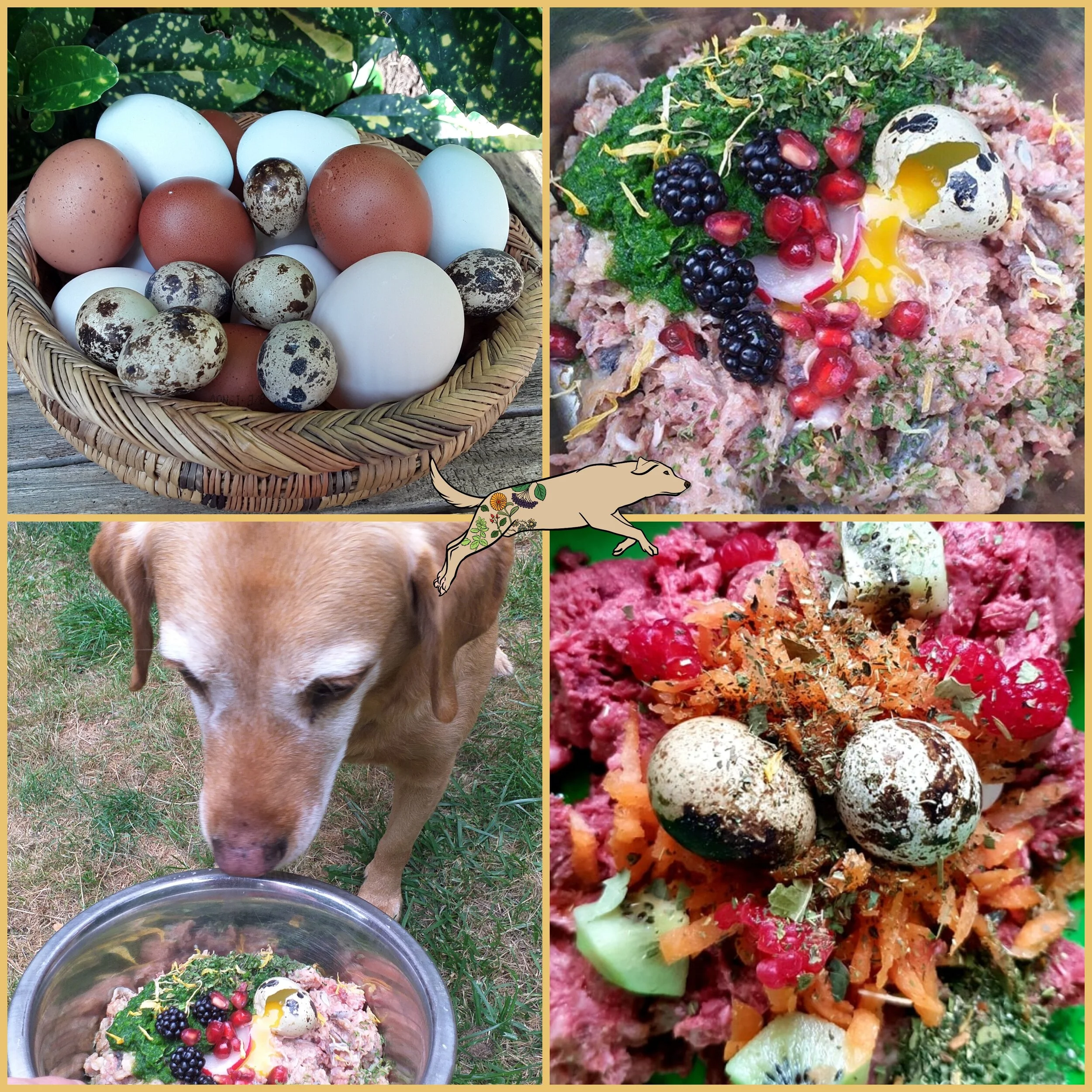
Either fed raw or lightly cooked, eggs are a valuable addition to our dogs diet.
Eggs provide a high quality, complete source of amino acids which are the building blocks of protein.
A good source of vitamin A, B12, Riboflavin, Iron, Folate, Zinc, Selenium, Fatty acids, Choline, Fat soluble vitamin E,D and K and provide the ideal ratio of calcium and phosphorous, if the shell is also fed.
Just one egg will provide 13 essential vitamins and minerals, including lutein which is essential for eye health. Egg whites contain a substance called avidin which affects the uptake of biotin, but the egg yolk has high levels of biotin. So, unless you are feeding just the egg whites on a regular basis rather than the whole egg there shouldn’t be an issue.
Egg shell can be used as a calcium supplement, and the inner membrane of the egg contains an abundance of nutrients to support joint health. This opaque membrane will provide collagen, elastin, glucosamine, chondroitin and hyaluronic acid.
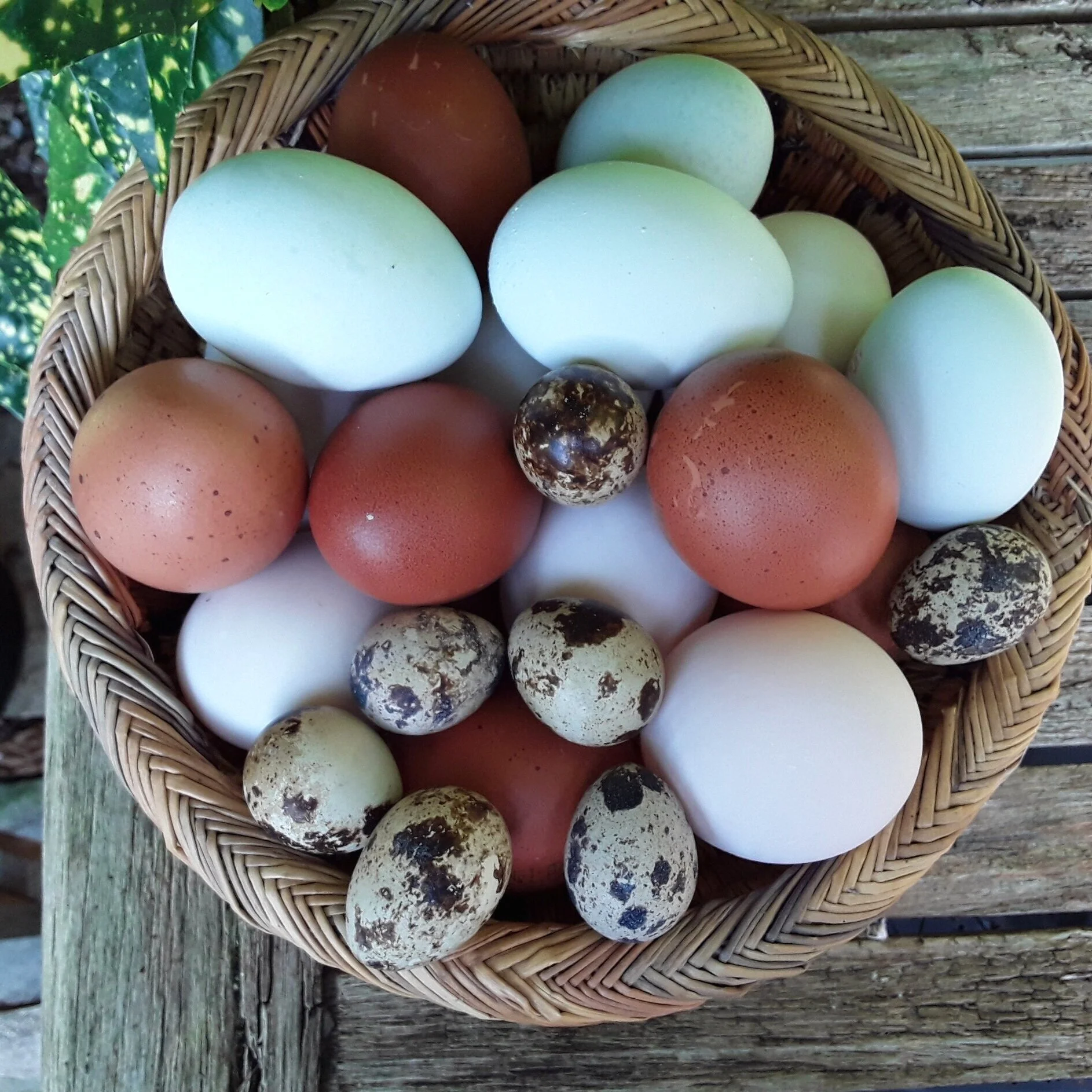
Feeding a selection of eggs including chicken, duck, quail and guinea fowl will offer a broader range of nutrients. One thing that is essential, is that the eggs must be free range and preferably organic as these are higher in animal welfare as well as offering higher levels of the anti-inflammatory Omega 3 fatty acids. These free range birds will have benefitted from a natural lifestyle of foraging, had sunlight on their backs and lived a more relaxed life.
The eggs pictured are from a local farm shop where the hens & ducks can be seen roaming free. The eggs are higher in nutrition as the birds have access to a natural lifestyle of foraging and I know that the shells haven`t been sprayed with chemicals unlike many supermarket eggs, which is important if you are going to feed the shells.
Duck eggs have a larger yolk to white ratio and are higher in protein, fat and contain more Omega 3.
Quail eggs although tiny, have large amounts of vitamin B1 and 5 times as much iron and potassium as hens eggs. Their protein value is 13% where as hens eggs are 11%. Quail eggs rarely cause allergies or sensitivities so worth considering if eggs normally cause problems.
Your dog will benefit from eating free range organic eggs 2-3 times a week.
Eggs can be offered whole, either raw or lightly cooked or broken onto your dogs usual food. If you would rather cook them then a scrambled or boiled egg very lightly cooked will be well received.

There are almost 200 different breeds of chickens in the world, and one hen will lay anything between 250 and 300 eggs a year !
www.hedgerowhounds.co.uk