Styles of Raw Feeding
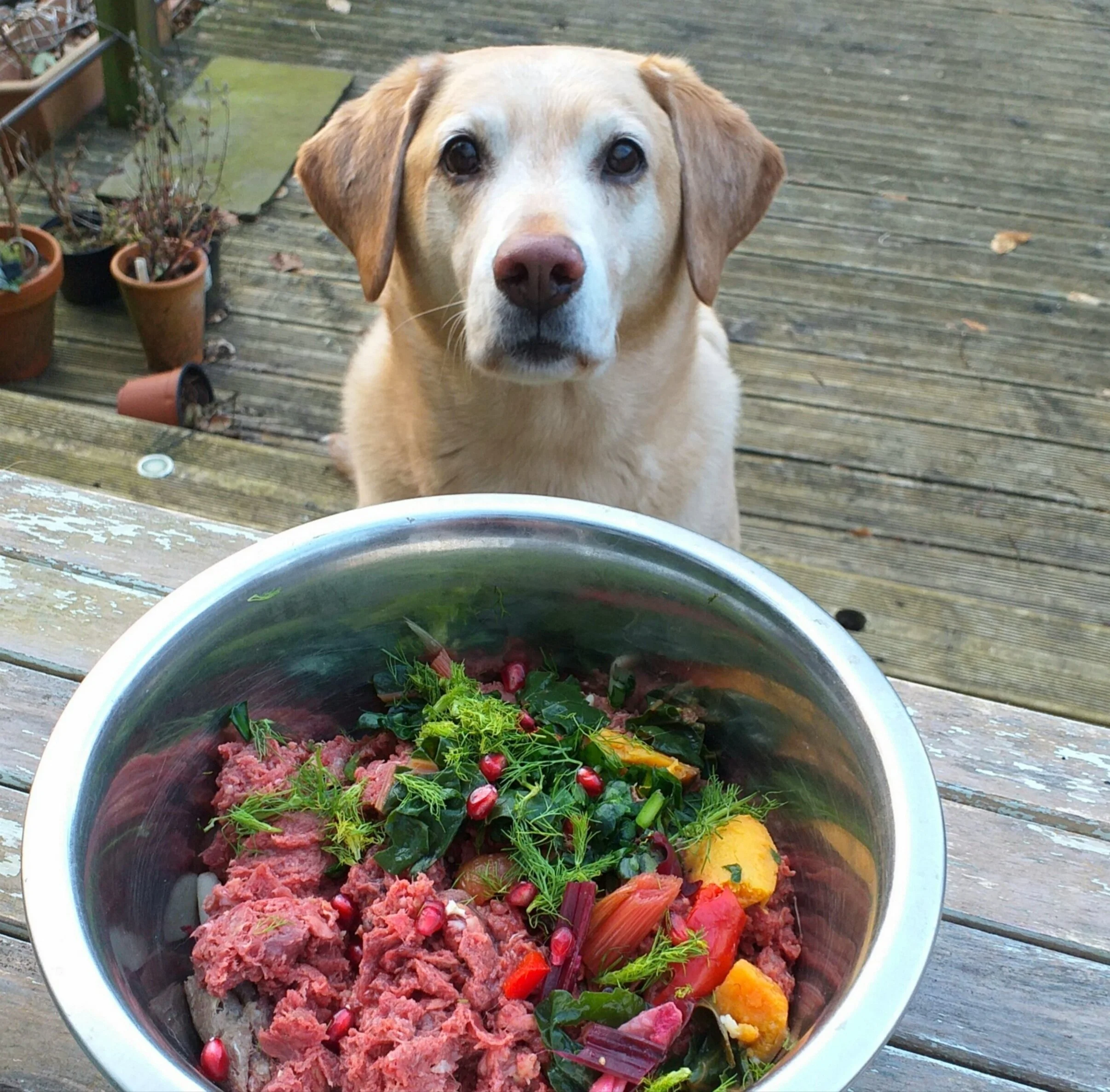
There are a number of ways to feed your dog a raw food diet. Here we explore the different styles and what will suit your dog and your own lifestyle.

There are several different ways to feed your dog a raw diet.
For some people it is personal preference, what suits their individual dog or what can be fed due to the availability of certain ingredients.
BARF
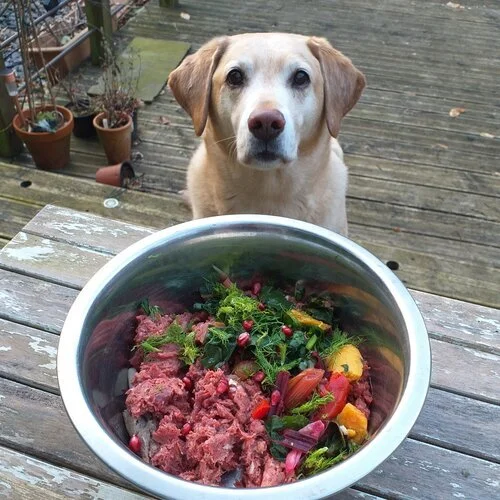
The most popular way to feed a raw diet is the BARF method which stands for Biologically Appropriate Raw Food or Bones and Raw Food.
Many barf complete meals add seasonal vegetables and include supplements so be mindful if you are also adding supplementation to these meals that you are not giving an excessive amount or doubling up on one particular supplement.
They tend to follow the percentage of 70% muscle meat, 10% raw minced bone, 10% offal (5% of which is liver) and 10% vegetables although there are variations within the brands some of which omit offal altogether and others will include 20% vegetables.
It may be a case of trial and error until you find a brand that suits your dog. Most of the raw manufacturers now offer a large range of proteins making it easy to rotate the type of meat and offer a good variety.
Barf meals are usually packaged in convenient tubs or tubes and are simply defrosted and served. This is a good way to feed if the owner is hesitant to handle raw meat or alternatively there are raw meals provided in the form of sausages which are simply lifted out with a fork directly into the bowl.
80-10-10: You can buy ready made complete meals with an 80-10-10 ratio in which 80% is muscle meat, 10% raw minced bone and 10% offal.
80-10-10 is a good choice it you want to either omit vegetables or have the flexibility to add your own.
Prey Model Raw (PMR) or Whole Prey: Prey model feeders try to replicate a very natural diet and will often not add any vegetable matter. Typically, the diet follows 80% muscle meat, 10% whole raw bone, 10% offal (5% of which is liver) The muscle meat tends to be offered in large whole pieces rather than a mince. When using the whole prey method an entire prey animal is fed such as a rabbit, quail, fish, pigeon or chicken etc which has the fur and feather left on to add to the ration. It can be difficult to source many different types of whole prey in order to add variation and not every dog will eat this way.
DIY: This can be the cheapest way to feed a raw diet but it does require additional research in order to get the correct ratio of meat, bone and offal plus a reliable source of ingredients in order to rotate the proteins and provide a broad range of nutrients. Making up your own meals gives flexibility and can be useful for dogs that need certain proteins omitting from their diet due to intolerance and sensitivities, but it is important to seek advice in order to provide all the essential nutrients that your dog needs to thrive.
Caroline Hearn ISCP.Dip.Canine.Raw.Nutrition, Dip ICAT
Resource Guarding

Mine, all mine !!
Resource guarding is what happens when a dog tries to control access to something it values highly. It is usually food, bones, toys, people or places, but it can be anything the dog finds it wants more than another dog or a human.
Not all dogs will resource guard though; some will guard one thing or just in one particular situation, while others guard everything, everywhere! Many dogs don’t resource guard at all.
You might think that dogs in animal abuse cases, who have been starved, are more likely to guard food, but it isn’t always the case. Sometimes it is the dog who has food available all day long or who is overweight that guards their food. You won’t be surprised to learn that the dogs who do guard, do it with varying degrees of intensity.
Why do they do it?
It is something that has been a very successful strategy for dogs during their evolution. He who controls the resources, eats today or has shelter tonight! So, resource guarding is instinctual and has provided an evolutionary advantage to some dogs over many years.
It also used to be a behaviour that was better understood and tolerated in the past. It used to be the case that most people would say “don’t go near that dog, he is eating/has a bone/sleeping (take your pick)”. I wonder why have we apparently lost that level of understanding of this behaviour? Perhaps it is the increased number of multiple dog homes we have nowadays? Perhaps more frequent fights are occurring where two or more dogs in one household resource guards?
How do you recognise it?
Dogs resource guard by using defensive body language. Hunching over the item and showing the whites of their eyes is a good first indicator. They may put a paw on it indicating ‘this is mine!’ to whoever is approaching. They might run over, barge past you and grab an item – a bone or a toy – if another dog or person dares to approach it.
It is generally explicitly clear that they want it for themselves, and they are not going to give it up easily. If no one is likely to get injured (human or dog), perhaps this behaviour can be viewed as, fair enough! Dogs have very little choice in their lives nowadays so why not let them keep something they value so much?
If it is safe and not going to do anyone any harm, I personally, would probably leave a dog to it. Dogs in my household seem to respect it and are perfectly happy to allow the resource guarder amongst them to get just on with it. The item is clearly not that valuable to the other dogs. It is almost like they have personal preferences and are accommodating to each other. However, if a dog is unfairly resource guarding all the toys, all the bones etc, then yes, I would step in, to even things up. I won’t tolerate one dog bullying the others.
What happens when the item being guarded is dangerous to them or valuable to me?
Sometimes though, it isn’t well tolerated by the other dogs in a household, or a dog resource guards from a human. What happens if the item is not safe for the dog to keep? It might be something inappropriate, like a tv remote, a child’s toy or worse, something that is downright dangerous for the dog – your dropped medication! Then you would want a way to safely take it away from the dog without getting injured or causing a huge rift in your relationship by having a ‘stand-off’ or confrontation with your dog.
What not to do!
So, what could you do when you are facing a lip lifting or growling dog who now sees you as the person who is going to take away the most valuable thing they have ever had in their entire life? Well, the one thing you shouldn’t do is chase them or attempt to get the item away from them. If you do, you or someone else could get injured. Badly!
All that chasing and tugging teaches a dog is that it must be an ultra-valuable resource, really worth guarding, at all costs! Sadly, all you have done is reinforce that it is definitely worth guarding. They may even think it is a fun game that you are happy to partake in and do it all the more just to get some additional attention from you.
Prevention is better than cure
My first important advice is to understand when your dog is likely to resource guard so you can take steps to prevent it. Write a list of all the occasions your dog guards’ items. Most people know about food, bones, chews and toys but it can also be dog beds (or your bed), clothing, chairs, your lap, an area under a table and even things with particular scents.
Writing down what they guard and where they guard it, taking into consideration what time of day it is, are they hungry or full, previously relaxed or excited, at home or away from home, guards from other dogs or people, feeling ill or are in good health, in pain or not, will be extremely valuable information for you and any behaviourist you subsequently engage to help you.
If you know when it is likely to occur, then you can put in place measures to ensure it is either prevented altogether or at least minimised. Your plan may include clearing up the children’s toys before allowing your dog into the room, making sure the remote control is not left in a place accessible to your dog (this may be valuable as it will smell of you). All the socks and shoes are tidied away promptly, and medications are handled well away from your dog over a kitchen or bathroom worktop. Bones and chews can be picked up when your dog is safely away from them (perhaps while they are having their dinner or out on a walk). Prevention is absolutely vital!
What do you do if they get hold of something they shouldn’t have?
You will need a strategy to handle the times when you have not been able to prevent it and I would suggest the first thing you do is take a deep breath and keep calm. Then, walk away and say, ‘Let’s Go’. This means you walk into another room, for me it is the kitchen, where there is a treat jar full of my dogs’ favourite goodies.
Then ask for a well-practiced behaviour or ‘trick’ - a sit, a wave or a down, something you can cue them to do and then can reward them for doing it. As their reward, toss them a treat (in the direction furthest away from the thing they were resource guarding) and while they are distracted retrieving the treat, calmly walk the other way, close the door between you and your dog and pick up the item they discarded in their excitement to follow you. Return and carry on with some more sits, downs, waves and shaking of paws. It’s a fun time for them, they are getting rewarded, and the guarded item is almost certainly forgotten.
Being prepared for when prevention fails
Okay, this doesn’t happen without training. The ‘Let’s Go’ cue needs to be well practiced and practiced without the resource guarding actually happening. Don’t leave it until you have a situation you need to handle. It needs to be an instinctive reaction to your invitation to leave the room and your dog needs to know for sure that they will be getting an opportunity to perform an easy ‘trick’ for a huge reward.
By adding in a cued trick or behaviour, you are breaking the link to the guarding eliciting a reward (for those that were wondering about us just rewarding a dog for guarding). It is a distraction technique that can get you out of all sorts of bother indoors or out. Teach this one now and think of it as an emergency technique included in your toolkit.
Teaching an alternative ‘mutually exclusive’ behaviour
The other thing that worked wonderfully well for me was teaching my dog an alternative behaviour that he just couldn’t do while holding on to his resource guarded item (a mutually exclusive behaviour). Firstly, I taught him how to catch a toy and eventually the game of ‘fetch’. I did spend quite a long time sitting with an open hand waiting for the exact moment he dropped it, just to be able to capture the moment with a ‘yes’, before throwing it back to him, showing him there was more fun in releasing the item than holding on to it. I eventually added a cue, ‘drop’.
Once he got the idea of catching, fetching and dropping, and realised how much fun it could be, he never resource guarded a toy ever again. Well, almost never! A brand-new toy might be guarded for the first 5 minutes but after that it was just like all the other toys in the house; meant for sharing and being caught in mid-air and not for holding on to it for hours at a time (and he did at first)!
Using an old ‘low value’ toy that your dog doesn’t guard when working on teaching catch, fetch and drop will help speed things up. Other things you could teach is ‘leave it’’, ‘go to your bed’, ‘wave’, shake paw’, or ‘back-up’.
Seeking professional help
Of course, if you are worried about your dog biting (in this or any other situation), then you really should seek help and I recommend you always look for a positive, force-free, rewards-based behaviourist.
Please avoid anyone who tells you that you need to punish your dog for resource guarding (or anything else!). It won’t help and it can make things worse. Remember it has been a successful strategy for dogs for many thousands of years and it is a perfectly natural instinct that some dogs utilise more than others.
Don’t allow dogs to sort it out amongst themselves (well, not all the time)
Dogs have a way of setting rules for themselves, for example, if one dog has a toy between his paws and is looking at it, then he should be able to keep it and the other dog should respect that. However, if the toy is between their paws and they are looking around, that usually indicates that the other dog is free to take it. This is great communication and the last thing you want to do is intervene as you could just spoil their perfectly normal relationship.
Finally, if you have more than one dog that resource guards, please don’t allow your dogs to ‘sort it out amongst themselves’, this could be terribly dangerous. They are unlikely to come up with a ‘pecking order’ no matter what your friend who ‘has had dogs all their life’ says! It is much more likely, they will fight! If you then try to intervene you will almost certainly get injured too.
Living with that level of tension and possible intimidation in a household is stressful and can cause other behavioural issues and even stress related illnesses. Much better to get professional help, well before you end up with expensive vets’ bills!
June Pennell, ISCP.Dip.Canine.Prac., MCMA ISCP Principal
Qualified behavioural help can be found at this link Practitioner | The ISCP
Holistic Care of your Senior Dog
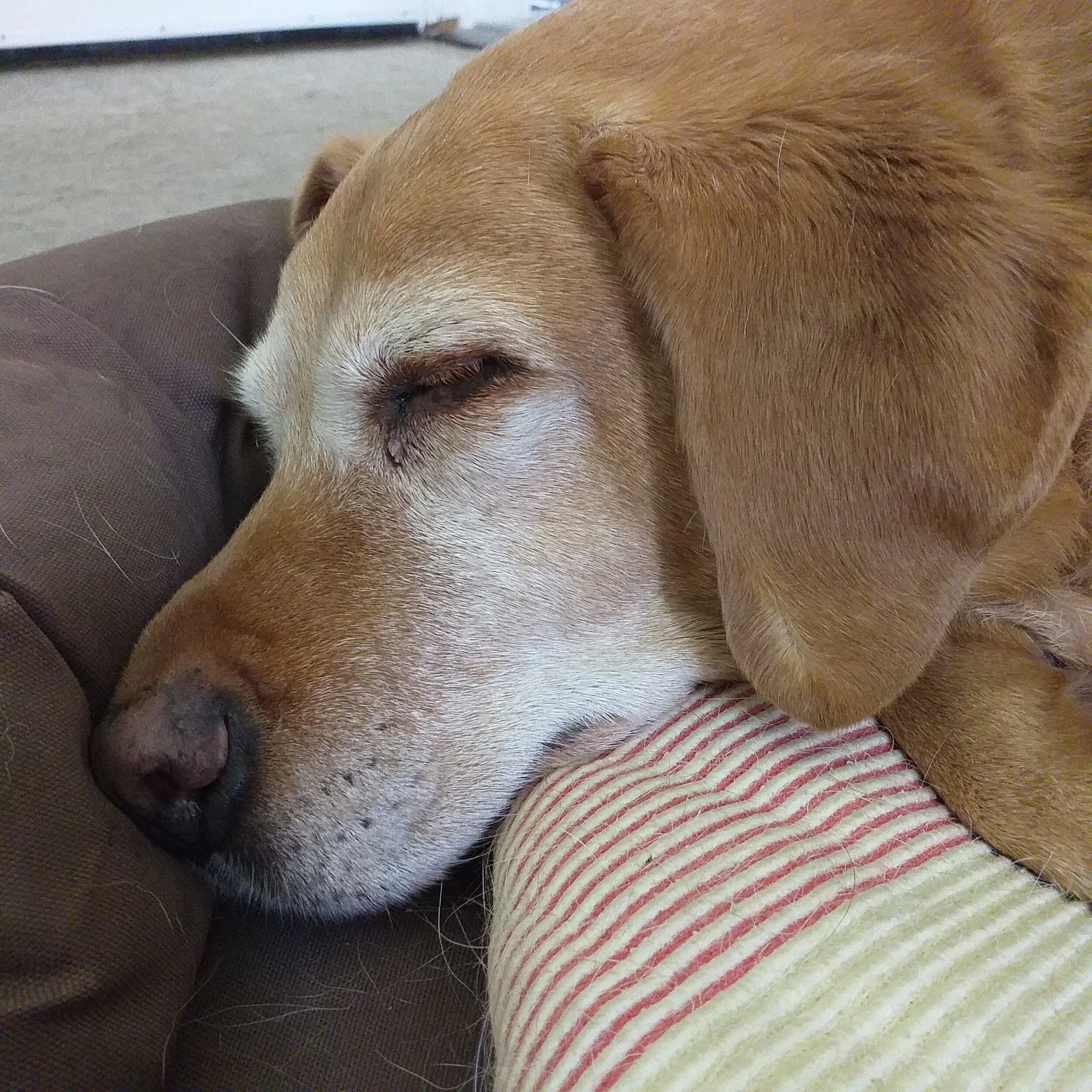
It is inevitable that as our beloved dogs age their requirements will change and they start to show visible signs of slowing down and a reluctance to perform tasks which they once enjoyed.
Here are a few pointers to look out for and changes to put in place which can make a positive difference to your senior dogs quality of life and make the transition into their golden years a little easier.

Possibly the first sign that your dog is feeling his advancing years is loss of mobility, general stiffness or a reluctance to do certain activities.
Noticing that our dog is limping is an easy sign to spot but sometimes things can be much more subtle. They could suddenly refuse to jump in or out of the car, be constantly licking their legs, struggle to lift themselves off of their bed, exhibit uncharacteristic behaviours or are starting to no longer be clean in the house.
Weight reduction: Excess weight certainly makes it more difficult to improve or manage health complaints, particularly where joint pain is concerned. It will also mean that the positive lifestyle changes that you put in place are less successful.
“Fat is not inert, it contains precursors of inflammatory mediators, which is like petrol on an arthritic joint fire” H Capon - Canine Arthritis Management
Pain relief and Supplements Many people are reluctant to resort to veterinary prescribed medication for pain relief but they can be really useful in the overall management of pain and inflammation and if used alongside an entirely holistic approach you can often greatly reduce the use for drugs altogether. It is important that the dog is not in pain and is encouraged to gently exercise with minimal compensatory movement, this will allow muscle tone to improve which aids in supporting fragile joints, maintaining weight loss and increasing the range of movement in joints. Non-steroidal anti inflammatory drugs (NSAIDs) are not without their side effects in longer term use particularly where the kidneys, liver and stomach are concerned, so this is why it is really important to make many other lifestyle changes that give an overall improvement to health and not just rely on medication.
There are many supplements available for aging dogs which can help with mobility issues brought on by old age. It is important to start early particularly with a dog who has been very active or for working and competition dogs that have suffered more wear and tear over the years. Glucosamine, chondroitin and green lipped mussel based supplements have been popular for some time in helping to improve the mobility of joints but there are also other natural ingredients that are often added such as Boswellia serrata, msm (methylsulfonylmethane) and turmeric which are used to for their anti-inflammatory properties. The inclusion of Omega 3 fatty acids in the diet is a great idea for mobility, improved coat and skin and overall reduction in inflammation.
Suitable Flooring & Home Improvements: Inappropriate flooring such as laminate and slippery tiles can really take their toll on arthritic, frail or nervous dogs. They struggle to grip on the surface underneath them causing strain on their joints, risk of falls and it can really knock their confidence. Simple additions of rubber backed runners and mats in these areas can make a huge difference.
Keeping any excess hair in between the pads, well trimmed will prevent slipping and also very importantly, keep the nails short. I will explain why this is just so important in managing the arthritic dog in the blog https://www.hedgerowhounds.co.uk/news/paw-and-nail-care
Use a car ramp It is so much kinder to your dogs joints and particularly to their shoulders than jumping in and out of the car, not to mention the potential strain to your own back if you lift the dog to and from the boot of a car.
Take time to get them used to going up and down the ramp on a lead and support them by cradling chest and hind end or use a suitable harness to guide them up if necessary until they get confident using it, make it fun by using treats, it will be worth the effort and invaluable as the dog gets older. Purchase one that you find easy to use and importantly has non slip footing and ideally it should have a raised border which can help blind dogs sense that they are close to the edge of the ramp whilst walking up it. Read our blog for more advice on this: https://www.hedgerowhounds.co.uk/news/teaching-your-dog-to-use-a-car-ramp
Dog beds Elderly dogs sleep a lot so providing a soft bed which offers protection and support for their joints is crucial. Some dogs love to stretch out and others curl up in a ball, so bear this in mind when choosing a bed. If you have the hard plastic beds make sure they are big enough so that the dog isn`t forced into an unnatural shape and that they have enough room to stretch out when needed, this is particularly important for neck and limb comfort. I find that senior dogs cope better with a raised bed, as this aids in getting up from a prone position. Not so high they have to jump down from it but raised enough to assist in getting on and off with ease. There are many new orthopaedic style dog beds that are really supportive and much more suitable than many blankets which end up entangled around the dogs legs and offer no support to the body.
Additional warmth can really help arthritic and elderly dogs, particularly in winter. The heat pads that are filled with wheat and placed into the microwave are very useful and for longer periods of constant heat, the Pet Remedy heat pad is excellent.
Exercise Requirements will start to change and this can become tricky in a multiple-dog household if you have an oldie that still thinks they can keep up with the younger dogs and as much as they enjoy themselves at the time the following days can see them really struggle because they have overdone it. There will come a time when the older dog needs to be walked separately so they get the benefit of exercise that is appropriate for them at their level of mobility.
Inappropriate exercise such as repeated ball throwing or vigorous tug-of-war games will have to become a thing of the past as they will undoubtedly undo any of the good work put in place with a holistic healthcare plan.
If you have very elderly or frail dogs then all they need is a mooch around the garden or a very gentle short stroll, leaving them to dictate the pace. One of a dog’s greatest joys is sniffing and following a scent, so to prevent them from doing this is taking away one of their basic needs. It is so upsetting to see people dragging their elderly dogs behind them on a lead, it causes the dog stress and puts tremendous strain on their joints and muscles as they try and keep up with the handler.
Many dogs lose their confidence and feel vulnerable as they become frail or their eyesight and hearing fails, often becoming vocal or reactive, maybe for the first time in their life. See this as a sign that they are not coping well with the environment they are being exercised in and only allow familiar, calm dogs to interact with them or take the dog somewhere very quiet where they feel safe.
Complementary therapies are really helpful for the older dog and help keep them mobile. Massage and gentle body work is excellent and can pick up muscle weakness, compensatory movement, stiff joints and tight shortened muscles which when all the information is put together helps form a picture of how your dog is using their body and why that may be so. Ask your therapist for some homework you can do in between treatments. Heat pads are a good idea for very cold weather or use a soft fleece dog coat for additional warmth. Acupuncture is a fantastic treatment for the elderly dog and helps in managing arthritic conditions in particular. The fine needles are applied in very precise areas of the body to stimulate the release of endorphins which are the body’s own form of pain relief.
Age-related cognitive decline Is the canine equivalent of dementia which can vary in its symptoms from mild to severe. The symptoms can include staring into space, confusion at which way a door opens even though the dog may have used the same doorway for years, restlessness and becoming vocal at night, soiling in the house, and extreme changes in temperament towards people and other dogs. It is important to rule out other physical factors such as pain, infection, or sudden decline in eyesight for instance before coming up with a plan of action to manage the situation.
Although there is no cure for cognitive decline providing the dog with stimulating mind games such as hunting for treats and toys in the garden or using food puzzles and snuffle mats can help keep their minds active. The inclusion of antioxidants and omega-3 fatty acids in the diet will also help in some way to slow the decline down if the initial symptoms are spotted early.
Listed below are supplements that are targeted to support the needs of the aging dog and are all available on the Hedgerow Hounds shop.
The Golden Years herbal blend is handmade specifically to support the needs of senior dogs. https://www.hedgerowhounds.co.uk/products/golden-years-1
Carnivore or Omnivore?

Whether dogs are carnivores or omnivores seems to spark many a passionate debate.
All their anatomical attributes point to them being facultative (scavenging) carnivores. Which in general terms means that they are predominately meat eaters but they can, if needed survive on plant matter.
One way to explore what our dogs are designed to eat is to look at their anatomical and physiological features and what nature has given them in order to survive to the best of their abilities.
Dogs come in a vast array of shapes, sizes and specific breed types but basically their anatomy and how their bodies work has barely changed over thousands of years.
The natural wild survival and behavioural traits may have lessened over the centuries but there are still many attributes that our pet dogs have in common with their distant ancestors.
Scenting ability
Nature has given the dog the most exceptional sense of smell for a very good reason. Dogs dedicate 33% of their brain for the very important task of following a scent, which is essential if you need to track and kill your own dinner or seek out something tasty to scavenge.
Their ability to recognise a scent is exceptionable and with 300 million olfactory receptors compared to our 5 million they are in a different league to most other mammals when it comes to scenting ability.
A dog can quickly use his nose to gain lots of information about his environment and also to detect species that have travelled through the surrounding area. They also have the physique to run at speed with their nose a matter of centimetres from the ground and to follow a scent over many miles, even when the “prey” has long since passed by.
Dew Claws
Dogs have a pointed dew claw on the inner aspect of their front legs which does not come into contact with the ground until they are moving through the faster paces, then it provides a very important role.
Many people think that dew claws have no purpose, but if you have ever observed a dog eating a raw bone you will see that they dig the dew claw into the meat or sinew to position and prevent movement of the bone while eating.
Dew claws also have a vital role in stabilising the lower leg and in particular when cornering at speed, as there are five tendon attachments coming off it leading to muscles that prevent twisting of the limb when it comes into contact with the ground. This can prove essential in injury prevention when travelling over uneven terrain at high speed, such as the chasing of prey or needing to flee a source of danger.
Head
Carnivores have very big jaws in relation to the size of their heads. Although they have reduced facial muscles to allow for the opening of the mouth, the primary muscles that operate the jaws are the large, developed temporalis muscle on their skull and combined with powerful neck and shoulder muscles, overpower, hold prey , crush bones and have the strength to carry away items that have been scavenged so they can be eaten in a safe environment.
Teeth
The teeth of the dog are probably the biggest clue as to what canines are designed to eat. Like a Swiss army knife, each group of teeth have a very specific job to do in order to deal with capturing, puncturing and devouring almost a whole carcass. None of the structure or function of the dogs teeth and jaws lend themselves to eating or grinding cereals.
Incisors are the small teeth at the front of the mouth, they are used to nibble and strip away sinew and meat from the bone.
Canine teeth also referred to as fangs or cuspids are the long pointed teeth used for holding and puncturing flesh. There are two canines in the upper jaw (maxilla) and two in the lower jaw (mandible). They are single rooted teeth and the upper canine tends to be longer and more pointed than the lower.
Premolars are designed to crush and slice due to their uneven surface and scissor like action. There is a modified molar called a Carnassial which you will see as the largest and most jagged premolar. It has three roots and is a heavy-duty tool to crush bones and meat. A dog will often tilt their head to one side to gain full use of this tooth when gnawing on a bone or to slice through a large chunk of meat for easier swallowing. The top jaw has two molars each side and the bottom jaw has three which are used for crushing.
Mouth
Dogs do not have any side to side action in their jaws so unlike ourselves or herbivores they can’t grind their food before swallowing. Their jaw is a simple hinge joint and has a chomping up and down movement and a strong, muscular tongue which can manipulate food to where it can be crushed by the powerful jaws.
They do not possess any salivary amylase, which is a specialised digestive enzyme that herbivores and omnivores produce in their mouth and together with the chewing and grinding action of the molars starts to immediately break down starchy carbohydrates before we even swallow.
The oesophagus is capable of allowing the passage of large pieces of meat, after all the dog isn't capable of breaking the meat down by chewing or salivary amylase, so it needs to get the food to where that can happen, which is in the stomach.
Stomach and Digestive tract
Dogs have a short digestive tract so they can expel waste quickly which is particularly important if they have been eating food that is covered in bacteria.
We have all seen dogs eat the most disgusting and decaying of items, which if eaten by ourselves would have us omitted to hospital, yet at worst they may have a slight upset tummy for 24 hours.
They have an incredibly strong stomach acid of around pH1 which is needed to break down large amounts of protein, to dissolve bone and as a protection against any decaying food that may have been scavenged. The walls of their stomach are covered in a thick mucosa to provide protection from the corrosive acid and to literally stop the stomach from digesting itself.
Dogs produce amylase in their pancreas which is passed into the blood stream to assist in digesting carbohydrates.
All the leading dog food companies state that dogs have no nutritional need for carbohydrates in their diet, yet they appear in very large amounts in the majority of processed foods.
Recent studies have shown that there has been some adaptation over the years in dogs’ ability to digest starch. One study comparing wolves to our domestic dogs showed that dogs of today had between 4 – 30 copies of a gene code for amylase while wolves had 2 copies. This shows that dogs may now find it easier to digest carbohydrates, but with such a large gap between 4 and 30 copies it also shows that some dogs will not thrive as well as others on a high carbohydrate diet. It comes back to the importance of treating a dog as an individual and just like ourselves, what is ideal for one person can be very detrimental to the health of another.
Behaviour traits
Dogs still exhibit some of the behaviour traits of their ancestors and in certain breeds this will be particularly noticeable.
Man has taken full advantage of these natural behaviours and over many hundreds of years, through selective breeding have created companions to work alongside them. This can be anything from using their natural herding instinct to manage sheep, tracking and bringing down prey to feed the owners family and retrieving shot game.
Many dogs are keen diggers and will bury food and in particular bones as if storing them for a time when food is scarce.
Heightened senses and prey drive
All their senses are heightened, eyesight, hearing and in particular sense of smell so they can continually analyse who is approachable and where any potential food source may be.
This strong prey drive is still noticeable today in the gundog, terrier and hound groups who are just primed to follow a scent or in the case of sight hounds to chase sudden movement.
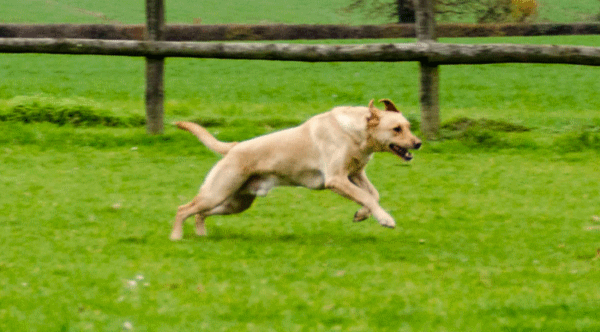
Instinctively driven to eat seasonal berries, grasses and herbivore droppings.
ling an empty stomach and go some way to enriching the life of a highly sensory being that is our beloved If dogs are given a large, natural environment to wander over it is surprising how much time they spend exploring, sniffing, experimenting what is edible and generally foraging. This can include a particular type of grass, seasonal berries, herbs, plant roots or tubers, clay soil or rotting wood. This could be for medicinal use, to ease a stomach upset, rid the body of parasites, provide additional fibre and moisture or to top up on minerals that are lacking in their diet.
Studies of wild canine populations demonstrate the wide variety of food stuffs that they will eat over the changing seasons. This is also dependant on location and if there is access to fallen fruit, nuts, berries, fish, small mammals or waste food from human inhabitation nearby in which to supplement the diet.
Dogs particularly favour the droppings of herbivores such as horses, cows and deer. Although this is only digested, fermented grass and possibly hay in the case of domesticated animals, it does provide enzymes, fibre, moisture and have probiotic qualities.
What are dogs?
Set aside for a moment your views on what dogs should be eating and look instead at what Canis Lupus Familiaris, aka our dogs, actually are?
They are highly intelligent, inquisitive, scavengers, exploring their world primarily by scent. They investigate aroma, taste, texture and edibility with all their senses. They are foragers, trackers, diggers, chewers, adventurers, opportunists and hunters. They are playful, problem solvers that adapt to their environment and not only the food source that is available at that given time but also the volume and frequency of that food.
Nature has given them the anatomy and physiology to eat a vast array of food types and if it was absolutely necessary, the ability to track, catch or at least scavenge their own dinner.
Baring all this in mind, are we not doing them a major disservice by serving up the same beige pellets in a bowl, every single day for a lifetime?
I am certainly not suggesting that you encourage or allow your dog to chase and catch wildlife, but could you offer some more enrichment at mealtimes?
This could be by adding a little steamed or pureed vegetables into their meals, a sprinkling of herbs or blackberries, offering some appropriate fresh cooked food, rotating the flavour or type of food you offer, the use of interactive food toys, snuffle mats, games in the garden that involve tracking and finding their favourite treats or food.
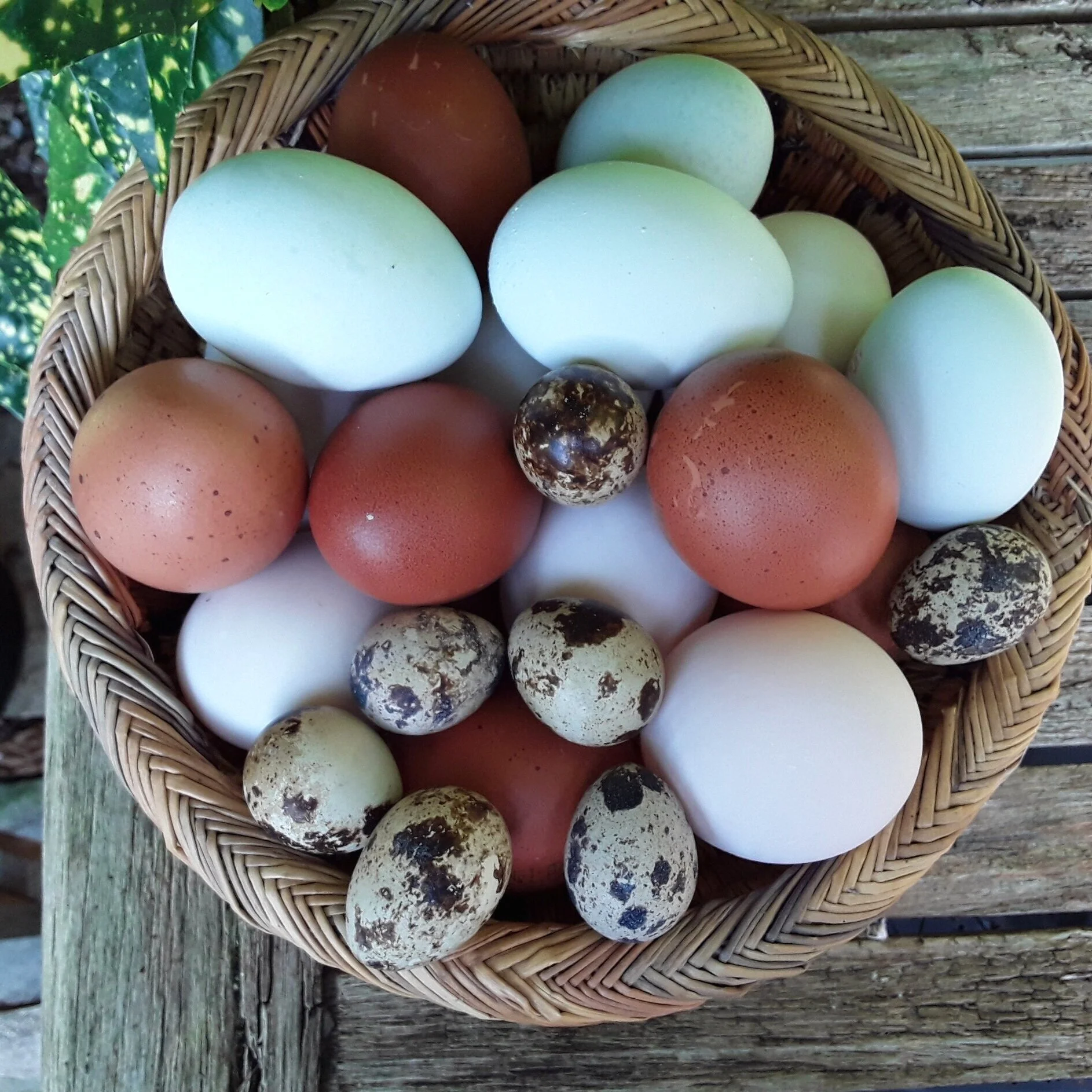
Eggs are great for our Dogs !
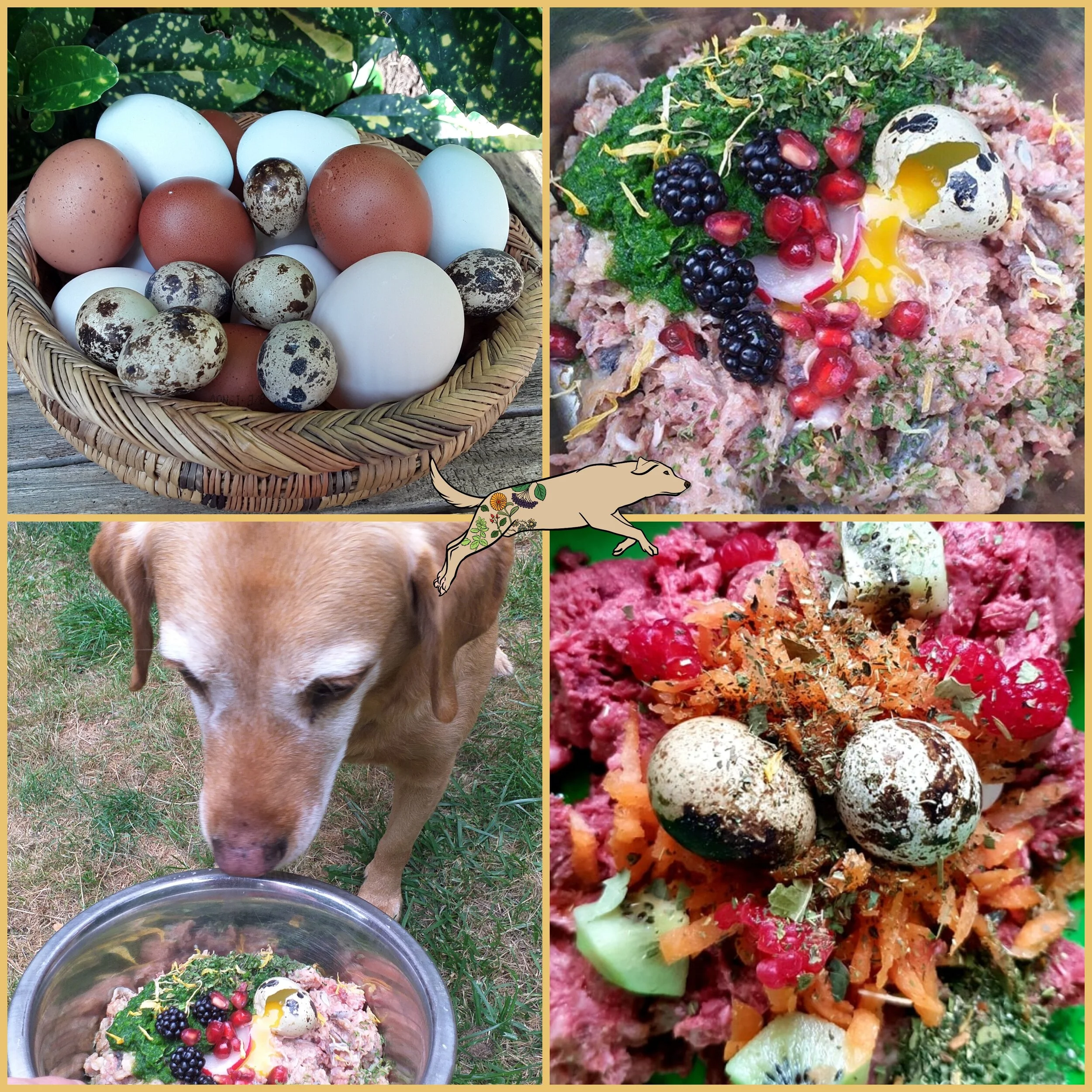
Either fed raw or lightly cooked, eggs are a valuable addition to our dogs diet.
Eggs provide a high quality, complete source of amino acids which are the building blocks of protein.
A good source of vitamin A, B12, Riboflavin, Iron, Folate, Zinc, Selenium, Fatty acids, Choline, Fat soluble vitamin E,D and K and provide the ideal ratio of calcium and phosphorous, if the shell is also fed.
Just one egg will provide 13 essential vitamins and minerals, including lutein which is essential for eye health. Egg whites contain a substance called avidin which affects the uptake of biotin, but the egg yolk has high levels of biotin. So, unless you are feeding just the egg whites on a regular basis rather than the whole egg there shouldn’t be an issue.
Egg shell can be used as a calcium supplement, and the inner membrane of the egg contains an abundance of nutrients to support joint health. This opaque membrane will provide collagen, elastin, glucosamine, chondroitin and hyaluronic acid.
Feeding a selection of eggs including chicken, duck, quail and guinea fowl will offer a broader range of nutrients. One thing that is essential, is that the eggs must be free range and preferably organic as these are higher in animal welfare as well as offering higher levels of the anti-inflammatory Omega 3 fatty acids. These free range birds will have benefitted from a natural lifestyle of foraging, had sunlight on their backs and lived a more relaxed life.
The eggs pictured are from a local farm shop where the hens & ducks can be seen roaming free. The eggs are higher in nutrition as the birds have access to a natural lifestyle of foraging and I know that the shells haven`t been sprayed with chemicals unlike many supermarket eggs, which is important if you are going to feed the shells.
Duck eggs have a larger yolk to white ratio and are higher in protein, fat and contain more Omega 3.
Quail eggs although tiny, have large amounts of vitamin B1 and 5 times as much iron and potassium as hens eggs. Their protein value is 13% where as hens eggs are 11%. Quail eggs rarely cause allergies or sensitivities so worth considering if eggs normally cause problems.
Your dog will benefit from eating free range organic eggs 2-3 times a week.
Eggs can be offered whole, either raw or lightly cooked or broken onto your dogs usual food. If you would rather cook them then a scrambled or boiled egg very lightly cooked will be well received.

There are almost 200 different breeds of chickens in the world, and one hen will lay anything between 250 and 300 eggs a year !
www.hedgerowhounds.co.uk
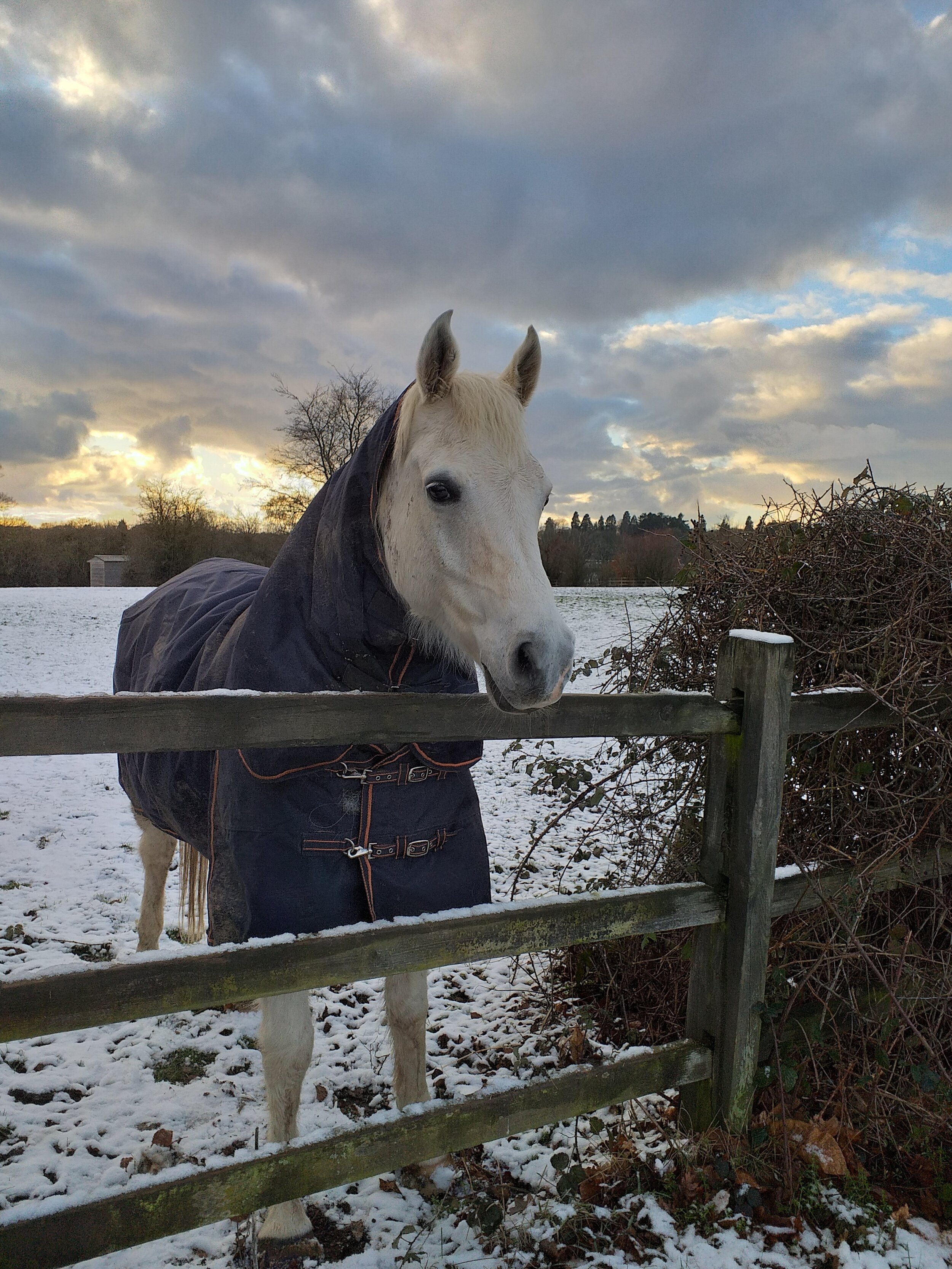
Winter Care for Your Horse - The Holistic Approach
Horses are trickle feeders and designed to have forage passing through their gut most of the time. Eating hay, not only provides warmth, as it ferments in the hind gut, but also reduces the risk of colic and gastric ulcers.
Caring for horses over the winter months brings many challenges, not least copious amounts of mud, frozen taps and bored horses confined to their stables.

Here are a few helpful tips while we eagerly await springtime, which also comes with its own issues, but that is another story!!
Forage & Hard Feed: Horses are trickle feeders and are designed to have forage passing through their guts for most of the time. Eating hay not only provides warmth, as it ferments in the hind gut, but also reduces the risk of colic and gastric ulcers.
Varying the position and ways in which hay is fed in the stable by tying haynets in different locations and also placing hay on the ground or in trug buckets, allows the horse to stretch down in a natural grazing position rather than constantly pulling at haynets, invariably from one side, causing muscle imbalance and soreness.
Senior or dentally challenged horses can still get plenty of fibre by feeding the soaked hay replacer, this tops up hydration levels too. It also provides some variation to any horse’s diet if they are confined to the stable for most of the day.
If your horse lives out then it may be necessary to provide hay, particularly if there is snow on the ground. If there are multiple horses then ensure there are more piles laid out than there are horses, as one horse can guard many piles at once, causing fights or stress to others.
If the horse is not being worked then the hard feed will need to be reduced and more fibre added to the diet.
Water is a particularly important consideration in the wintertime and especially for the stabled horse. Adequate hydration is essential for normal digestion and how the food moves along the gut. Limited water intake can increase the risk of impaction colic.
To encourage drinking and correct levels of hydration, make sure all troughs are clear of ice, top up indoor buckets with hot water, include un-molassed soaked sugar beet in the feed and offer steamed or soaked hay.
If your stable has automatic drinkers, put a bucket of water in as well so you can monitor the horses drinking. As a guide, a 16-hand horse will require a minimum of 6 gallons of water a day. Having free access to a salt lick is also helpful.

Providing ample clean water is just as important in Winter as it is in Summer.
Exercise: Some horses spend huge amounts of time confined to a stable, dependant on their owners to ride or turn them out in a paddock. Even if your horse has daily turnout, the winter months can mean, due to floods, mud, snow and ice, that turn out is either impossible or very limited.
Movement is needed for efficient digestion, to aid circulation, maintain muscle tone and normal joint function.
If you are lucky enough to have a school then you can probably keep on riding if the surface allows or certainly work the horse in hand on the lunge or better still long reins. Allow more time for warm up before moving onto trot and canter to prevent injury.
In hand walking is very valuable and you can allow the horse to pick at some grass and weeds and stretch their heads and necks down if they spend a lot of time eating from raised mangers and haynets. Two or three short wanders a day will also break up the monotony if they are stuck in due to the weather. Make sure the conditions underfoot are safe and clear any areas of snow and ice.
Boredom: Horses are social animals that are evolved to move, and in the wild will often cover 20 miles in a day within a herd. They are foragers, browsers and capable of forming close friendships and many are kept in an unnatural environment which is geared more towards what is convenient for us rather than what is best for them.
Horses do suffer from depression and boredom if they can’t carry out some of their normal behaviour. This can be more so in the winter months as their routine changes.
We can help to relieve boredom in several ways. Including making more daily visits to them or arranging a rota with other liveries, so each horse gets attention, a treat ball or small section of hay placed in the stable. Some horses love having the radio on, classic fm is a good one, calming music and some talking seems to be a good choice.
Picking grass, herbs such as cleavers (great for lymphatic circulation) dandelion leaves (urinary health) and tucking them in the hay can add interest as can hiding carrots, parsnips and apples tucked into haynets. Swedes hanging from string can provide hours of entertainment too.

The new Hedgerow Horse seasonal blend is ideal to replace the herbs, berries and seeds that the grazing horse would normally forage for. It is available on the Hedgerow Hounds shop.
Hedgerow Horse has a seasonal range of herbs including an Autumn-Winter blend called Foragers Harvest which provides herbs and berries that a horse would naturally forage for if they had free access to them.

Horses can form lasting friendships with field companions and will miss the interaction when confined to a stable.
Rugs: It is important not to over rug your horse. Horses that are clipped, underweight or elderly will benefit from wearing an appropriate rug, both in the stable and also when out in the field. Make sure any rugs used are comfortable and fit well, but also remove them everyday to check they are not causing sores, particularly over the wither area. This is also a good opportunity to evaluate the overall bodily condition of the horse.
Skin issues: Unfortunately winter conditions are not kind to the skin. I have found Leucillin and Green Clay an absolute godsend for treating mud fever, minor injuries, skin complaints and preventing infection taking hold. A must have for your winter first aid kit. Both can be found on the Hedgerow Hounds shop with details on how to get the best out of using them.

Green Clay, once tried you will never want to be without it. Perfect for horses, dogs, cats and all livestock.
Hang on in there Spring is just around the corner !!
Find out more at : www.hedgerowhounds.co.uk
The Facebook page @HedgerowHorse
Or on Instagram hedgerow_horse
Feeding your Dog during the Coronavirus
During these unexpected and worrying times we may have to adapt the way we feed our dogs, at least until life gets back to normal again.

Tinned, Raw and Dried Food, enhanced with a few fresh ingredients, can make meal times go a little further.
It is a very difficult time for all of us at the moment and without the freedom to nip to the shops to purchase our usual supplies or in many cases finding the supermarket shelves bare when we get there, can be a stressful situation.
While many pet food suppliers are carrying on trading, you may find that there are certain considerations in place when you come to order. My local store had to close but they are taking orders over the phone and either delivering locally to your door or you are allocated a slot where you can collect from outside the shop. If you are concerned, then contact your usual supplier to see what their procedure is for ordering food. I am sure they will be more than happy to help you. The situation with the virus escalated quickly and some panic buying was reported, which now has even out, as people start to adapt to living differently.
The other issue I have found, is that I only have one small freezer, which generally has more dog food in it than human food. This has never been a problem up until now but I need to claim some freezer space back for my own food so I am stocked up for a couple of weeks with essentials.
If you are struggling to get the normal volume of your dogs food and are looking for ways to make what you have last a bit longer or maybe you want to add a little fresh food into your dogs diet and are unsure of what to use, then the following information should help.
Firstly, have an honest look at your dogs current weight and condition, are they carrying too much weight and would they benefit from losing a few pounds?
Has their routine changed since the movement restrictions? ie: they are used to having an hours exercise off lead in the fields but at the moment they are getting a 15 minute walk around the block on a lead, so therefore need fewer calories.
Do they have a major health issue or specific dietary requirements? If so, this may not be the time to make major changes without expert guidance.
If you have never added any fresh food before or made any major changes to your dogs diet, start off with small amounts of green leafy vegetables which have been lightly boiled, steamed or pulped in a blender. Then gradually increase over a number of days, until a quarter (15%) of your dogs meals have been replaced by fresh food. Feeding a variety of the foods listed below will avoid excess or deficiencies and keeping it to 15% maximum will not upset the balance.
Try to offer a small selection, so for example in the photos above, I have included a single tinned pilchard, some greens, a slice of cooked sweet potato, a couple of blueberries and a tablespoon of cooked quinoa which adds up to approximately 15% of the meal. The easiest way is to set a few bits and pieces aside in a separate bowl as you prepare you own meals.
These are a few ideas to make their meals go a little further, bulk up the food you do have and add volume to prevent hunger pangs.
Items to consider adding:
Eggs: A raw or lightly cooked free range egg, 3 times a week are a fantastic source of protein. If your dog isn’t a fan of vegetables you could make them an omelette and sneak a little cooked veg in the pan as well.
Rice or Pasta: Brown or wild rice is preferable but if white rice is all you can find then this is acceptable in small amounts for the short term. Rinse well, before cooking thoroughly.
Buckwheat, Quinoa, Millet: It is important to thoroughly cook grains before you feed them to your dog so they can digest them easily. Out of the grains available these are gluten free and better suited to dogs.
Sweet Potato: Sweet potato is not a member of the nightshade family but is actually from the Bindweed family. This means that dogs who can`t tolerate normal potatoes are often fine when fed small amounts of sweet potato.
Tinned sardines or pilchards: These are a great item to have in the store cupboard and can used to replace some meat or kibble in the diet. They are cheap, tasty and an excellent source of Omega3. Try and find them in spring water or failing that tomato juice, which you can drain away before feeding.
Green leafy vegetables: Green vegetables are an ideal way to start to incorporate a little fresh food into your dogs meal times. Kale, spinach, courgette, broccoli florets and stalks, green beans, coz lettuce are all good additions. Vegetables do need to be steamed or alternatively fed raw but blitzed in a blender to form a thick puree. This allows the cellulose in the plants to be broken down for easier digestion. This means your dog can gain nutrients from the vegetables and are less likely to get an upset stomach.
Cottage cheese or plain natural yoghurt: If dairy suits your particular dog then small amounts of natural live yoghurt or natural cottage cheese can be added to your vegetable mix.
Kibble or dried food: I am not a fan of kibble, but if needs must then there are a few out there which have nice ingredients and are not made using harsh cooking methods. It`s a good idea to look on the website All about Dog food, which compares and gives ratings to the brands on the market. You can always limit the volume fed by measuring out a set amount and placing it in treat dispenser toys, snuffle mats or use for interactive scent games in the garden. As an example of a better quality dried food there is a company called Akela that sell cold pressed as well as the regular kibble that score highly on the All about Dog food website. It has a high percentage of meat so you need to feed less of it than the standard kibble.
Tinned food: There is a good choice of quality tinned foods available such as Natures Menu which are stocked in most pet food stores. Tins have the advantage of a long shelf life and can be stored anywhere cool.
Dehydrated or Freeze-dried foods: While this isn’t a cheap option there are many good products of this type on the market. They have a long shelf life and do not need fridge or freezer space in order to store it.
Recreational bones: Large raw bones or beef tracheas can provide hours of entertainment and the act of chewing releases feel good hormones. I find after my dogs have chewed on a bone for a period of time they are so tired that they sleep soundly for hours afterwards, they are often so satisfied that they don’t miss not having a second meal that particular day. Beef tracheas can be stuffed with a portion of your dogs daily meal so they have to work a bit harder to consume it.
Of course, not all dogs can be given raw bones due to resource guarding or issues within a multi dog household, so this may not be an option.
What to avoid: Do not feed grapes, raisins, chocolate, onions, gravy which contains high levels of salt, garlic and onions, anything that contains sweeteners such as Xylitol and cooked fat.

Other ways to keep your dog entertained and to make feed time last a bit longer, is to make them work for their treats. Hiding dried food in snuffle mats, using boxes in the undergrowth of your garden to place treats in or stuffing a trachea or Kong with a portion of their daily food.
If you need additional help with your dogs diet or they have special requirements due to ill health or sensitivities then our canine nutritional specialist Katie McCaul can advise you. She can be contacted by email at the following address katiemccaul@hotmail.com